

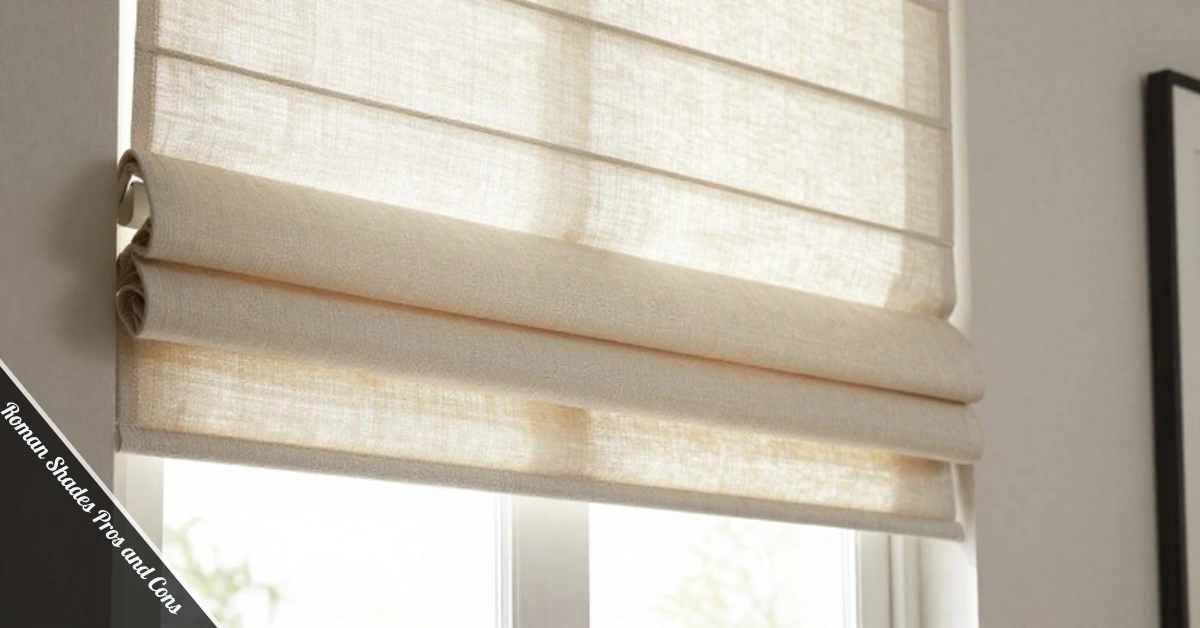
Roman shades combine classic elegance with practical functionality, featuring fabric that folds into horizontal pleats. They offer excellent light control, privacy, and energy efficiency with thermal linings adding R-4 to R-5 insulation value. However, they cost $150 to $900 per window and require regular maintenance due to their fabric construction, making them unsuitable for high-moisture areas like bathrooms.
Are you considering Roman shades for your home but unsure if they’re the right choice? You’re making a smart decision to research first. These window treatments offer a unique combination of style and function, but they’re not perfect for every situation.
This guide breaks down everything you need to know about Roman shades. You’ll learn their main benefits, potential drawbacks, what they actually cost, and whether they fit your specific needs. By the end, you’ll have the information to make a confident decision.
What Are Roman Shades?
Roman shades are fabric window coverings that fold into neat, horizontal pleats when raised. Unlike curtains that gather to the side or blinds with individual slats, Roman shades stack upward in uniform sections.
The design is simple yet effective. A single piece of fabric attaches to a headrail at the top of your window. When you pull the cord or activate the lift mechanism, horizontal rods create evenly spaced folds as the shade rises. When lowered, the fabric hangs flat or with soft folds, depending on the style you choose.
You can mount Roman shades inside your window frame for a clean, built-in look, or outside the frame to cover more wall space and block additional light. The choice depends on your window size, wall space, and privacy needs.
Main Benefits of Roman Shades
Roman shades bring instant sophistication to any room. Their clean lines work equally well in modern minimalist spaces and traditional homes. You can choose from hundreds of fabric options, from bold geometric patterns to subtle textures that blend into your existing decor.
The fabric-forward design lets you showcase your personal style in ways that plastic blinds or simple roller shades cannot. Whether you select luxurious silk, casual linen, or practical cotton blends, your windows become a design feature rather than just a functional necessity.
Superior Light Control and Privacy
You get precise control over how much light enters your room. Lower the shade partially for filtered natural light while maintaining privacy, or close it completely for darkness. This flexibility makes Roman shades ideal for bedrooms, living rooms, and home offices.
The fabric itself determines your light control options. Sheer fabrics allow diffused light while obscuring the view from outside. Blackout linings block nearly all light, creating the darkness needed for quality sleep or daytime television viewing without glare.
According to the U.S. Department of Energy, properly installed window treatments can reduce heat gain by up to 77% when closed during peak sun hours. Roman shades excel at this because they fit snugly against or within your window frame, minimizing gaps where light and heat enter.
Energy Efficiency That Lowers Your Bills
Roman shades provide measurable insulation for your windows. Standard Roman shades add R-2 to R-3 insulation value to bare windows. Add thermal lining, and that jumps to R-4 to R-5, according to energy efficiency studies from 2024.
Your windows account for 25 to 30% of your home’s heating and cooling energy use. Roman shades create an insulating barrier that traps air between the fabric and the window glass. This pocket of trapped air acts as natural thermal protection, keeping warm air inside during winter and blocking heat gain in summer.
A typical home spending $2,000 annually on heating and cooling can save $200 to $400 per year with proper window treatments. The layered fabric construction and tight fit against window frames make Roman shades particularly effective at stopping drafts and maintaining comfortable indoor temperatures.
Multiple Style Options for Different Looks
Roman shades come in four main styles, each creating a different aesthetic:
Flat Roman shades hang completely flat when lowered, creating a smooth, modern appearance. They’re perfect for showcasing patterned fabrics and work well in contemporary spaces. Most designers add a permanent fold at the bottom to maintain visual interest even when fully extended.
Relaxed Roman shades feature a gentle curve or “smile” along the bottom edge. This softer look suits casual, lived-in spaces like family rooms and bedrooms. The curved bottom creates a more forgiving, less formal appearance.
Hobbled Roman shades maintain visible folds even when lowered. The extra fabric at each fold adds dimension and visual texture. These require more material than flat shades but create a luxurious, tailored appearance that suits formal dining rooms and master bedrooms.
Balloon Roman shades gather into full, rounded folds when raised. This dramatic style works best in vintage, Victorian, or historically inspired interiors. However, design experts caution that balloon shades may date quickly and should be chosen carefully to avoid a trendy look that becomes outdated.
Automation Options Add Convenience
Modern Roman shades can be motorized for enhanced convenience. Motorization offers benefits beyond simple convenience. Automated shades position themselves optimally throughout the day to maximize energy savings, even when you’re away from home.
You can program motorized Roman shades to lower automatically during peak sun hours, reducing air conditioning costs. In winter, schedule them to open during sunny periods to capture free solar heat. Some systems integrate with smart home platforms like Alexa or Google Home for voice control.
Motorized options also address safety concerns. Traditional corded shades pose strangulation risks for children and pets. Cordless and motorized systems eliminate exposed cords, making them the safest choice for families.
Roman Shades Disadvantages You Should Know
Roman shades require a significant upfront investment. Standard ready-made Roman shades typically cost $150 to $300 per window. Custom shades range from $400 to $900 per window, depending on fabric choice, lining options, and window size.
For comparison, basic roller shades start around $25 to $100 per window. Venetian blinds cost $50 to $200. If you’re covering multiple windows, the price difference adds up quickly. Outfitting 10 windows with Roman shades could cost $1,500 to $9,000, compared to $250 to $2,000 for basic roller shades.
The higher cost reflects the materials and labor involved. Roman shades use more fabric than most window treatments. They require precise construction with horizontal rods, cord systems, and often lining materials. Custom shades add measurement, tailoring, and installation fees that increase the total investment.
Motorized options push costs even higher. Expect to add $200 to $400 per window for basic motorization. High-end systems with smart home integration can exceed $500 per window.
Maintenance Requires Regular Attention
The fabric construction that makes Roman shades attractive also creates maintenance challenges. Dust accumulates in the folds and pleats, requiring regular vacuuming or dusting. Most manufacturers recommend vacuuming weekly with a soft brush attachment to prevent buildup.
Stains happen, especially in kitchens, dining rooms, or homes with children and pets. While some fabrics can be spot-cleaned with mild soap and water, others require professional dry cleaning. Always check the care instructions for your specific fabric before attempting to clean stains yourself.
The cord systems and rings that create the signature folds can wear over time. Cords may fray, rings may become loose, and lifting mechanisms can stick or fail. These issues require professional repair or replacement, adding to your long-term costs.
Unlike wipeable blinds or easily washable curtains, Roman shades cannot simply be thrown in the washing machine. The structured construction with horizontal rods and cord systems makes machine washing impossible for most styles.
Not Suitable for High-Moisture Areas
Bathrooms pose particular problems for Roman shades. The fabric absorbs moisture from showers and baths, creating conditions for mold and mildew growth. Steam can cause fabrics to wrinkle, sag, or develop water stains.
Some homeowners successfully use Roman shades near kitchen sinks, but only with proper ventilation and careful fabric selection. Synthetic fabrics resist moisture better than natural fibers like cotton or linen. Even then, splashes and steam exposure should be minimized.
If you must have fabric shades in a bathroom, consider moisture-resistant materials specifically designed for humid environments. Better yet, choose alternative window treatments like faux wood blinds or vinyl roller shades that handle moisture without damage.
More Complex Installation Process
Installing Roman shades requires precise measurements and careful attention to detail. Inside-mount shades must fit exactly within your window frame. Even a quarter-inch error can cause binding, gaps that let in light, or an inability to raise and lower the shade smoothly.
Outside-mount installation offers slightly more forgiveness but still requires accurate measurements to ensure the shade covers the window completely and hangs level. You’ll need to locate wall studs or use appropriate anchors to support the weight of the shade and headrail.
The cord mechanisms add complexity compared to simple curtain rods or basic roller shades. Some styles require professional installation to ensure proper operation and maintain warranty coverage. Professional installation typically costs $50 to $150 per window, adding to your total investment.
DIY installation is possible if you’re handy and follow instructions carefully. However, mistakes can result in damaged shades or windows, potentially costing more to fix than professional installation would have cost initially.
How Much Do Roman Shades Actually Cost?
Understanding the full price range helps you budget accurately for your window treatment project.
Base Price Ranges
Ready-made Roman shades from big-box retailers like Home Depot or Lowe’s start around $150 to $300 for standard window sizes. These offer limited fabric choices and style options but provide an affordable entry point.
Custom Roman shades from specialty retailers cost $400 to $900 per window for standard sizes. Premium fabrics like silk, velvet, or designer textiles can push prices above $1,000 per window.
The 2025 average cost for professional installation ranges from $900 per window installed for basic Roman shades to $2,600 for motorized options with premium fabrics and features.
Cost Factors That Increase Your Price
Fabric choice dramatically impacts cost. Basic polyester blends are the most affordable. Natural fibers like linen and cotton cost more. Premium materials like silk, velvet, or specialty designer fabrics command the highest prices.
Lining options add $50 to $200 per window. Thermal linings improve energy efficiency. Blackout linings block all light for bedrooms. Some fabrics come with built-in linings, while others require separate lining installation.
Window size affects material requirements and labor. Standard 36-inch by 60-inch windows fall in the average price range. Oversized windows or custom shapes require more fabric and complex construction, increasing costs by 25% to 50%.
The operating mechanism changes the price significantly. Standard cord-lock systems are the baseline. Cordless mechanisms add $30 to $75. Basic motorization adds $200 to $400. Smart home-integrated motorized systems can add $500 or more per window.
Installation location impacts labor costs. Ground-floor windows with easy access cost less to install than second-story or hard-to-reach locations that require ladders or special equipment.
Ways to Save Money
Choose standard sizes when possible. Custom-sized shades cost significantly more due to the tailoring required. If your windows fit standard dimensions, you’ll save 30% to 50% compared to custom orders.
Select mid-range fabrics that balance quality and cost. You don’t need the most expensive silk to get beautiful, functional Roman shades. Quality cotton blends or polyester fabrics offer durability and style at lower price points.
Purchase multiple shades together. Many retailers offer volume discounts when you order several windows at once. Even a 10% to 15% discount adds up when covering an entire home.
Consider DIY installation for ground-floor windows in straightforward locations. Save $50 to $150 per window in labor costs if you’re comfortable with basic tools and following detailed instructions.
Are Roman Shades Right for Your Home?
Best Uses for Roman Shades
Living rooms and family rooms benefit from Roman shades’ combination of style and light control. The soft fabric appearance complements furniture and decor while providing privacy without blocking natural light completely.
Bedrooms work well with Roman shades, especially when paired with blackout linings. The clean, tailored appearance creates a calm, restful environment. Cordless or motorized options eliminate tangled cords that detract from the peaceful atmosphere.
Home offices gain both style and function. Lower shades partially to reduce screen glare while maintaining a connection to the outdoors. The professional appearance looks polished on video calls.
Dining rooms showcase the formal, elegant qualities of Roman shades. Hobbled or relaxed styles add visual interest without overwhelming the space or competing with table settings and artwork.
When to Choose Something Else
Bathrooms need moisture-resistant treatments. Choose faux wood blinds, vinyl roller shades, or cellular shades specifically rated for high-humidity environments instead of fabric Roman shades.
Rental properties may not justify the investment. If you’re not planning to stay long-term, less expensive window treatments make more financial sense. Basic roller shades or curtains are easier to take with you when you move.
Extremely large windows may function better with alternative treatments. Very wide or tall Roman shades become heavy and difficult to operate smoothly. Consider panel track systems or drapery for sliding glass doors and oversized windows.
Tight budgets may require starting with less expensive options. If cost is your primary concern, roller shades or faux wood blinds provide function at lower price points. You can always upgrade to Roman shades later when your budget allows.
Final Thoughts
Roman shades deliver a winning combination of style, light control, and energy efficiency that few window treatments can match. Their fabric construction creates warmth and sophistication while providing practical benefits like insulation and privacy.
The higher cost and maintenance requirements are real considerations. You’ll pay more upfront and invest time in regular cleaning compared to simpler options. The moisture sensitivity limits their use in certain rooms.
For most living spaces, though, Roman shades earn their place. The timeless style adapts to changing decor trends. The energy savings accumulate over the years. The precise light control enhances daily comfort.
Consider your specific needs, budget, and the rooms you’re covering. If style matters as much as function, and you’re willing to invest in quality window treatments that will serve you well for years, Roman shades deserve serious consideration. Just avoid using them in bathrooms, and budget appropriately for both purchase and maintenance costs.
FAQs
How long do Roman shades typically last?
Quality Roman shades last 5 to 10 years with proper care and maintenance. Premium fabrics and construction can extend lifespan to 15 years. Regular dusting, prompt stain treatment, and gentle operation help maximize longevity. Motorized components may need replacement after 7 to 10 years of daily use.
Can I wash Roman shades in my washing machine?
No, you should not machine wash Roman shades. The structured construction with horizontal rods, cords, and rings makes machine washing impossible without damaging the shade. Most fabrics require professional dry cleaning or careful spot cleaning with mild soap and water.
Do Roman shades really save energy?
Yes, Roman shades provide measurable energy savings. Standard shades add R-2 to R-3 insulation value, while thermal-lined versions reach R-4 to R-5. The U.S. Department of Energy reports that proper window treatments can reduce heat loss by 10% and cut heat gain by up to 77%, translating to $200 to $400 annual savings for average homes.
Are cordless Roman shades as durable as corded versions?
Cordless Roman shades are equally durable and often more reliable than traditional corded systems. The cordless mechanism eliminates the most common failure point (tangled or frayed cords). Modern cordless designs use internal spring systems or continuous loop chains that operate smoothly and last as long as the shade itself.
What’s the difference between inside mount and outside mount?
Inside mount Roman shades fit within the window frame, creating a clean, built-in appearance. They work best when you have sufficient window depth (at least 2 inches) and want to showcase window trim. Outside mount shades attach to the wall above and beyond the window frame, covering more area to block light gaps and make windows appear larger.