

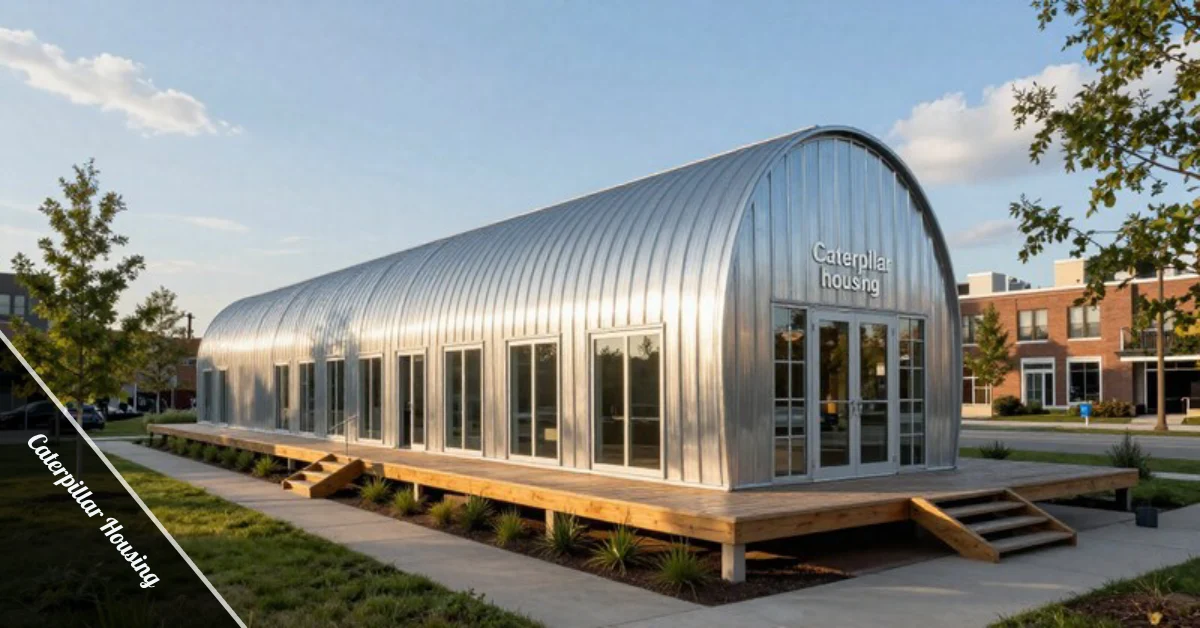
Caterpillar housing in Detroit transforms a 192-foot Quonset hut into eight modern apartments with 23-foot ceilings and massive windows. Built by Prince Concepts in Core City, this prefab steel structure delivers affordable, light-filled homes for $1,350 to $2,500 monthly. The design proves Quonset huts can create inspiring residential spaces at lower costs than traditional construction.
What Makes Caterpillar Housing Different
You’ve probably never seen an apartment building quite like this. In Detroit’s Core City neighborhood, a gleaming metal structure stretches 192 feet long and sits surrounded by 168 newly planted trees. This is Caterpillar housing, named for its long, slender shape that resembles the insect from above.
The project houses eight units in one massive Quonset hut, offering high quality space at an accessible cost. Developer Prince Concepts completed the building in March 2021, and every unit was leased before construction finished.
The numbers tell an interesting story. Each apartment features 12 to 18 windows, ceilings that soar to 23 feet, and units ranging from 750 to 1,300 square feet. Monthly rents run from $1,350 for smaller units to $2,500 for the largest spaces.
The Quonset Hut Housing Revolution
Caterpillar housing relies on a building method originally designed for World War II military bases. Quonset huts are modular structures made from commercial-grade steel that can be assembled by a team of two to five people in a few days.
SteelMaster manufactured this particular unit, a Q-Model measuring 46 feet wide. The company worked closely with Prince Concepts to add 36 openings on each side of the curved metal facade. These aren’t standard warehouse windows. The design stacks small windows above medium ones above large glass doors, flooding each unit with natural light.
According to recent data, Quonset hut kit packages typically cost $10 to $20 per square foot, while installed costs range from $17 to $34 per square foot. This makes them significantly cheaper than traditional construction, which averages around $123 per square foot for U.S. homes.
Inside the Caterpillar Design
Walk into a Caterpillar apartment, and you’ll notice something unusual. There are no traditional rooms with four walls and corners. Instead, you stand inside a semicircular slice of space with a curved ceiling overhead.
The design team arranged apartments next to one another, similar to a sushi roll, with each apartment being a semicircular slice of space. In the middle of each unit sits a compact plywood box that houses the bathroom, shower, and kitchen. This service core separates the bedroom from the living areas.
The layout follows what architect Ishtiaq Rafiuddin calls “utility versus ceremony.” All the practical necessities hide in the central box, leaving the dramatic curved spaces for daily living. Skylights sit directly above each shower, creating an unexpected moment of connection with the outdoors.
Six units serve as standard apartments, while two include live/work spaces for residents who need home offices or creative studios.
How Caterpillar Housing Fits Core City
Detroit’s Core City neighborhood looks different from most urban areas. You’ll find open spaces between buildings, iconic church structures, and community farms rather than dense rows of houses. Caterpillar sits on seven merged residential lots and anchors a block with an iconic Detroit church building across the street and the vibrant Fisheye Farm next door.
The building doesn’t try to mimic traditional residential architecture. Instead, it embraces its difference. Prince Concepts raised the entire structure on a platform and wrapped it with a deck that takes cues from Detroit’s porch culture. Ramps lead to a covered breezeway that cuts through the middle of the building, creating natural gathering spots.
Landscape architect Julie Bargmann planted rescue trees purchased for $25 each from a nearby nursery, creating a misfit forest that joins the surrounding spontaneous vegetation. The trees follow a staggered pattern inspired by the sheet music for John Coltrane’s “A Love Supreme,” adding another layer of cultural reference to the project.
The Cost Benefits of Quonset Housing
Traditional home construction in Detroit faces the same challenges as other U.S. cities. Rising material costs, labor shortages, and lengthy timelines push prices higher. Caterpillar housing offers an alternative approach.
Here’s what you can expect for Quonset hut construction:
- Kit-only costs: $6 to $20 per square foot
- Basic shell with foundation: $40 to $80 per square foot
- Finished residential space: $30 to $80 per square foot
- Assembly time: A few days for the basic structure
Philip Kafka, president of Prince Concepts, explains the strategy clearly. The team decided against complex floor plans and expensive materials, instead utilizing the Quonset hut to reallocate savings toward spacious, thoughtful interiors that prioritize natural light.
For developers and future homeowners, these numbers matter. A 1,200 square foot Quonset home costs roughly $24,000 to $42,000 for the kit alone. Add foundation, assembly, and basic finishing, and you’re looking at $60,000 to $114,000 total. Compare that to traditional construction at $147,600 for the same square footage.
Living in a Caterpillar Unit
What’s it actually like to live here? Residents report that the curved walls take some getting used to, but the space feels surprisingly open. The orientation of each unit lets you experience sunrise in the bedroom and sunset in the living room.
Those 23-foot ceilings create volume that standard apartments can’t match. The polycarbonate window panels let in light without sacrificing privacy. And the outdoor deck space gives every unit access to fresh air and views of the surrounding trees.
The smallest units at 750 square feet work well for individuals or couples. The 1,100 square foot mid-size apartments offer room for small families. The largest units at 1,300 square feet include private patios that run 46 feet long along the building’s side.
Monthly utility costs run lower than expected. The steel construction provides excellent insulation once properly finished, and the passive solar gain from all those south-facing windows reduces heating needs.
Why Developers Choose Quonset Structures
Prince Concepts didn’t stop with Caterpillar. The company has completed multiple Quonset projects in Core City, including True North in 2017, 5k in 2020, and Core City Park in 2019. This track record suggests the model works.
Several factors drive this choice:
Speed of construction: Four unskilled laborers can typically assemble a Quonset hut house in just a few days. This means projects move from concept to occupancy much faster than traditional builds.
Material efficiency: The arch design uses less steel than rectangular structures while maintaining strength. When we recycle one ton of steel, we help prevent the mining of 2,500 pounds of iron ore, 1,400 pounds of coal, and 120 pounds of limestone.
Weather resistance: Quonset huts handle snow loads, high winds, and extreme temperatures better than conventional construction. Their curved shape sheds water quickly and deflects wind pressure.
Design flexibility: Once you have the basic shell, interior layouts can vary widely. Caterpillar proves this by creating eight distinct units within one structure.
The Challenges of Quonset Housing
Not everything about Caterpillar housing is simple. The project required extensive collaboration between Prince Concepts, architect Ishtiaq Rafiuddin of UNDECORATED, Studio Detroit, and landscape architect Julie Bargmann of D.I.R.T. Studio.
SteelMaster’s Senior Project Manager Greg Broderick spent months working out custom details. The windows presented the biggest challenge. Standard Quonset huts don’t include 36 openings per side, so engineers had to calculate load distribution and structural integrity for each modification.
Financing also poses obstacles. Many lenders don’t have established guidelines for Quonset residential projects. This can slow approval processes or require larger down payments than traditional mortgages.
Zoning boards sometimes struggle with these buildings, too. They don’t fit neatly into existing residential categories. Prince Concepts worked closely with Detroit’s planning department to navigate these issues.
What This Means for Affordable Housing
The project has enjoyed 100% occupancy since completion in March of 2021. This success raises an important question: can Caterpillar housing serve as a model for other cities facing affordable housing shortages?
The math looks promising. If you can build residential units for $30 to $80 per square foot instead of $100 to $150, you create more housing with the same budget. You also complete projects faster, getting people into homes sooner.
But replication requires more than just copying the design. Caterpillar works in Core City because the neighborhood has available land, supportive city policies, and a community willing to embrace unconventional architecture. Other areas might face different constraints.
The project also benefits from Detroit’s relatively low land costs. The same approach in coastal cities with expensive real estate would struggle to achieve similar affordability.
The Design Team Behind Caterpillar
Ishtiaq Rafiuddin founded UNDECORATED with a focus on function over decoration. His firm’s name reflects this philosophy directly. Rafiuddin notes that he is interested in the present, not the wrapping paper around it.
Studio Detroit served as executive architect, handling technical drawings and permitting. Their experience with prefab structures helped navigate the approval process.
D.I.R.T. Studio’s landscape work transformed the site from vacant lots into an urban woodland. Julie Bargmann’s strategy of using rescue trees and simple ground cover keeps maintenance costs low while creating visual impact.
This collaboration shows why Caterpillar housing works. Each team member brought specialized expertise, but they shared a commitment to affordable, thoughtful design.
Comparing Caterpillar to True North
Prince Concepts’ earlier project, True North, also uses Quonset huts but takes a different approach. True North consists of 10 units across 8 huts on 5 lots, designed at different angles and in different shapes and sizes to create open outdoor spaces.
Caterpillar concentrates all units in one long structure. This creates economies of scale in construction and maintenance. It also produces a more dramatic architectural statement.
Both projects prove Quonset huts can support various housing models. True North feels like a cluster of individual buildings. Caterpillar reads as a single unified structure. Neither approach is inherently better; they serve different urban contexts and resident preferences.
The Future of Metal Housing
Caterpillar housing represents one experiment in a broader trend toward alternative construction methods. Rising costs and housing shortages push developers to consider options beyond stick-built homes.
Metal buildings offer clear advantages: faster construction, lower costs, better weather resistance, and easier maintenance. The challenge lies in changing perceptions. Many people associate metal structures with warehouses or garages, not homes.
Projects like Caterpillar help shift these perceptions. When a metal building offers 23-foot ceilings, abundant natural light, and thoughtful interiors, it stops feeling like a compromise. It becomes a legitimate housing choice.
The construction industry is watching these experiments closely. If Caterpillar maintains high occupancy rates and resident satisfaction over the next several years, expect to see similar projects in other cities.
Final Thoughts
Caterpillar housing proves Quonset huts can create beautiful, functional residential spaces at prices below traditional construction. The 192-foot structure in Detroit’s Core City neighborhood houses eight units that stay fully occupied, with residents paying $1,350 to $2,500 monthly for light-filled apartments with soaring ceilings.
The model isn’t perfect. It requires skilled design teams, supportive city policies, and available land. But for developers seeking affordable housing solutions, it offers a proven alternative worth considering.
You can see the impact of walking through Core City today. Where vacant lots once sat empty, a gleaming metal structure anchors the block. Trees grow around it. Residents live inside it. And other developers take notes.
FAQs
How much does it cost to build Caterpillar-style housing?
Construction costs run $30 to $80 per square foot for finished residential Quonset spaces. This includes the steel kit, foundation, assembly, interior finishing, and utilities. A 1,000 square foot unit costs roughly $30,000 to $80,000 to build.
Can you get a mortgage for a Quonset hut home?
Yes, but financing can be more challenging than traditional homes. Many lenders lack established guidelines for Quonset residential projects. You may need to work with specialized lenders or provide larger down payments. Some buyers choose construction loans that convert to traditional mortgages after completion.
How long do Quonset hut apartments last?
When properly maintained, Quonset structures can last 50 to 100 years or more. The commercial-grade steel resists rust, doesn’t rot like wood, and handles extreme weather well. Regular inspection of seals and fasteners keeps the building weathertight.
Are Quonset huts energy efficient?
They can be very efficient when properly insulated. The curved shape provides natural air circulation, and the minimal surface area relative to interior volume reduces heat loss. Adding spray foam insulation and energy-efficient windows creates comfortable, low-cost living spaces.
What are the downsides of living in a Quonset apartment?
The curved walls make furniture placement tricky. You can’t hang standard wall art easily. Some people find the industrial aesthetic too stark. And the open floor plans don’t suit everyone. Noise can also carry more easily in the metal structure, though insulation helps with this issue.


