

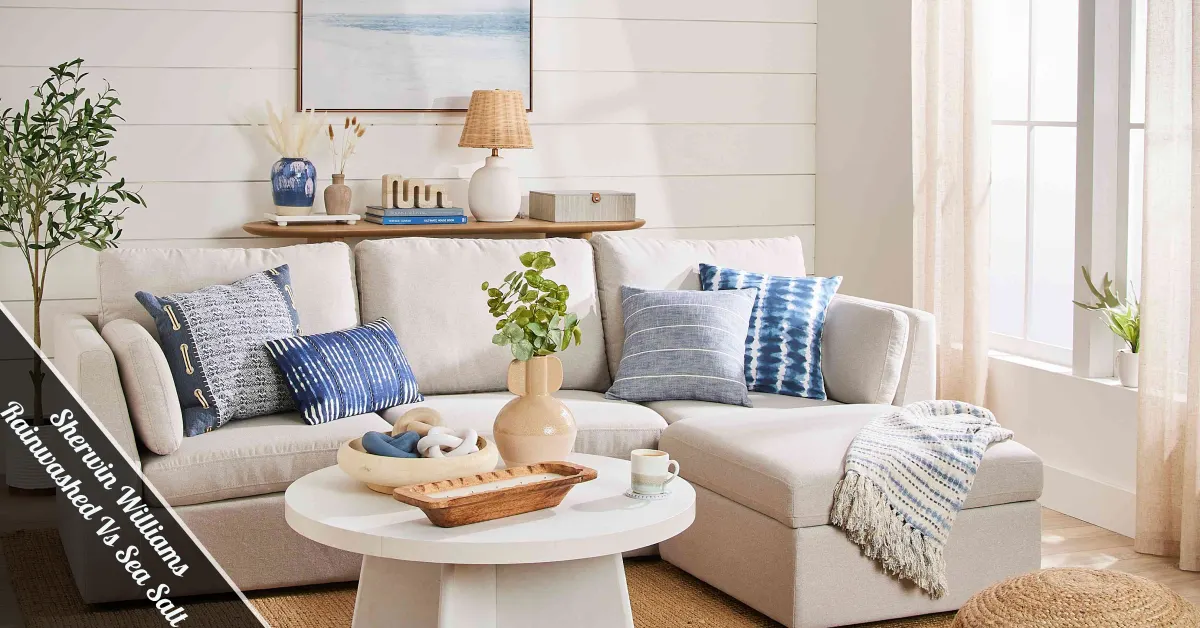
Both colors look nearly identical on the swatch. Swear to God — you’ll hold them side by side and wonder if you’re losing your mind.
That’s the Sherwin Williams Rainwashed vs Sea Salt trap. They’re both soft, airy, blue-green neutrals. But subtle undertone differences can make or break a room.
Pick the wrong one and your bedroom walls might look gray and cold. Pick the right one, and you’ve got a spa retreat that feels effortless.
This breakdown covers LRV, undertones, lighting behavior, room-by-room performance, and pairing tips — everything you need before you touch a roller.
Color Profiles: Getting to Know Each Paint
Sherwin Williams Rainwashed (SW 6211)
Rainwashed is the one that actually looks like a color. You can see it on the wall — and that’s the point.
Its primary undertone is blue, with green as secondary. Low gray content means it stays visible even in dim lighting. That’s a big deal for darker rooms.
The LRV sits at around 59–60. Lower LRV means it absorbs more light — so it retains its color in north-facing spaces where other colors fade to nothing.
Depending on when you look, Rainwashed shifts from aqua in bright morning light to a softer blue in the evening. It’s not dramatic — just gorgeous.
Sherwin Williams Sea Salt (SW 6204)
Sea Salt is the chameleon of the two. Some days green. Some days are blue-gray. Occasionally just… gray.
It’s a soft green-gray with subtle blue undertones — higher gray content than Rainwashed, which pushes it toward neutral territory. For an in-depth breakdown of SW 6204’s full color profile, Sherwin-Williams’ official Sea Salt page has the complete specs.
The LRV is around 63 — lighter than Rainwashed. It reflects more light and feels airier in well-lit spaces, but can wash out in darker rooms.
Sea Salt is the safe bet for whole-home use. It flows room to room without demanding attention. Pairs with warm woods, cool metals, white cabinets — basically everything.
Sherwin Williams Rainwashed Vs Sea Salt: The Real Differences
LRV — Light Reflectance Value
LRV tells you how much light a color bounces back — on a scale of 0 (black) to 100 (white). You can dig into how LRV works in real rooms before committing to a color.
Sea Salt’s LRV of ~63 makes it feel open and expansive in bright rooms. Rainwashed’s ~59–60 keeps it intentional and rich — the color actually sticks around in low light.
That four-point difference sounds minor. But I’ve watched those same two colors look completely different in the same space with different lighting. Don’t sleep on it.
Undertones: The Make-or-Break Factor
Sea Salt’s primary undertone is green, with blue and gray as secondary. That gray content is why it can shift toward a hospital-hallway gray in cool north-facing rooms.
Rainwashed leads with blue and follows with green. Less gray means more saturation. Even in lower light, the color is still readable — still doing its job.
Warm accents and warm-toned bulbs can rescue Sea Salt in tricky lighting. But Rainwashed needs less intervention. It holds up on its own.
Lighting Behavior — North vs South Facing
Lighting direction changes everything with these two colors. This guide on how light affects paint color is worth reading before you buy a gallon.
Sea Salt in a north-facing room? It can read as straight gray-blue — cool, flat, and kind of sad. In south-facing rooms with lots of sunlight, it can wash out and look almost off-white.
Rainwashed handles north-facing rooms much better. The lower LRV and stronger blue undertone keep it visible. South-facing light turns it bright and beachy — genuinely beautiful.
East-facing rooms give Rainwashed a turquoise morning quality that softens by afternoon. Sea Salt in east light brings out more green early and shifts toward gray later.
Quick Comparison: Rainwashed Vs Sea Salt Side-by-Side
| Feature | Sea Salt | Rainwashed |
| Color Code | SW 6204 | SW 6211 |
| LRV | ~63 (higher) | ~59–60 (lower) |
| Primary Undertone | Green | Blue |
| Secondary Undertones | Blue + Gray | Green |
| Gray Content | Higher — more muted | Lower — more colorful |
| Best Lighting | South/West-facing rooms | North-facing, low light |
| Best Room Use | Living rooms, kitchens, hallways | Bathrooms, bedrooms |
| Style Fit | Farmhouse, Transitional, Scandi | Coastal, Cottage, Contemporary |
| Trim Pairing | Pure White, Alabaster | Oxford White, Extra White |
| Mood | Calm, neutral, effortless | Fresh, beachy, personality-driven |
Room-by-Room: Where Each Color Actually Works
Living Room
Rainwashed in the living room makes a statement. It’s not background noise — it’s part of the conversation. Works best with minimal, coastal, or transitional styles.
Sea Salt is safer for living rooms, especially open-concept layouts. It flows seamlessly from space to space without competing with furniture or decor.
If your living room gets strong natural light, Sea Salt glows. If it’s dimmer or north-facing, Rainwashed is your better play — it stays colorful and intentional.
Bedroom
Rainwashed delivers a fresh coastal bedroom vibe — the kind where you wake up feeling like you’re on vacation. Eastern windows make it peak morning.
Sea Salt in the bedroom is the foolproof calm. Muted and restful. Pairs beautifully with white bedding, warm wood furniture, and soft textiles. Also, photographs extremely well.
If blue energizes rather than relaxes you, Sea Salt is the smarter bedroom pick. It’s quieter without being boring.
Bathroom
Both colors are built for bathrooms. The spa-like quality is undeniable in a small, humidity-heavy space that needs a calm visual anchor.
Rainwashed paired with white subway tile and chrome fixtures? That’s a coastal spa right there. It stays visible even in windowless bathrooms under artificial light. See some real Rainwashed bathroom inspiration on Houzz.
Sea Salt in bathrooms is a classic for a reason — soft, soothing, flexible with both warm and cool metals. White cabinets plus Sea Salt is a proven combo.
Kitchen
Sea Salt is the stronger kitchen performer. It handles light wood tones better — the green-gray undertone complements oak and similar woods naturally.
Rainwashed in the kitchen works if you’ve got white or light cabinets and want personality on the walls. White shaker cabinets plus Rainwashed walls look clean and fresh.
For kitchens with mixed materials — different countertops, wood tones, backsplashes — Sea Salt’s neutrality makes coordination easier. Fewer decisions, more harmony.
Pairing Guide: Trim, Cabinets, and Accents
What to Pair with Rainwashed
Rainwashed pairs best with cool-toned whites. Oxford White (SW 8829) and High Reflective White (SW 7757) give it a clean coastal contrast. Sherwin Williams’ Rainwashed page has their curated palette suggestions too.
Chrome and brushed nickel are your metals. Avoid warm brass or honey wood tones — they fight the cool undertone. Light natural wood works fine; medium warm woods, not so much.
Accent colors: soft corals or blush pinks add warmth without clash. Navy blue in artwork or pillows grounds the whole look. White or cream upholstery keeps it airy.
What to Pair with Sea Salt
Sea Salt plays well with both warm and cool whites. Pure White (SW 7005) for crisp contrast; Alabaster (SW 7008) for a softer spa-like warmth.
Light oak, medium warm woods, gray countertops, white quartz, marble — all work. Sea Salt is flexible. It doesn’t demand a specific material palette.
Warm metallics like brass and gold bring out Sea Salt’s green side nicely. Cool metals like chrome lean it toward blue-gray. Both work depending on the mood you want.
When to Choose Rainwashed — And When to Go Sea Salt
The core Sherwin Williams Rainwashed vs Sea Salt decision comes down to how much color you want to live with.
Choose Rainwashed if you want to actually see color on your walls. If you have north-facing rooms, dimmer spaces, or want a fresh beachy personality — Rainwashed delivers.
Choose Sea Salt if you want a whole-home neutral that works everywhere without much effort. It’s calmer, more muted, and easier to coordinate long-term.
If Sea Salt feels too dark but you love the vibe, try SW Opaline (LRV 72) instead of lightening it. You can order sample pots directly from Sherwin-Williams and test both on large swatches before committing.
One thing both colors agree on: test them in your actual room, at different times of day, before you buy a full gallon. That’s not optional — it’s the only cheat code that actually works.
Final Call: Rainwashed Vs Sea Salt
When it comes to Sherwin Williams Rainwashed vs Sea Salt, there’s no universal winner — just the right color for your specific room and lighting situation.
Sea Salt is your play well with everything, works in most rooms, low-maintenance option. Rainwashed is your personality pick — colorful, coastal, and confident.
Both are excellent. Both have made rooms look incredible. But they’re excellent for different reasons and different spaces — and now you know which is which.
Sample both. Watch them through the day. Then trust your gut — because you’ve done the work.