

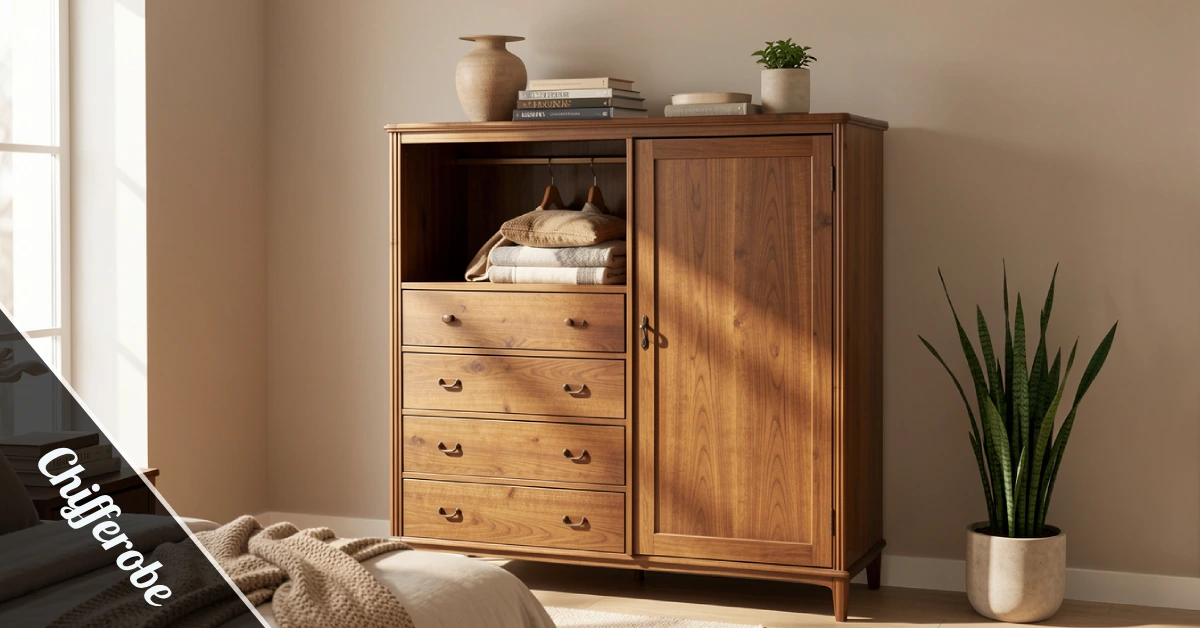
You know that feeling when you walk into a room, and something feels… off? The furniture’s fine. The paint’s fresh. But there’s this awkward energy, like the space doesn’t quite know what it wants to be. Nine times out of ten? It’s a storage problem. Specifically, it’s a “where do I put my stuff without it taking over my life” problem. Enter the chifferobe.
This vintage gem has been quietly solving bedroom chaos since before your grandparents met. And honestly? It might be exactly what your space is craving.
What Actually Is a Chifferobe?
Let’s cut through the confusion right now. A chifferobe is basically a freestanding closet that refuses to pick sides. One section provides hanging space for dresses, suits, or that one shirt you’re hesitant to fold. The other side? Stacked drawers for everything else. It’s the storage equivalent of having your cake and eating it too.
Design historian Maile Pingel breaks it down simply: it’s an American term for a tall storage piece split right down the middle—hanging on one side, drawers on the other. The name itself is a mashup of “chiffonier” (a fancy French chest of drawers) and “wardrobe.” First spotted in a 1908 Sears catalog, where they called it “a modern invention.” Fancy, right?
Why Your Grandparents Had It Right
Here’s the thing about old-school furniture—it worked. Before walk-in closets became the dream, people needed smart solutions. The chifferobe was their answer. And honestly? We’re circling back to that same problem today.
New apartments often skimp on closet space. Older homes? They weren’t built for our overflowing wardrobes. A chifferobe slides into that gap like it was waiting for the invite. No renovation. No permits. Just solid storage that actually looks good.
Chifferobe vs. Armoire vs. Wardrobe: Let’s Settle This
People mix these up constantly. And sure, they’re cousins. But understanding the difference matters when you’re shopping.
| Feature | Chifferobe | Armoire | Wardrobe |
|---|---|---|---|
| Hanging space | One side only | Full interior | Full interior |
| Drawers | Built-in on the opposite side | Rarely included | Sometimes in the lower section |
| Doors | Usually one | Two swinging | Two swinging |
| Best for | Mixed storage needs | Hanging clothes only | Maximizing hanging space |
The armoire comes from French roots—originally for storing weapons, actually. Wardrobes date back to 14th-century England and started as entire rooms before shrinking into furniture. The chifferobe? Pure American pragmatism. Someone looked at both and said, “Why not combine them?”
Where a Chifferobe Makes the Most Sense
Not every room needs one. But certain spaces? They’ll thank you.
Small bedrooms with zero closet space get an instant upgrade. Park it against any wall, and suddenly you’ve got a dressing area without construction. Guest rooms benefit big time, too. Visitors don’t want to live out of suitcases, but installing a closet for twice-a-year guests feels excessive. Chifferobe to the rescue.
Then there’s the rental situation. Can’t build built-ins. Can’t knock down walls. But you can absolutely roll in a chifferobe and call it a day. When you move? It moves with you. That’s Freedom Furniture.
Spotting Quality When You’re Thrifting
Here’s where it gets fun. Hunting for a chifferobe beats buying new any day. But you need to know what you’re looking at.
Solid wood construction matters. Check the drawer slides—do they move smoothly? Look at the hanging rod. Is it sturdy or flimsy? Open and close everything. A little wear adds character. Major damage means negotiation time.
Facebook Marketplace and estate sales are gold mines. Pingel mentions finding an Art Deco gentleman’s armoire for $75 on Marketplace—had to wiggle it out of a Manhattan loft with a spiral staircase. Adventure storage. That’s the goal.
Materials and Construction: What Lasts
Old chifferobes were built differently. We’re talking dovetail joints, solid hardwoods, and hardware that doesn’t quit after three uses. Modern versions? Hit or miss.
| Material | Durability | Price Point | Vibe |
|---|---|---|---|
| Solid oak/mahogany | Generations | Higher | Classic heirloom |
| Pine | Decades | Mid-range | Rustic charm |
| Veneer over plywood | 5-10 years | Lower | Budget option |
| MDF/particle board | 2-5 years | Lowest | Temporary fix |
If you’re buying vintage, solid wood’s your friend. It’s heavy. It’s awkward to move. But it’ll outlast everything else in your room.
Styling Your Chifferobe Like a Pro
Okay, you’ve got the piece. Now what? Don’t just shove it in a corner and call it done.
Use the top as a display moment. Vintage luggage. A sculptural lamp. Stack of books with your favorite cover facing out. Plants always work—snake plants survive even if you forget to water them for two weeks.
Inside? Organization matters. The drawer side has dividers for socks and underthings. The hanging side? Group by color or length. Makes getting dressed feel like shopping your own mini boutique.
Caring for Your Vintage Find
Wood is alive. It breathes. It reacts to its environment. Treat it right, and it’ll treat your grandkids right.
Dust weekly with a soft cloth. Skip the spray-on polishes with silicone—they build up and ruin the finish over time. Use furniture wax or quality polish made for wood. Keep it out of direct sunlight unless you’re going for that faded antique look. And humidity? Not a friend. Bathrooms are off limits.
Check the hardware every few months. A screwdriver tightened now saves a broken hinge later.
The Sustainability Angle Nobody Talks About
Fast furniture fills landfills. You know this. But buying a vintage chifferobe? That’s recycling with style points. These pieces were built to last decades. Taking one home keeps it out of the dump and gives it another chapter.
Plus, there’s something satisfying about owning furniture with history. That scratch on the side? Someone’s kid drew there fifty years ago. The worn drawer pull? Decades of morning routines. It’s furniture with stories.
Red Flags When Shopping
Not every old piece is a winner. Watch for:
Smells. Smoke or must means the smell’s embedded. Hard to fix. Wobbly legs mean joint issues. Sometimes fixable, sometimes structural. Missing hardware? Good luck matching that patina. Veneer bubbles mean moisture damage underneath.
Also, measure everything. Doorways. Hallways. Stairs. Getting a chifferobe home only to realize it doesn’t fit through the bedroom door? Tragedy.
Modern Versions Worth Considering
If vintage hunting isn’t your vibe, new options exist. Companies make chifferobe-style pieces with modern materials and cleaner lines. You lose some character but gain convenience.
Look for solid wood construction even in new pieces. Avoid anything that feels hollow when you knock. Check weight capacity on drawers—cheap versions sag fast. And read reviews about the assembly. Some are DIY nightmares.
Making the Final Decision
Still wondering if a chifferobe belongs in your life? Ask yourself a few questions.
Do you need more hanging space AND more drawer space? If yes, this is your answer. Does your room feel unfinished or chaotic? Storage often fixes that. Do you appreciate furniture with personality? Because chifferobes have it in spades.
If you answered yes to any of those, start hunting. Your perfect piece is out there waiting.
The Bottom Line on Chifferobes
Look, furniture should work for you. Not the other way around. A chifferobe pulls double duty without asking for extra floor space. It’s storage that respects your style and your square footage.
Whether you grab a hundred-year-old antique or a fresh-off-the-line modern version, you’re buying into a smarter way to organize. And honestly? That’s worth clearing out a corner for.