

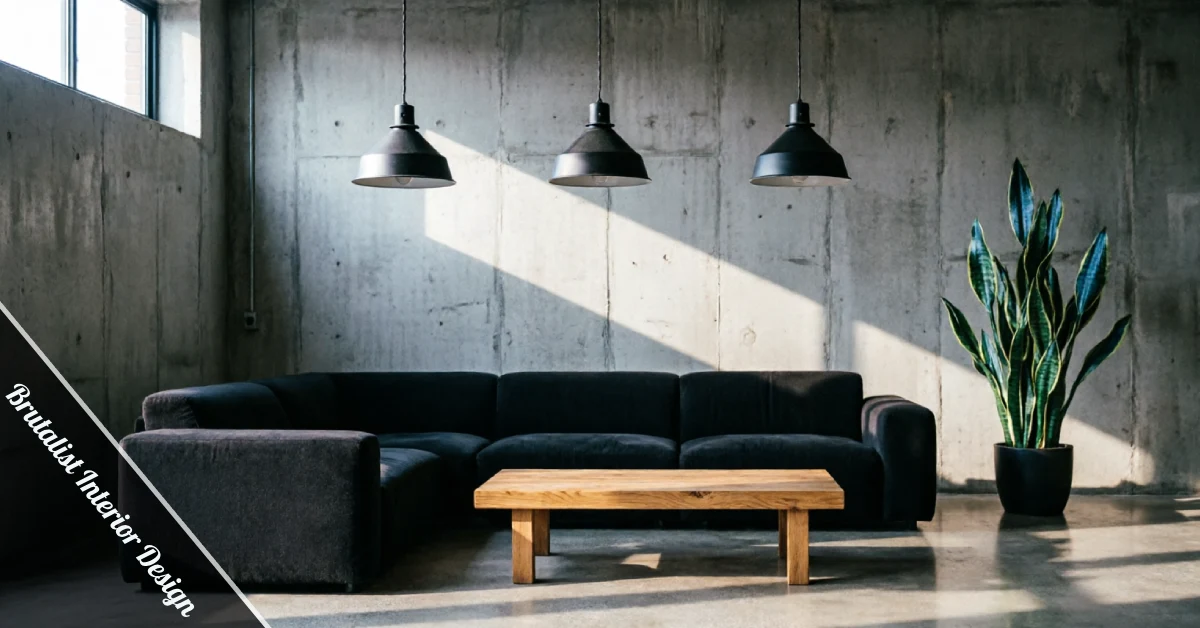
Concrete walls. Heavy furniture. Zero apologies. Brutalist interior design isn’t for the faint-hearted, but it’s having a serious moment right now.
You’ve probably seen it — those raw, stripped-back spaces showing up in architecture blogs, design magazines, and high-end apartments. What was once dismissed as cold and uninviting is now one of the most talked-about aesthetic directions in interior design. Real estate listings citing brutalism have surged over 450% in recent years, and that number isn’t slowing down.
This guide breaks down what brutalism actually is, where it came from, how it looks in real homes, and exactly how to pull it off without turning your living room into a parking garage.
What Brutalist Interior Design Actually Means
Brutalism doesn’t mean brutal. The name comes from the French term béton brut, meaning “raw concrete.” It’s a style built on honesty — materials left exposed, forms kept bold, and function treated as the main event.
Think exposed concrete walls, steel beams, chunky geometric furniture, and unfinished wood. Everything feels intentional and weighty. Colors stay in the gray, black, brown, and white zones, letting textures do the heavy lifting.
The focus is on showing what a space is made of, not hiding it behind layers of polish and paint. That’s the whole drip — authenticity over decoration.
The History Behind the Style
Le Corbusier, the French-Swiss architect, coined the term béton brut and laid the foundation for what became brutalism in the late 1940s. Architecture critic Reyner Banham later gave the movement its name and platform in the 1950s and 60s.
Post-World War II, architects needed to build fast and cheap. Concrete was the answer. Britain went all-in, and brutalist buildings started appearing at universities, housing estates, and civic centers throughout the 1960s and 70s. Iconic structures like London’s Barbican Centre and Boston City Hall defined the era.
By the 1980s, brutalism took a hit. People found it cold and oppressive. Poor construction on some projects didn’t help the reputation either. Then came the revival, and designers started seeing what the critics missed — raw honesty and real character.
The Core Elements That Define the Look
Brutalist interior design has a specific vocabulary. Once you know it, you’ll spot it everywhere.
| Design Element | What It Looks Like |
|---|---|
| Raw Concrete Surfaces | Unpainted walls showing natural texture and marks |
| Heavy Geometric Furniture | Blocky, angular pieces with serious visual weight |
| Industrial Lighting | Metal pendants, exposed bulbs, track lights |
| Minimal Color Palette | Grays, blacks, browns, whites — no loud colors |
| Cantilever Details | Floating stairs, counters that jut from walls |
| Integrated Built-ins | Shelving and seating are built directly into the architecture |
| Textural Wall Treatments | Board-formed concrete, aggregate finishes, deep grooves |
Each element earns its place. There’s no decoration for decoration’s sake. Every piece either serves a function or adds genuine texture to the space.
Key Features Worth Knowing
Monolithic furniture is the signature move. Tables, benches, and cabinets look like they were carved from a single block. No visible joints, no fussy details — just solid, continuous surfaces that command attention.
Repetition creates rhythm. Brutalist spaces often use identical shelving units in rows or modular square elements across an entire wall. It feels mathematical, almost sculptural, and it works.
Scale contrasts are intentional. You’ll often see a small decorative object sitting on a massive concrete shelf. That tension between tiny and huge is a deliberate design choice, and it makes rooms feel both grand and personal at the same time.
Neo-Brutalism: The Warmer Version
Pure brutalism can feel severe. Neo-brutalism is the answer for people who want the aesthetic without living in a fortress.
It keeps the geometric forms and concrete surfaces but adds warmth through wood accents, soft textiles, and better lighting. You’ll see brass fixtures paired with raw walls, cozy seating against exposed brick, and plants softening the hard edges.
| Feature | Modern Brutalism | Neo-Brutalism |
|---|---|---|
| Materials | Pure concrete and steel | Concrete with wood and textile accents |
| Colors | Strict grays and neutrals | Warm tones with selective color |
| Scale | Monumental proportions | Human-scaled and comfortable |
| Comfort | Function-first | Comfort balanced with bold aesthetics |
Neo-brutalism is where most people actually land when they say they love the style. It’s brutalism with a livable edge.
How to Bring It Into Your Home
You don’t need to gut your entire space. Start with one element and build from there.
Raw materials first. Concrete flooring, an exposed brick wall, or an unfinished wood beam can shift the entire energy of a room. These surfaces add texture and character without requiring a full renovation.
Go geometric with furniture. Look for [blocky, angular pieces](https://www.architectural digest.com/story/brutalism-interior-design) with bold silhouettes. Metal chairs, plain wooden tables, and chunky shelving units all speak the language fluently.
Light and shadow are your tools. Large windows, skylights, and minimal window treatments let natural light play across rough surfaces in ways that look genuinely stunning. For artificial light, industrial fixtures and track lighting add an edgy but practical layer.
Add greenery. Low-maintenance plants like snake plants or succulents contrast beautifully against concrete and steel. They bring organic shapes into a space that’s all hard angles. Eco brutalism — the trend mixing brutalist aesthetics with sustainable materials and plants — is one of the fastest-growing directions in the style right now.
Keep decor intentional. Abstract art, black-and-white photography, and geometric sculptures all work well. The raw backdrop lets each piece stand out without competing for attention.
The Designers Who Made It Famous
Three architects built the foundation. Le Corbusier created the visual language. Carlo Scarpa, the Italian master, worked with concentric squares and interlocking geometric motifs. Marcel Breuer used board-formed concrete in ways that influenced interior design for decades.
On the artisan side, Paul Evans built sculptural metal furniture that collectors still chase today. Kelly Wearstler, one of the most influential contemporary designers working in this space, uses carved stones, metal chunks, and spiky forms that push brutalism into luxury territory.
These aren’t just names to drop. They’re the people who proved that raw materials could be genuinely beautiful.
Why It’s Controversial — and Why That’s the Point
Brutalism has always divided opinions. Critics call it cold, oppressive, even prison-like. Supporters see honest beauty in the raw materials and bold geometry. A popular Reddit thread on brutalist architecture showed exactly this split — some users calling it a zombie shelter, others pointing to Ricardo Bofill’s The Factory in Barcelona as proof of its potential.
The controversy is kind of the point. Brutalist interior design doesn’t try to please everyone, and that’s what makes it interesting. It has a “take it or leave it” confidence that a lot of softer design styles simply don’t have.
The class associations are real, too. Brutalism got tied to social housing projects in the 1960s, and poorly built versions gave the whole style a bad reputation. Today’s revival reclaims it on its own terms — focused on craftsmanship, material honesty, and bold design choices.
Is It Right for You?
If you’re drawn to spaces that feel strong, real, and a little unapologetic, brutalist interior design is worth exploring. You don’t have to commit fully. One concrete element, one angular piece of furniture, or one industrial light fixture can shift the mood of a room in a real and noticeable way.