

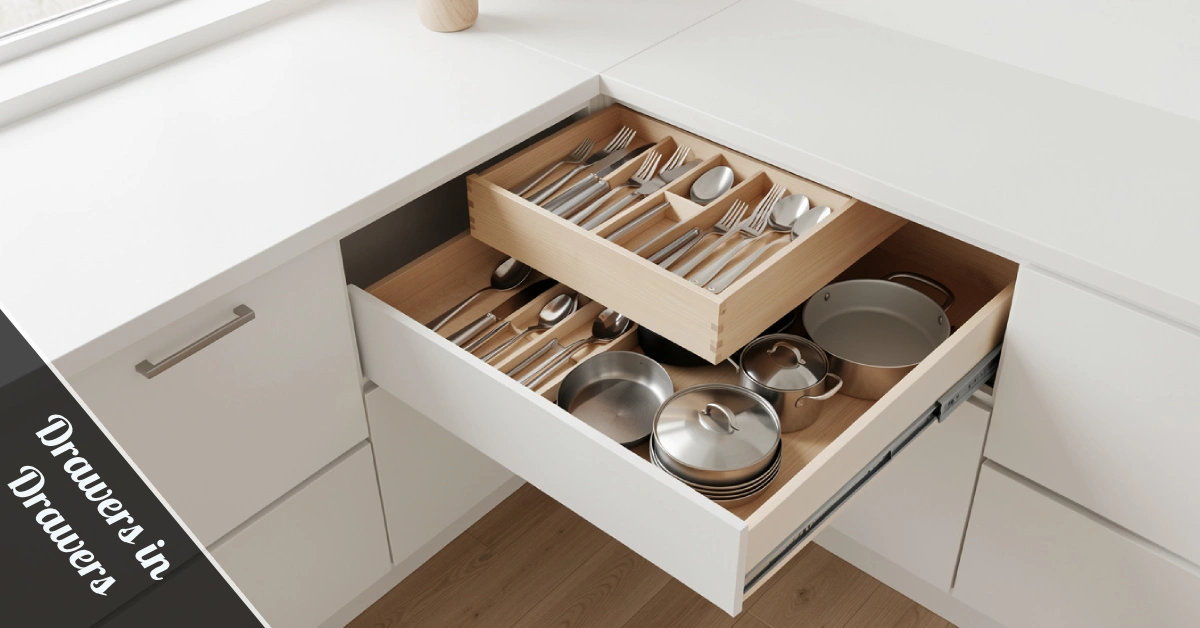
You pull open a deep kitchen drawer and things topple everywhere — a spatula, some mystery lids, and a rogue garlic press. Sound familiar? That’s the chaos drawers in drawers that were literally built to fix. One deep space becomes two smart layers, and just like that, calm replaces chaos.
This guide walks you through what the system actually is, where it works best, which brands do it right, and how to DIY your own setup easily.
We’re pulling from real-world setups, brand research, and the smart storage strategies used by professional organizers who swear by layered systems.
What Are Drawers in Drawers, Exactly?
At its core, drawers in drawers is a layered storage setup where a shallow inner drawer, tray, or organizer lives inside a deeper outer drawer. You’re not adding furniture — you’re making your existing furniture actually work smarter without any extra bulk showing from the outside.
Think of it like a filing cabinet for your daily life. Everything has a layer, a zone, and a job — no digging required.
There are three main styles to know: built-in inner drawers like the IKEA MAXIMERA system, organizer-based trays you drop inside any existing drawer, and hidden false-bottom drawers for things you’d rather keep out of sight.
Why Everyone’s Obsessed With This Storage Trend
Smaller homes and apartments don’t come with unlimited cabinet space. That reality is pushing people toward smarter vertical use of the storage they already own, instead of buying more furniture.
Drawers in drawers solve the deep-drawer problem without touching your walls or your wallet.
Brands have also normalized this idea. IKEA, Blum, and similar companies now offer official inner drawer systems with tested load capacities and proper hardware. It’s no longer a DIY hack from a Reddit thread — it’s a real, warrantied storage solution that cabinet makers actively recommend.
The bonus? Your home still looks clean from the outside. One smooth drawer front, but behind it, everything is sorted, layered, and completely under control — exactly the vibe people love in modern home tours.
Kitchen: Where Drawers in Drawers Shine the Most
The Pan Drawer Problem — Solved
Your biggest kitchen drawer is probably wasted. You’ve got a tall front hiding a cavernous space where lids slide around, and spatulas get buried. IKEA’s MAXIMERA inner drawer system paired with a UTRUSTA front is designed exactly for this: pots stay on the bottom, cutlery and tools slide out separately from the top.
Daily items go in the top inner layer, bulkier backup items stay below — and you never shuffle things around again.
That one change alone makes your kitchen feel like a totally different space.
Hidden Drawer Inside a Kitchen Drawer
If you like subtle storage, a slim hidden compartment at the top or back of a main drawer works brilliantly for recipe cards, keys, spare cards, or anything you don’t want out on display for guests.
Just be real: it’s a privacy win, not a vault. Great for ‘I’d rather guests not see this’ — not for serious valuables.
IKEA ALEX: Already a Drawers in Drawers Legend
The IKEA ALEX 9-drawer unit has become a cult favorite for makeup artists, content creators, crafters, and home-office workers. It’s tall, slim, and already has multiple shallow drawers that act like built-in organizers.
To push it into true drawers-in-drawers territory, add acrylic or bamboo trays inside each drawer and create sub-categories. One drawer for camera gear, split into cards, batteries, and lenses. One drawer for makeup, divided into base, eyes, lips, and tools. That’s layered organization done right.
Don’t want to pay IKEA prices? There are solid ALEX dupes out there. Just check that the drawers fully extend, the frame doesn’t wobble, and the slides handle daily use without sagging.
Best Rooms for Inner Drawer Systems
| Room / Use Case | Best System | Pro Tip |
| Kitchen | IKEA MAXIMERA + UTRUSTA inner drawers | Top layer = daily tools; bottom = pots & pans |
| Home Office / Studio | ALEX 9-drawer unit with acrylic inserts | One drawer per category; label everything |
| Bedroom / Wardrobe | Slim trays + Blum LEGRABOX system | Hidden bottom layer for passports or jewelry |
| Bathroom Vanity | Modular stackable bins inside deep drawers | Skincare front, backups in the lower section |
Every room has at least one ‘black hole’ drawer — and that’s exactly where layered storage does its best work.
How to DIY a Drawer in a Drawer
Adding an inner drawer to an existing deep cabinet doesn’t require a carpenter. Measure the inside width, depth, and height. Decide how much vertical room you can spare for a shallow tray. Choose light-duty slides for a simple tray, or proper runners if you want a real sliding inner drawer.
Build or buy a shallow box with a few millimeters of clearance on each side. Mount it so it glides without hitting the front or catching the countertop above. Test it fully loaded before committing — that’s it.
If you’re working with heavy-use zones or premium cabinetry, Blum’s LEGRABOX and TANDEMBOX inner drawer systems are built for serious weight and soft-close reliability.
Common Mistakes — Don’t Do These
Overstuffing inner drawers until they scrape and jam is the number-one mistake. A good inner drawer system loses all its value the moment it becomes hard to open — keep the layers light and intentional.
Always measure slide clearance before buying anything. An inch off ruins the whole setup.
Don’t go ultra-cheap on the hardware either. Trays that warp, bins that collapse, and slides that drag after a month will make you give up on the whole system entirely. Invest just enough to make it last.
Design & Style: Looking Good While Being Organized
Function matters, but so does the vibe. White or clear organizers inside white drawers feel seamlessly built-in. Bamboo inserts warm up minimalist kitchens and vanities. Black inserts work well for modern, industrial, or gaming setups. The contrast of a clean, simple exterior and a highly organized interior is genuinely satisfying — and very Pinterest-worthy.
Premium systems from brands like Blum and IKEA are designed to keep fronts minimal while hiding every ounce of organization happening inside the drawer.
Is It Worth the Investment?
You don’t need inner drawers everywhere — start where the frustration is loudest. The main kitchen prep drawer, your daily makeup or grooming drawer, the home-office desk drawer, and yes, the legendary junk drawer are the four highest-impact places to start with drawers in drawers.
Entry-level means simple trays dropped into existing drawers. Mid-level means IKEA-style inner drawer systems. Premium means custom Blum integration built into full cabinetry. The value isn’t just more stuff inside — it’s less time searching, less visual clutter, and fewer duplicate purchases.
Start Small, Feel the Difference
Drawers in drawers aren’t just a Pinterest trend. They’re a practical system for anyone who wants a calmer, smarter home without a renovation budget or a bigger floor plan to work with.
Start with one chaotic kitchen drawer. Add a tray, create two layers, and see how it changes the way you move in the morning. That one small win will show you exactly where to go next.
Smart layered storage is one of those upgrades that quietly makes every single day easier, calmer, and more intentional — without adding a single piece of furniture.