

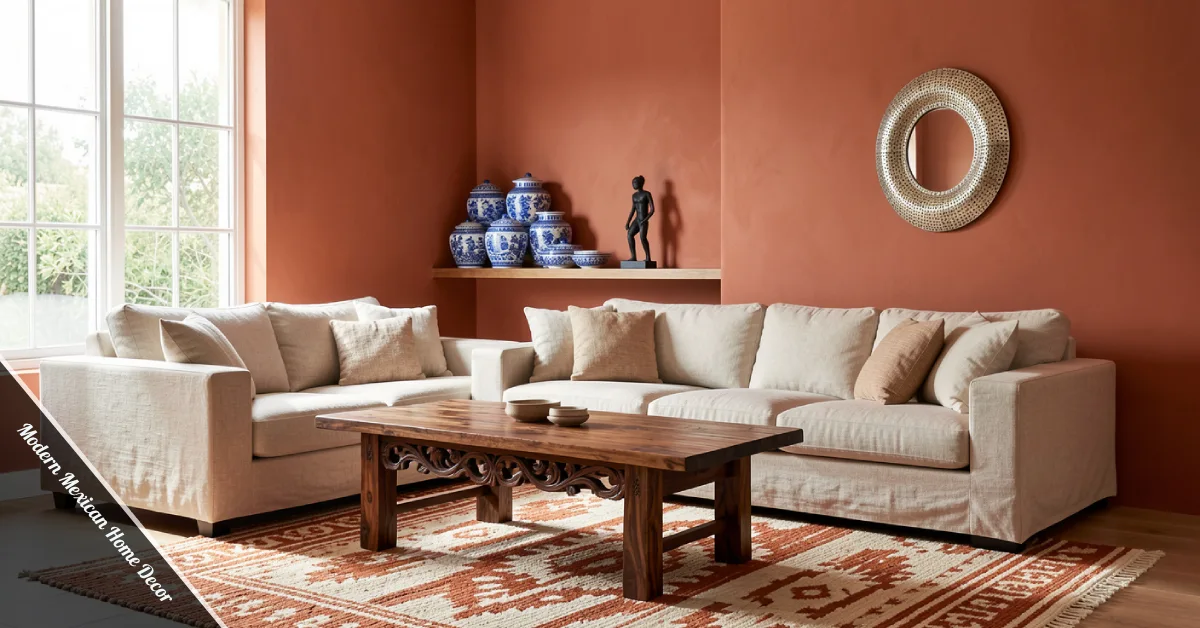
Modern Mexican home decor blends handcrafted artisan pieces, earthy natural materials, and bold color with clean, contemporary lines. Think terracotta walls, Talavera tile accents, woven textiles, and carved wood furniture. The style avoids both the sterile minimalism of Scandinavian design and the clutter of maximalism, landing on something grounded, warm, and visually specific without feeling like a souvenir shop.
The global interest in this style is growing fast. Mexico’s home decor market reached USD 11.7 billion in 2024 and is on track to hit USD 16.5 billion by 2033. That growth reflects a broader shift toward interiors rooted in cultural identity and handmade craft over mass-produced neutrals.
What Modern Mexican Home Decor Actually Means
Many people confuse authentic modern Mexican decor with festive kitsch: bright pink walls, piñata ornaments, and Day of the Dead figurines everywhere. That version exists, but it is not what professional interior designers or discerning homeowners are reaching for in 2026.
Modern Mexican design pulls from two traditions at once. On one side, you have Mexico’s deep artisanal heritage: hand-painted Talavera ceramics from Puebla, woven Oaxacan textiles, carved mesquite wood furniture, and encaustic cement tiles. On the other hand, you have contemporary architecture’s preference for open plans, clean geometry, and restraint.
The result is a home that feels specific and personal, not generic. Every object carries a story without making the space feel busy. The key is knowing which elements to keep and which to leave out.
The Right Color Palette for a Modern Mexican Home
Color is the first thing people associate with Mexican design, and getting it wrong is easy. Most people either go too neutral and lose the style’s identity, or go too loud and make the space feel chaotic.
Start with an earthy base. Warm terracotta, clay, sand, and warm cream work well as wall colors and larger furniture tones. These anchor the room and do the heavy lifting. From there, you bring in deliberate color through accents: a cobalt blue ceramic vase, a deep ochre cushion, a single wall of hand-painted tiles in sunflower yellow and rust.
This approach also aligns with one of 2026’s broader design directions. Interior designers have noted a growing move toward color-drenched rooms, where a single saturated tone wraps walls, ceilings, and upholstery together. A terracotta-drenched living room with woven natural accents and carved wood shelving fits squarely into that direction, connecting Mexican heritage with what is current.
What to avoid: mixing too many high-saturation colors in one room. Pick one bold accent per space and build the rest around neutrals.
Materials That Define the Style
Modern Mexican home decor is a tactile style. The materials you choose matter as much as the colors.
Wood is foundational. Look for hand-carved or hand-turned pieces in mesquite, walnut, or pine. The grain, the weight, and the small imperfections are part of the aesthetic. A reclaimed wood console table or a hand-turned wooden bowl on a kitchen counter does more for this style than a whole shelf of mass-produced decor.
Clay and ceramic are equally central. Talavera pottery from Puebla is the most widely recognized example: blue-and-white hand-painted designs on dishes, planters, and decorative tiles. Oaxacan black clay pieces, known as barro negro, work well as sculptural objects on shelves or mantels.
Woven textiles add texture and warmth without weight. Look for Zapotec-style rugs from Oaxaca, woven wool throw blankets, or cotton rebozos used as table runners or wall hangings. These are not purely decorative. They are functional objects with centuries of craft behind them.
Metal plays a role, too. Punched tin lanterns and mirrors are traditional in Mexican design, and this works in your favor right now. Tin as a decorative material is emerging strongly in 2026 interiors, with designers noting a surge in punched and tarnished metal accents across kitchens, entryways, and bathrooms.
Stone surfaces, exposed brick, and concrete floors give modern Mexican spaces their grounding. These materials age well and develop character over time, which fits the style’s preference for things that look lived-in rather than showroom-perfect.
How to Decorate Room by Room
Living Room
Keep the furniture clean-lined and neutral: a linen sofa, a dark wood coffee table, simple shelving. Then bring the Mexican elements in through accents. An Oaxacan rug anchors the seating area. A cluster of Talavera pottery on a shelf. A large woven basket is near the fireplace. One statement piece of folk art or a hand-carved wooden sculpture on the mantle.
Avoid lining every surface with ceramics. Group things in odd numbers, leave negative space, and let the objects breathe.
Kitchen
The kitchen is where Talavera tiles shine most. Use them on a backsplash or as accents around a range hood rather than covering every surface. A few hand-painted tiles mixed into a standard tile field create more visual interest than an all-Talavera wall.
Open shelving in wood with ceramic dishware displayed openly is a natural fit. A hand-thrown clay pot for utensils, a colorful ceramic fruit bowl, and a small potted herb plant are all small moves that add up.
Bedroom
Layer textiles. A woven blanket at the foot of the bed, embroidered pillowcases, a cotton throw in a warm tone. Keep the wall color simple and warm, whether terracotta, warm white, or a muted clay. One piece of Mexican folk art or a framed textile print on the wall is enough.
A carved wood bedside table or a tin-framed mirror makes the connection to the style without overloading the space.
Entryway
This is the right place to make a strong first impression. A hand-painted Talavera tile panel above a console, a punched tin mirror, a hand-woven runner on the floor, and a pottery piece for keys or mail. The entryway is small enough to hold strong elements without overwhelming.
Where to Buy Authentic Modern Mexican Decor
Your best source is always direct from Mexican artisans and small importers. Shops like Lolo Mercadito, Ibarra Imports, and Modern Mexico carry curated pieces that reflect actual craft traditions rather than factory-produced versions. If you are in Los Angeles, Phoenix, or Chicago, local Mexican artisan markets run regularly and stock pieces you will not find online.
Online, Etsy has a strong selection of Zapotec weavers and Talavera potters who sell directly. For furniture, look for importers who source from Jalisco or Michoacán, where wood carving traditions are strongest.
Emerging studios from Mexico City, like Studio Lares and Studio Multiply, are now blending traditional techniques with contemporary design for an audience that wants craft without nostalgia. Their pieces are showing up at design fairs internationally and represent the direction the style is moving: away from purely folkloric and toward objects that work in any modern interior.
One practical note: always ask sellers where and how the pieces were made. “Mexican-inspired” often means made in a factory overseas. Authentic pieces cost more and are worth it, both for quality and for the fact that the money goes back to the artisans making them.
FAQs
Can modern Mexican home decor work in a small apartment?
Yes. Focus on a few strong pieces rather than many small ones. A Talavera tile backsplash in the kitchen, one woven rug, and a carved wood item or two create the style without crowding a small space.
How do I avoid making Mexican decor look kitschy?
Stick to authentic handmade pieces rather than mass-produced decorative items. Limit novelty objects like painted skulls or tourist-market ceramics. The style earns its depth through craft quality, not quantity of cultural references.
What modern furniture works with Mexican decor?
Clean-lined sofas in neutral linen or leather pair well. Avoid ornate or highly contemporary pieces like acrylic or chrome furniture. Mid-century modern silhouettes often work because they share Mexican design’s preference for simple forms and natural materials.
Is this style expensive to pull off?
Not necessarily. Woven textiles and folk art pieces can be very affordable when bought from markets or direct importers. The biggest investment is usually in furniture and architectural elements like tile. Start with textiles and pottery, then add furniture over time.
What is the difference between traditional and modern Mexican decor?
Traditional Mexican design is denser in pattern and color, with heavy folk art influence throughout. Modern Mexican strips it back: fewer pieces, cleaner lines, more white space, with the artisan elements used as accents rather than the dominant visual layer.