

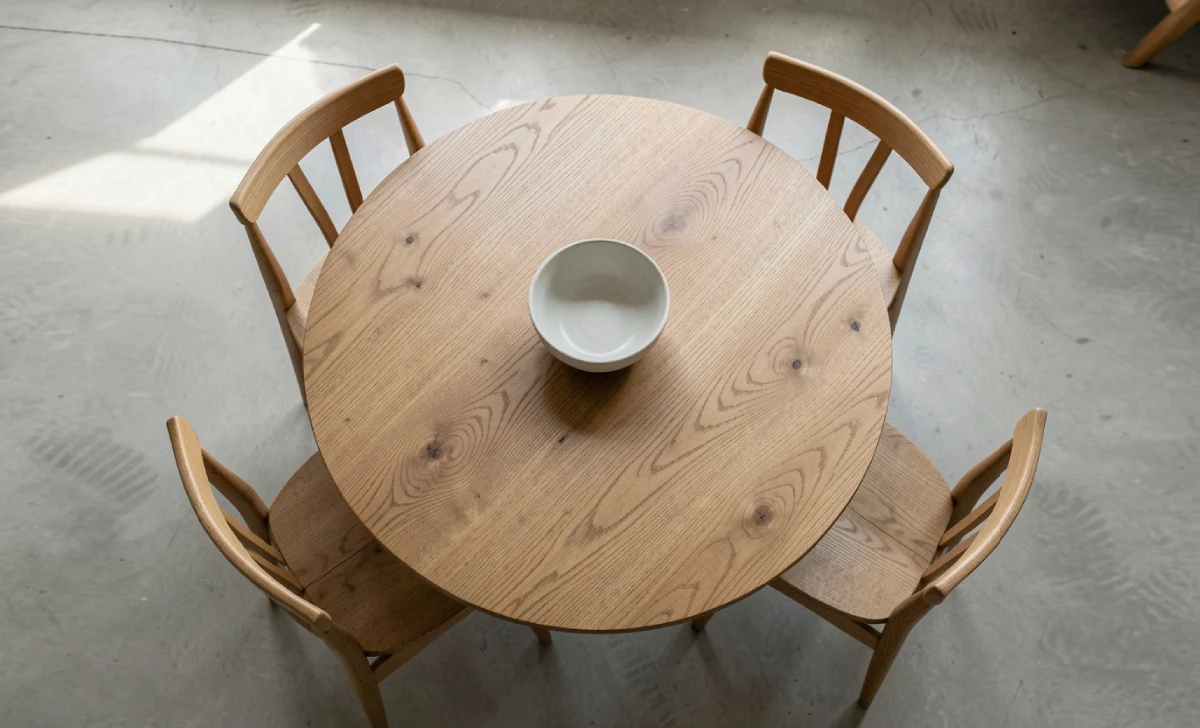
A round wood dining table works well in small and medium dining rooms because it removes sharp corners, keeps conversation easy, and seats more people in a tight space. The best choice depends on room size, wood type, and base style. Solid hardwoods like oak and walnut last for decades. Allow at least 36 inches of clearance around the table so chairs can pull out freely and people can move without bumping into walls or furniture.
Why a Round Wood Table Makes Sense
Round tables solve a problem that most rectangular tables create: everyone feels equal. There is no head of the table, no one stuck in a corner, and food placed in the center is easy for everyone to reach.
Interior designer Crickett Kinser of Kitchen Places puts it simply: “When you go to a wedding, would you rather sit at a round table where you can talk to everybody, or would you like to sit in a long line?”
Wood adds to that warmth. In 2025, natural wood finishes continue to lead dining table trends, with designers moving away from heavy varnishes toward raw, visible grain that shows the material for what it is. A wood table also ages well. Minor scratches can be sanded out, and the surface develops character over the years of use.
What Size Round Table Do You Actually Need
Getting the size wrong is the most common buying mistake. Start by measuring your room before you look at any product.
The rule is straightforward: leave at least 36 inches of clearance between the table edge and the nearest wall or piece of furniture. This gives people room to push back chairs and walk behind seated guests without squeezing through. For high-traffic rooms or households with young children, 42 to 48 inches of clearance is more comfortable.
For seating capacity, plan on about 24 inches of width per person around the table edge. Here is a quick reference:
- 36-inch diameter: seats 2 to 3 people
- 42 to 44-inch diameter: seats 4 people comfortably
- 48 to 52-inch diameter: seats 4 to 6 people
- 60-inch diameter and above: seats 6 to 8 people
A round table in a small room also creates an illusion of more space because no corners are pushing against the walls. According to one furniture sizing guide, new U.S. rental apartments averaged just 887 square feet in 2022, down 54 square feet from a decade earlier. A round table works harder in these tighter footprints than a rectangular one does.
Best Wood Types for a Round Dining Table
The wood species you choose affects how the table looks, how long it lasts, and how much care it needs. Here are the most common options:
Oak is the most popular choice. It is dense, handles daily use without denting easily, and its open grain pattern hides light scratches. White oak has a cooler, slightly gray tone. Red oak leans warmer and more golden.
Walnut is darker and richer. It suits mid-century modern and contemporary rooms where you want a statement piece. It is softer than oak, so it scratches more easily, but it can be refinished.
Mango wood has a strong natural grain with color variation across the surface. It is often more affordable than oak or walnut and works well in farmhouse and rustic styles.
Acacia is dense, moisture-resistant, and has bold, swirling grain. It handles busy households well and takes stains evenly.
Ash and rubberwood are lighter in color and suit Scandinavian or Japandi-style rooms where you want a bright, airy feel.
Audrey Scheck, founder of Audrey Scheck Design, notes that natural wood finishes are a major trend right now: “I love how this adds warmth and character to a dining space.” She also points to the shift toward soft, curved shapes: “Dining tables with organic shapes and rounded corners create a more welcoming atmosphere.”
Avoid tables labeled “wood-look” or “engineered wood” without further detail. These often use low-grade particle board under a thin veneer that swells and chips when exposed to moisture. If the product listing does not specify the species and construction clearly, that is a sign to look elsewhere.
Pedestal Base vs. Four-Leg Base
The base style affects both the look of your table and how many people can sit around it comfortably.
A pedestal base uses a single central column to support the top. This opens up legroom around the entire table and makes it easier to pull chairs in from any angle. It also makes tight seating arrangements easier when you need to squeeze in an extra guest. The trade-off is that pedestal bases need to be well-built to avoid tipping when someone leans on the edge. Look for a wide, heavy base plate and solid construction at the column joint.
A four-legged base is more traditional and tends to feel more stable at a glance. It works well for smaller tables up to 44 inches in diameter. Beyond that, the legs can interfere with seating and make it harder to fit chairs evenly around the table.
Some tables combine a pedestal column with spreading legs at the base, which balances stability with open seating. This works especially well for larger tables in the 52 to 60-inch range.
How to Check Build Quality Before You Buy
Whether you shop in a store or online, a few checks will tell you if a table is worth the price.
In a store, try this quick test: grip two opposite edges and apply gentle diagonal pressure. A well-built table will barely flex. Press down on each corner individually. There should be no creaking or popping. Solid mortise-and-tenon or dowel joints hold up far better over time than tables that rely only on metal brackets and screws.
Online, look for these signals:
- Clear material specs (species name, solid vs. veneer vs. engineered)
- Close-up photos of the grain, edges, and underside
- Specific dimensions and weight (heavier usually means more solid construction)
- FSC certification if sustainability matters to you
- Low-VOC or water-based finish information
Heavier tables are generally a reliable signal of better construction. A 48-inch solid oak pedestal table should weigh 80 to 120 pounds. If a table in that size range weighs under 50 pounds, ask what it is actually made of.
Room for the Round Wood Dining Table Trend
In 2025 and into 2026, the direction in dining furniture is clear. Designers are choosing pieces that feel less formal and more connected to natural materials. Curved shapes, visible wood grain, and warmer finishes are replacing sharp-edged, high-gloss options.
The global wooden furniture market was valued at around 461 billion USD in 2024 and is forecast to grow at 5.7% annually through 2032, driven by demand for durable, long-lasting pieces rather than disposable alternatives.
Round wood tables sit at the center of this shift. They are not a trend in the way that color palettes are trends. They are a practical choice that a lot of people are discovering for the first time after years of defaulting to a rectangular table because it seemed like the “normal” option.
If you entertain regularly, host family dinners, or simply want a table that works well in a compact or square-shaped room, a round wood table is worth serious consideration.
Caring for Your Table Over Time
Solid wood is forgiving if you stay on top of basic maintenance. Use trivets or coasters for hot dishes and wet glasses. Wipe spills quickly, especially near joints where water can seep in.
For light scratches, a matching furniture wax or touch-up pen usually does the job. For water rings, gentle rubbing with a non-abrasive cleaner often lifts the mark. More serious damage to a quality table is usually worth a professional refinish rather than a replacement.
Avoid placing solid wood tables in direct sunlight for extended periods. UV exposure fades the finish and can cause uneven color changes across the surface over time.
FAQs
What size round dining table fits 6 people?
A 52-inch diameter table seats 6 people comfortably. A 48-inch table can seat 6 in a pinch, but works best for 4 to 5. For relaxed seating with more elbow room, a 60-inch diameter is the better choice for 6 people.
Is a pedestal base better than four legs on a round table?
Pedestal bases offer more legroom and make it easier to fit chairs around the full circle. Four-leg bases are more stable visually and work well for smaller tables under 44 inches. For larger tables, a pedestal or spread-leg base is usually more practical.
What wood is most durable for a dining table?
Oak is the standard recommendation for durability. It is dense, handles scratches well, and is easy to find in many finishes. Walnut and maple are also strong choices. Avoid soft woods like pine for tables that see heavy daily use.
How much clearance do I need around a round dining table?
Allow at least 36 inches between the table edge and the nearest wall or furniture. Lauren, a furniture sizing expert cited by Taste of Home, recommends 36 to 48 inches for easy movement and a comfortable chair pullout.
Can I add chairs beyond the standard seating capacity?
Yes. Round tables handle extra seating more easily than rectangular ones because there is no fixed head or foot. You can often squeeze in one or two extra chairs without anyone feeling crowded, especially with a pedestal base that keeps legroom open around the full circumference.