

You know that soggy patch in your garden that turns into a mini lake every time it rains? Yeah, that’s your property screaming for help. Let’s talk soakaways—the underground heroes that keep your yard from looking like a swamp and your foundations from turning sketchy.
Here’s the thing: most homeowners ignore drainage until water’s already causing problems. Smart move? Not really. Understanding what is a soakaway is could save you thousands in foundation repairs and give you bragging rights when neighbors are dealing with flooded gardens.
What is a Soakaway?
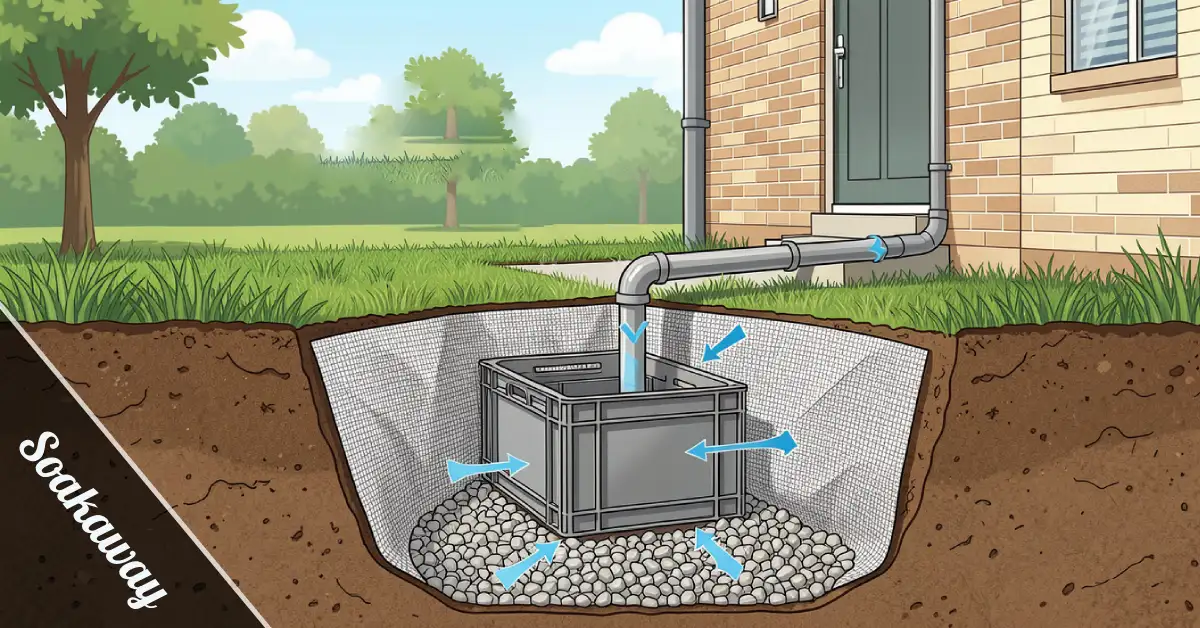
Think of a soakaway as your garden’s secret weapon against waterlogging. It’s basically a buried pit filled with special plastic crates or rubble that catches excess rainwater and slowly releases it back into the ground. No drama, no flooding—just nature doing its thing at a controlled pace.
The setup’s pretty straightforward. You dig a hole, stack it with soakaway crates that look like oversized milk crates, wrap everything in a breathable fabric membrane, then cover it back up. Your downpipes and gutters feed into this underground storage system, and the water gradually seeps into the surrounding soil. It’s like giving your property a built-in sponge.
Modern systems use geo-cellular crates because they’re lighter and hold more water than traditional rubble-filled pits. But if you’re demolishing something and have leftover building rubble, that works too. Either way, the goal’s the same—keep surface water where it belongs instead of pooling around your house.
One thing, though: soakaways aren’t for sewage. Laws changed in 2015, and now you need proper drainage fields with Environment Agency permits for wastewater. Soakaways are strictly for rainwater. Mix those up, and you’re looking at legal headaches nobody needs.
How Does a Soakaway Actually Work?
Your roof collects rain. Gutters channel it to downpipes. Those downpipes feed into underground pipes leading to your soakaway. Simple physics from there—water fills the void spaces in your crate system, then slowly infiltrates the soil through the permeable membrane.
The size matters more than you’d think. A bigger roof area means more water, which means you need a larger soakaway. Most residential setups handle multiple downpipes without breaking a sweat, but calculate wrong, and your system fails faster than you can say “foundation damage.”
Here’s where it gets practical: a properly sized soakaway should drain to half-empty within 24 hours. Any slower, and you’re building up water that’ll eventually overflow. Any faster, and congrats—your soil’s perfect for drainage. The sweet spot depends on your specific ground conditions, which is why testing matters.
The beauty of this system? It recharges underground aquifers naturally. You’re not just solving your drainage problem—you’re actually helping the local water cycle. Plus, that water stays on your property instead of overwhelming public sewers during storms.
Why You Actually Need One (Beyond Avoiding Swamps)
Building regulations aren’t suggesting soakaways for fun. Part H of the Building Regulations requires them for new homes, and there’s solid reasoning behind that. Flooding causes serious structural damage—we’re talking cracked foundations, basement seepage, and erosion that’ll cost way more to fix than installing drainage upfront.
The financial angle hits different when you factor in water bills. Got a soakaway managing your surface water? You’re entitled to a rebate from your sewerage company. Most homeowners don’t realize they’re paying around £1 billion collectively each year for public sewer rainwater processing. Switch to a soakaway, and you drop to foul-water-only charges.
Better yet, you can backdate that rebate up to six years. Do the math—that’s potentially hundreds of pounds sitting there waiting for you to claim it. Just contact your water company with proof that your rainwater drains to a soakaway, not public sewers.
Then there’s the whole climate angle. Heavy rainfall is getting more common, and old drainage infrastructure can’t keep up. Installing a soakaway takes pressure off overloaded public systems and reduces localized flooding risk. It’s one of those rare situations where what’s good for you is also good for your community.
Testing Your Soil (The 2-Hour Reality Check)
Before you start digging, you need to know if your soil can actually handle a soakaway. Clay soil? Forget it—water won’t drain fast enough. Sandy, chalky, or limestone-based soil? You’re golden.
The percolation test is dead simple. Dig a hole about 30cm square and 30cm deep. Fill it with at least 10 liters of water. If that water disappears within two hours, you’re good to go. If it’s still sitting there like a sad puddle after four hours, you need different drainage solutions.
For deeper analysis, go down a full meter. This matters because your soakaway base needs to sit at least one meter above the highest groundwater table level. Hit water before you hit that depth, and you’re basically trying to drain water into water—doesn’t work.
Some folks skip this test and regret it later. Don’t be that person. Unsuitable soil means your soakaway just creates a different waterlogging problem. The test takes 10 minutes of effort; fixing a failed installation costs thousands.
Installing Your Soakaway (Without Calling in Professionals)
Location’s your first call. Stay at least five meters from building walls and 2.5 meters from property boundaries. Any closer, and you risk undermining foundations or annoying neighbors with water seepage. Pick a lower spot in your garden where water naturally wants to collect anyway.
Grab your materials: soakaway crates, geotextile membrane, strong tape, drainpipe, compacted sand or shingle, and basic digging tools. Most DIY suppliers stock everything, and kits with silt traps run around £200-500, depending on size. The silt trap’s worth having—it stops leaves and debris from clogging your system.
Dig your pit large enough for the crates plus 15cm of base fill, backfill, and side fill. Remove stones and roots, smooth the bottom, then lay your sand or shingle base. Wrap those crates in the membrane, making sure every outward-facing surface is covered.
Connect your drainpipe by cutting a cross in the membrane at the pipe entry point and pushing the pipe through about 15cm deep. Backfill around the crates with more sand or shingle, cover the top with 15cm of fill, then replace your soil and turf. Done right, you won’t even know it’s there.
Soakaways for Driveways (When Tarmac Meets Rain)
Paving over your garden? Planning regs typically require you to handle surface water runoff properly. You’ve got options: permeable paving, porous asphalt, or directing non-porous surfaces to a soakaway. What’s not acceptable? Letting rainwater drain onto public roads.
If you’re going the soakaway route, slope your driveway so water collects at a low point and flows into your drainage system. Space-limited? You can actually build the soakaway under your driveway, but you’ll need heavy-duty crates rated for vehicle weight. Expect higher costs—structural requirements aren’t negotiable.
The calculations get more complex with driveways because you’re dealing with larger surface areas and different runoff patterns. Most contractors recommend oversizing slightly rather than undersizing and dealing with overflow. Think of it as insurance against that one massive storm that floods everything.
When Soakaways Don’t Work (And What to Do Instead)
Heavy clay soil’s the obvious dealbreaker. Contaminated land’s another hard no—you risk polluting groundwater. High water tables, unstable ground, and areas within five meters of buildings or roads also rule out soakaways. If your percolation test fails, accept reality and look at alternatives.
French drains work differently—they divert water elsewhere rather than storing and infiltrating it. Good for moving water off your property entirely, less ideal if you’re trying to be eco-friendly about it. Dry creeks and swales offer naturalistic drainage that can double as landscape features.
Some properties just need professional drainage fields connected to treatment systems. Others benefit from simple fixes like regrading landscapes to create gentle slopes away from structures. Sometimes the solution’s boring: amending soil composition with organic matter to improve natural drainage.
Trees can help, too. Willows and other moisture-absorbing species suck up groundwater naturally, though they come with trade-offs. Strong roots can damage nearby structures, and they’re thirsty enough to crowd out other plants. Use them strategically, not everywhere.
Maintenance (Or Lack Thereof)
Soakaways are low-maintenance by design, but “low” doesn’t mean “zero.” Keep vegetation cleared around the area so roots don’t interfere with drainage. If you used plastic crates, clean blockages with a jet wash instead of tools that might crack the material.
Most household soakaways need renewal every 10-15 years. That timeline stretches or shrinks based on construction quality, upstream silt interception, how close trees are, and how often heavy rains hit your area. Better materials and good maintenance push that deadline further out.
Check it periodically—look for slow drainage, overflow during moderate rain, or soggy spots above the soakaway location. Catch problems early, and fixes are cheap. Ignore them, and you’re looking at excavation and replacement, which runs into thousands.
If you installed a drainage field for sewage instead of a simple rainwater soakaway, maintenance gets more serious. Those systems need professional attention and regular pumping. Don’t DIY that—call the experts.
The Bottom Line on Soakaways
So what is a soakaway in practical terms? It’s your best bet for managing surface water if your soil cooperates. It’s cheaper than most alternatives, helps the environment, qualifies you for bill rebates, and protects your property from water damage. Not bad for a hole in the ground filled with plastic crates.
Skip the percolation test at your peril. Follow building regs. Size it right. Keep it maintained. Do those things, and your soakaway handles decades of rainfall without fuss. Most drainage problems have complicated solutions—this one’s refreshingly straightforward.
Dealing with drainage might not be exciting, but watching your neighbors battle flooding while your garden stays dry? That hits different. Install it right once, and you’re done thinking about it until your grandkids inherit the property.