

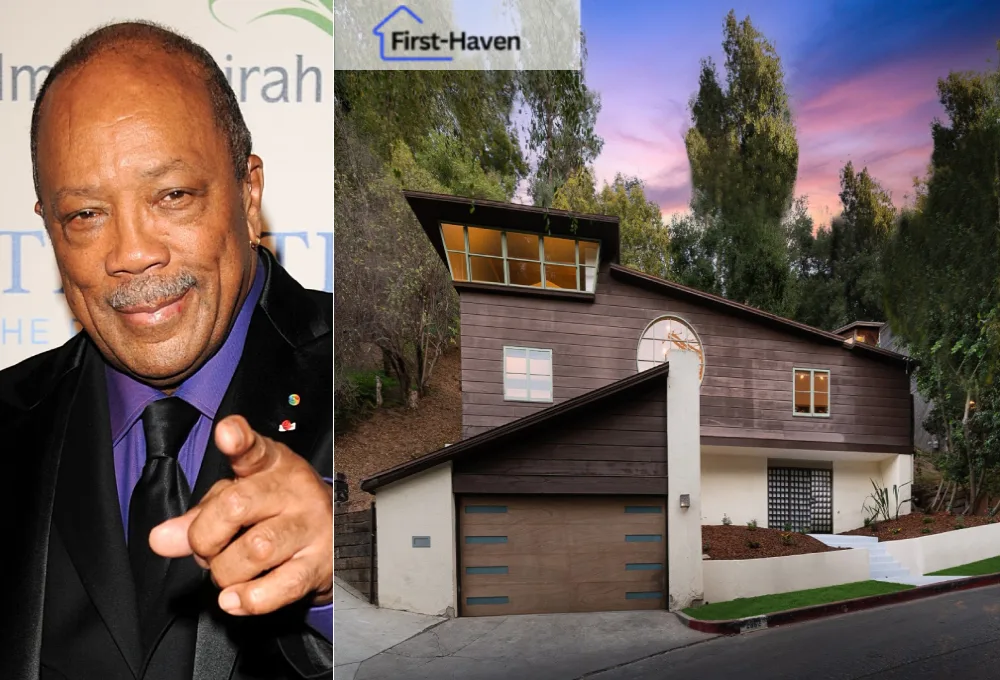
Quincy Jones was one of the most decorated figures in the history of American music. The man who produced Michael Jackson’s Thriller, won 28 Grammy Awards, and shaped the sound of half a century didn’t just leave behind a musical legacy — he left behind one of the most extraordinary private residences in Los Angeles.
Jones purchased land in Lower Bel Air in 1972 for $200,000 and spent years turning it into a completely custom estate that reflected his personality, his travels, and his creative life. Following his passing in November 2024 at age 91, the property was listed for sale in May 2025 at $59.995 million — and it has remained one of the most talked-about listings on the LA luxury market since.
This article covers everything you need to know: the estate’s location, architecture, key features, current listing status, and what makes it genuinely unlike any other property in Bel Air.
Quincy Jones House at a Glance
| Detail | Information |
|---|---|
| Location | Lower Bel Air, Los Angeles, CA |
| Lot Size | 2.33 acres |
| Interior Size | ~25,000 sq ft |
| Bedrooms | 5 |
| Bathrooms | 17 |
| Architect | Gerald “Jerry” Allison, FAIA |
| Year Built | Early 2000s (land purchased 1972) |
| Original List Price | $59.995 million (May 2025) |
| Current Asking Price | ~$46 million (as of early 2026) |
| Listed With | David Kramer & Andrew Buss, Compass |
Where Is the Quincy Jones House?
The estate sits at the end of a private, gated cul-de-sac in Lower Bel Air — one of the most secluded pockets of an already exclusive neighbourhood. It isn’t a showy mansion fronting a busy street. It’s deliberately hidden.
Suspended above Los Angeles on a rare 2.3-acre promontory, the property offers sweeping 270-degree views — a cinematic panorama stretching from the San Gabriel Mountains to the Pacific Ocean. The surrounding hills provide natural privacy on all sides, meaning neighbours and passers-by have no sight lines into the estate.
The location puts residents within minutes of the Bel-Air Hotel, Beverly Hills, Westwood, and the cultural corridor of the Westside — close enough for convenience, far enough for genuine quiet. It shares that same quality of studied privacy found in other high-profile LA-area compounds, such as the Stephen Ross house, which similarly prioritises seclusion over street presence.
Who Designed It — and What Was the Inspiration?
This is where the Quincy Jones estate separates itself from most celebrity homes. It wasn’t purchased off-the-shelf or handed to a developer. Jones spent six years designing the custom home alongside architect Gerald “Jerry” Allison, FAIA — a high school friend and globally recognised luxury hospitality architect.
The home’s design was inspired by The Palace of the Lost City, a luxury hotel in South Africa that Jones visited and admired. Jones commissioned the same firm, WATG, to design his residence, with Allison leading the project alongside WATG senior design adviser Tom Fo.
The result is a property that feels less like a traditional LA mansion and more like a private resort — bold in scale, but warm in detail. That resort-like approach to residential design has become increasingly common among elite athletes and entertainers — the Steph Curry house is a notable Bay Area example of the same philosophy applied to a modern luxury compound.
Note on A. Quincy Jones: Some searches conflate the music producer with A. Quincy Jones (Archibald Quincy Jones, 1913–1979), a celebrated mid-century modern architect who designed many notable homes in Bel Air, Brentwood, and Pacific Palisades. A. Quincy Jones developed a practice grounded in humanist design principles, refined post-and-beam construction, and a close integration between interior living and the Southern California landscape. The two men share a surname but are entirely unrelated.
Architecture and Layout: What Makes It Different
The 5-bedroom, 17-bathroom mansion sits on 2.33 acres and is arranged across three distinct wings — a circular central wing, an east wing, and a west wing — with sweeping 270-degree panoramic views throughout.
The Central Wing
The circular central wing features a dramatic, window-lined living room with a domed ceiling, bar, and library nook. A sunlit, double-height atrium flows into a wine bar, cellar and tasting room, which connect to an indoor garden that softens the scale of the interior.
The East Wing
The east wing houses the primary suite — complete with spa-style bath, gym, den, and private balcony — alongside a formal dining room, gourmet kitchen, and staff quarters.
The West Wing
Jones’ professional recording studio is located in the west wing, separate from the main living areas, with its own private entrance, reception gallery, and security office. Designed to accommodate both late-night solo composing and full group sessions.
This separation of work and personal life within the same estate was a deliberate design decision — a rare feature even at this price point.
Key Features and Amenities
Beyond the three wings, the estate includes a professional screening room, elevator, multiple staircases, a full-size lighted tennis court, circular motor court, and a large infinity-edge pool.
The infinity pool is perched high on the hillside, melting into a panoramic view of Los Angeles, with a stone hot tub above it framed by tropical trees and greenery.
Other notable spaces across the compound include a game lounge, wine cellar and tasting room, indoor garden, multiple verandas and patios, rolling lawns and lush gardens, and a double-height atrium with natural light throughout.
The home was custom-built in 2002 and reflects a level of personalisation that makes even exceptional celebrity estates harder to sell — the space mirrors Jones’ specific tastes and lifestyle so closely that it appeals to a narrower pool of buyers.
Quincy Jones: A Brief Profile
Understanding the man helps explain the home. Quincy Delight Jones Jr. was born in Chicago in 1933 and went on to become one of the most influential figures in recorded music.
Over a seven-decade career, he won 28 Grammys and helped shape the sound of artists including Frank Sinatra, Aretha Franklin, and Michael Jackson — producing Thriller, the best-selling album of all time. He was also a composer, arranger, conductor, and film producer.
Jones passed away in November 2024. He had designed the Bel Air estate himself and lived there until his death.
His daughter, actress Rashida Jones, described the home in a statement when it was listed: “He created it from the ground up with his boundless imagination and the talent of his high school friend, legendary architect Jerry Allison. Our family has a lifetime worth of wonderful memories and meaning imbued in this home.”
Current Listing Status (2025–2026)
The estate first listed in May 2025 at $60 million. As of early 2026, the asking price has been reduced to approximately $46 million following a series of price cuts.
The listing is held by David Kramer and Andrew Buss of Compass. The level of personalisation built into the home — from the recording studio layout to the resort-inspired architecture — is considered one reason the property has attracted significant interest without yet closing a sale. Ultra-custom estates tend to appeal to a narrower set of buyers, particularly when the design is as specific as this one. That challenge isn’t unique to Jones’ estate — deeply personalised religious and entertainment figures’ homes, like the Jimmy Swaggart house, often carry the same complexity when they eventually come to market.
Final Thoughts
The Quincy Jones Bel Air estate is a rare kind of property — one that genuinely reflects the life of the person who built it. It isn’t the result of a developer’s brief or a celebrity signing off on someone else’s vision. Jones spent years shaping it, room by room, with a friend he trusted.
That level of personal investment makes the house what it is: a 25,000-square-foot compound that functions as home, studio, resort, and archive all at once. Whether or not it sells at asking price, it will remain one of the most significant properties in LA’s residential history.
FAQs
Did Quincy Jones design his own house?
Yes, in close collaboration with architect Gerald “Jerry” Allison, a personal friend since high school. Jones was involved in the design process for approximately six years before the estate was completed in the early 2000s.
Who was the architect of the Quincy Jones estate?
Gerald “Jerry” Allison, FAIA — a luxury hospitality architect known for international resort projects. He drew design inspiration from The Palace of the Lost City hotel in Sun City, South Africa.
Is the Quincy Jones house the same as an A. Quincy Jones house?
No. A. Quincy Jones (Archibald Quincy Jones, 1913–1979) was a celebrated mid-century modern architect who designed many homes across Bel Air and Los Angeles. The music producer Quincy Jones and the architect A. Quincy Jones share only a surname — they are not related.
How much is the Quincy Jones house worth?
It was listed at $59.995 million in May 2025 and has since been reduced to approximately $46 million as of early 2026.
How big is the Quincy Jones house?
The estate covers approximately 25,000 square feet of interior space across 2.33 acres, with 5 bedrooms and 17 bathrooms.
Where exactly is the Quincy Jones house?
It’s located in Lower Bel Air, Los Angeles — at the end of a private, gated cul-de-sac on a promontory with 270-degree views toward the Pacific and the San Gabriel Mountains.
Does the house have a recording studio?
Yes. The west wing includes a professional-grade recording studio with its own private entrance, reception space, gallery, and security office.