

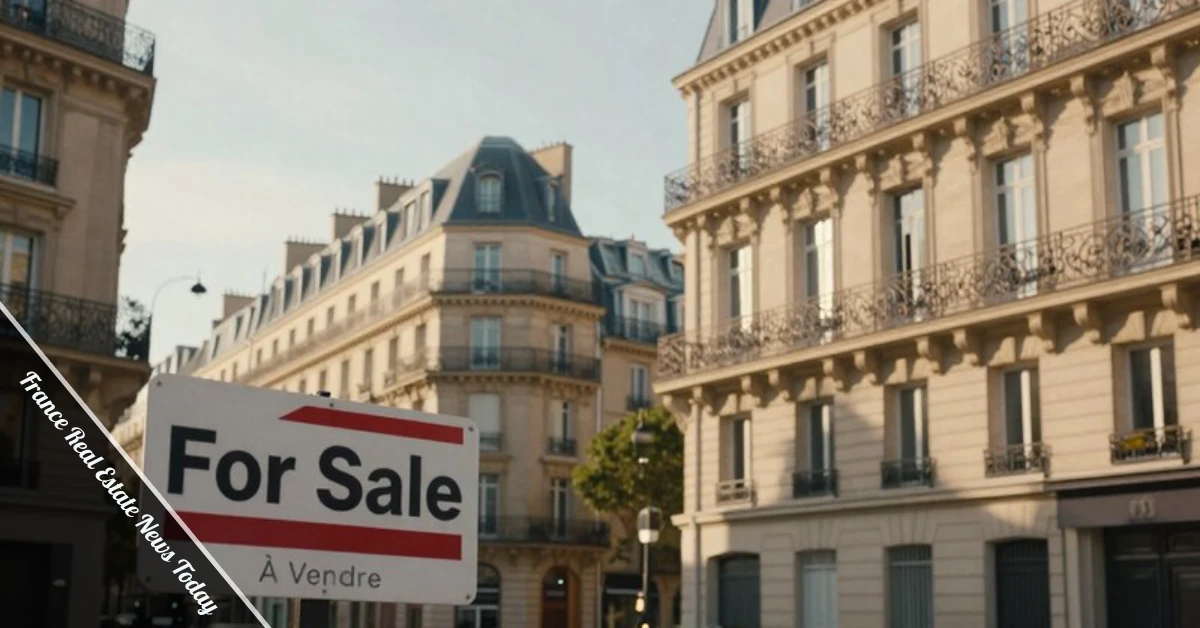
The France Real Estate News Today in 2026 shows stabilisation after two years of adjustment. Transaction volumes increased roughly 20% compared to 2025, while prices remain mostly flat, with 0% to 3% growth expected nationally. Interest rates stabilised at 3% to 3.5%, creating opportunities for buyers in regional cities.
Energy efficiency requirements continue to reshape the rental market, with G-rated properties now banned from rentals.
Market Recovery Takes Shape in Early 2026
France’s property market enters 2026 on steadier ground than recent years. After experiencing sharp declines in transaction volumes during 2023 and 2024, the market is showing measured signs of recovery.
Sales agreements rose 20% in the first half of 2025 compared to the previous year, according to French notaries (Notaires), whose recorded sale data forms the official benchmark for transaction prices. This upward trend continues into early 2026, though the pace remains cautious.
Activity improved slightly in autumn 2025 but slowed again at the end of the year. The slowdown reflects both seasonal patterns and broader uncertainty around France’s political situation and budget negotiations.
National prices show minimal movement. Residential property prices in France are expected to show flat to moderate growth of 0% to 3%, depending on region and property type. This marks a clear shift from the boom years of 2020 to 2022.
Transaction volumes remain below historical averages. Transaction activity in France sits at roughly 89% of its long-run normal level, which translates to approximately 5 to 7 months of inventory in most markets. Fnaim (the national real estate federation) reports that this inventory buildup is gradually shifting negotiation leverage toward buyers in several provincial markets.
Climate Resilience and Comfort Become Core Buyer Criteria
Beyond winter heating efficiency, summer thermal comfort has emerged as a quantifiable valuation criterion in the 2026 market. Buyer surveys and agent feedback indicate a marked shift in preferences regarding building materials and orientation.
Top-floor apartments beneath zinc roofing, historically iconic in Parisian architecture, are now frequently evaluated for heat retention during summer periods. Similarly, extensive south-facing glazing without adequate external shutters is increasingly cited as a functional drawback rather than a desirable feature.
Conversely, air conditioning systems, previously restricted by numerous co-ownership regulations in cities like Paris, are increasingly presented as value-add features in listing descriptions. Properties offering cross-ventilation, thick stone walls, or installed cooling units are demonstrating shorter marketing times compared to less climate-resilient equivalents, independent of traditional location parameters.
Current Pricing Across France’s Regions
Regional price differences remain stark across France. Paris continues to command premium prices, while provincial cities offer more accessible entry points.
In the capital, Paris 6th arrondissement commands roughly €14,000 per square meter, while Paris 19th arrondissement stays around €7,850 per square meter, showing an 80% price difference within the same city. The average across Paris stands at approximately €9,645 per square meter.
In Lyon, the market confirms its role as a structurally solid patrimonial market, with apartments trading near €4,450 per square meter and houses around €5,080 per square meter. On the French Riviera, Nice maintains prices between €5,600 and €6,000 per square meter, while the trophy market of Saint-Tropez records a median approaching €12,100 per square meter.
Entry-level buyers can find opportunities outside major cities. A realistic entry range in France in 2026 is €80,000 to €120,000, which can get you a small existing apartment of 25 to 40 square meters in regional cities like Saint-Etienne or Mulhouse.
Coastal properties maintain premium valuations. From Saint-Jean-Cap-Ferrat to Saint-Tropez, prices range from €12,000 to €25,000 per square meter. The Basque coast sees prices between €9,000 and €13,000 per square meter in towns like Biarritz and Saint-Jean-de-Luz.
For buyers with larger budgets, luxury property in the French market in 2026 is expected to pay between €1,500,000 and €5,000,000, which covers renovated apartments of 120 to 200 square meters in prime Paris arrondissements.
The gap between listing and sale prices provides negotiation room. The gap between listing prices and actual sale prices in France sits around 3% to 7%, though this varies significantly by location and property type. In cities still digesting previous peaks, such as Nantes—where prices remain down roughly 3.9% year-over-year—this gap can be more pronounced.
Interest Rates Shape Buyer Decisions
Mortgage rates remain the primary factor influencing buyer behaviour in 2026. Rates stabilised at 3% to 3.5% for qualified borrowers, a significant increase from the 1% to 1.5% rates common between 2016 and 2022.
This rate environment creates a lock-in effect. People who bought between 2016 and 2022 often borrowed at very low rates of 1% to 1.5%. Moving today would mean borrowing again at around 3% to 3.5%, with much higher monthly payments.
The European Central Bank’s stance remains crucial. With inflation largely under control, further rate increases appear unlikely. However, significant cuts also seem improbable in the near term.
Currency movements benefit international buyers. The euro remains relatively weak against the US dollar and British pound. For dollar-based investors, this offers immediate purchasing power, often the equivalent of a 5% to 10% discount compared with the pre-2020 rate environment.
Energy Efficiency Rules Reshape Rentals
Energy performance requirements continue transforming France’s rental market. G-rated properties can no longer be rented as of 2025, with F-rated properties following in 2028.
This creates clear market segmentation. According to the High Council of Notaries, a property rated G typically sells at an average price discount of approximately 12% compared to a comparable property rated D. This quantifiable gap reflects both the immediate renovation costs and the future rental restrictions buyers factor into their offers.
Notably, the DPE calculation methodology was updated on January 1, 2026. The conversion coefficient for electricity was reduced from 2.3 to 1.9. This change mechanically improves the energy ratings of numerous all-electric homes, meaning some properties previously classified as F or G may see an upgraded label without physical works, altering their marketability and valuation.
Government renovation grants remain available through 2026. The program focuses on homes rated E, F, or G, with emphasis on comprehensive improvements rather than single upgrades. Maximum grant amounts decreased compared to previous years, but subsidies can still cover 40% to 50% of renovation costs for qualifying properties.
Landlords face growing pressure to upgrade. The rental income declaration requirement, initially planned as mandatory for 2026, now remains optional after parliamentary debate. This delay provides temporary relief but doesn’t change the underlying efficiency requirements.
Investment Yields Vary by Location
Rental yields differ significantly across France’s regions. Paris typically delivers 3% to 5% gross yields, while secondary cities offer higher returns.
Five secondary towns deliver 6% to 8% rental yields, according to recent investment analysis. Towns like Albi, Valence, and Chalon-sur-Saône attract investors seeking better cash flow than coastal or capital properties provide.
Student rentals offer consistent demand. Furnished studios and one-bedroom apartments for students rent for €450 to €550 per month in university towns. These markets benefit from stable enrollment and limited supply.
Long-term rental strategies dominate in 2026. Short-term vacation rentals face increasing regulatory restrictions, particularly in Paris, Nice, and other tourist destinations. France has increasingly restricted short-term rentals, making traditional long-term leases more reliable for most investors.
Tax treatment affects net returns. Under micro-BIC, you declare 50% of rents; the other half is deductible as expenses. Apparent 8% yield equals real fiscal yield around 5%.
Tax Framework Adjustments
Two notable tax changes taking effect from July 1, 2027 warrant attention from long-term investors. First, for investment properties (excluding new builds), net rental losses will no longer be deductible against overall income tax, eliminating the negative gearing benefit currently available. Second, the 50% capital gains tax (CGT) discount on assets held for more than 12 months will be removed. However, purchasers of new-build properties may retain the previous advantageous regime, providing a potential structuring incentive for those acquiring off-plan or recently completed units.
Buyer Preferences Shift Toward Quality
The market psychology changed noticeably in 2026. Today’s buyers are asking more meaningful questions. Does the apartment work for daily life? Is the layout comfortable, not just nice in photos?
Speculation gave way to lifestyle focus. The urgency that characterised 2021 and 2022 disappeared. Buyers now take time to visit properties multiple times, consider renovation costs carefully, and imagine daily living rather than just resale potential.
Apartments in good locations, with natural light, practical layouts, and appealing neighbourhoods still attract buyers. Others, with odd layouts, high prices, or just novelty, are staying on the market longer.
This selectivity benefits quality properties while challenging marginal listings. Location, condition, and functionality matter more than timing or momentum.
American Buyer Interest Increases
US interest in French property jumped in 2025 and continues into 2026. According to platform analytics, there has been nearly a 30% increase in search interest from American buyers compared to the first half of 2024, making them a leading demographic in the foreign buyer recovery.
Currency advantage drives part of this interest. The euro’s weakness against the dollar creates favourable purchasing conditions for Americans. Combined with France’s stable legal system and lifestyle appeal, this attracts long-term investors.
American buyers typically pursue generational assets rather than speculative plays. They value France’s cultural offerings, quality of life, and position as a European base for their families.
Tax considerations remain important. Non-residency does not shield French real estate from IFI. A single high-value Paris apartment or luxury villa may be sufficient to trigger IFI exposure. The wealth tax on real estate holdings above €1.3 million affects foreign owners just as it does residents.
Commercial Real Estate Shows Resilience
France’s commercial sector demonstrates encouraging signs beyond residential properties. Office vacancy rates in Paris have stabilised at approximately 6.5% following their pandemic peaks.
Logistics properties benefit from structural trends. Industrial and logistics spaces situated near major ports such as Le Havre and Marseille are experiencing high demand due to nearshoring trends. E-commerce growth and supply chain reorganisation support stable returns.
Retail properties in tourist destinations show recovery. Prime locations along the Champs-Élysées and in Nice attract renewed interest as tourism normalises.
For institutional investors, warehouse and logistics REITs currently offer appealing yields of 7% to 9%, outperforming residential rental returns in most markets.
Outlook for Rest of 2026
Most market observers expect consolidation rather than dramatic movement through 2026. A clearer recovery could spread over 2026 to 2027, with the second half potentially showing more activity if political clarity improves.
SeLoger and Meilleurs Agents forecast approximately 960,000 transactions nationwide in 2026 versus approximately 925,000 in 2025. This represents modest growth rather than a surge.
Price movements will remain location-dependent. Rather than a broad-based rebound, price performance will be highly location-dependent. Prime urban centres and lifestyle destinations show more resilience than oversupplied suburban areas.
Construction activity stays constrained. New-build supply could remain constrained due to construction costs. This limited supply supports existing property values in tight markets but doesn’t address France’s long-term housing shortage.
The likelihood of a price crash remains low. The likelihood of a meaningful property price decline in France over the next 12 months is low to medium, with a full crash appearing unlikely. France’s limited supply, stable demand fundamentals, and disciplined lending standards provide support.
What This Means for Buyers and Sellers
Buyers hold negotiating power in most markets outside Paris and luxury coastal areas. The French property market leans toward buyers, meaning you have more negotiation room than during the boom years.
Successful buyers in 2026 come prepared with financing arranged and realistic expectations. They research regions carefully, visit properties multiple times, and avoid emotional decisions. Working with local agents and currency specialists helps navigate the process.
Sellers face a more demanding environment. Properties must be priced correctly and present well. Energy efficiency ratings matter significantly. Homes requiring major renovations need prices that account for work costs.
Well-located properties with good energy ratings still sell at reasonable prices. Marginal properties or those in oversupplied areas may sit on the market for extended periods.
Final Thoughts
France’s real estate market in 2026 rewards patience, research, and quality over speculation. The urgency and momentum of recent years disappeared, replaced by more thoughtful decision-making.
Prices stabilised rather than crashed, transaction volumes improved modestly, and regional differences widened. Energy efficiency requirements continue to reshape both rental and sales markets, while the newer emphasis on summer climate resilience introduces a fresh layer of valuation differentiation.
For international buyers, particularly Americans, favourable currency conditions and market stabilisation create opportunities. For investors, secondary cities offer better yields than Paris, though all strategies require careful analysis of the evolving tax landscape—particularly the 2027 changes to loss deductibility and capital gains treatment.
The market feels less like a race and more like a considered choice. Location quality, property condition, and long-term suitability matter more than timing. This shift toward fundamentals benefits serious buyers while challenging those seeking quick profits.
FAQs
Are property prices falling in France in 2026?
Prices remain mostly stable with minimal movement. National averages show 0% to 3% growth depending on region. Some oversupplied areas or properties with poor energy ratings see declines, but prime locations maintain values.
What are the current mortgage rates in France?
Qualified borrowers pay 3% to 3.5% for mortgages in 2026. This represents a significant increase from the 1% to 1.5% rates common between 2016 and 2022, but remains stable after the increases of 2023 and 2024.
Can you still rent properties with poor energy ratings?
G-rated properties cannot be rented as of 2025. F-rated properties will be banned from the rental market in 2028. E-rated properties face restrictions in 2034. Landlords must improve energy efficiency to continue renting.
Is now a good time to buy property in France?
Buyers have negotiating power in most markets outside Paris and luxury coastal areas. Inventory levels around 5 to 7 months provide options, and sellers show more flexibility than during the boom years. International buyers benefit from favourable currency exchange rates.
What regions offer the best rental yields?
Secondary cities like Albi, Valence, and Chalon-sur-Saône deliver 6% to 8% gross yields, significantly higher than the 3% to 5% typical in Paris. Student towns offer consistent demand, while logistics properties near ports provide 7% to 9% returns for institutional investors.