

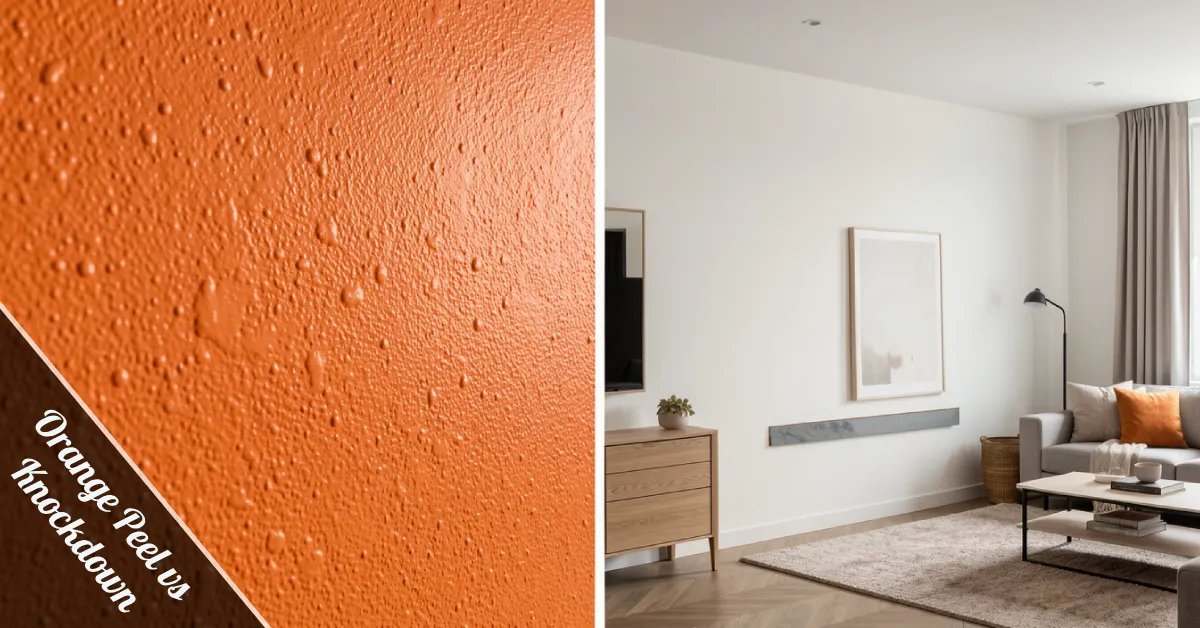
So you’re standing in front of a fresh sheet of drywall, and someone’s asking: orange peel or knockdown? It sounds like a small call — but it shapes how every room in your home feels, ages, and holds value.
Here’s the thing: this isn’t about picking the “better” texture. It’s about picking the right one for your space, budget, and how much patience you’ve got for upkeep.
In this breakdown of Orange Peel vs Knockdown, we’re cutting through the noise — appearance, cost, durability, ceiling use, and real repair situations all covered.
No filler, no fluff. Just the side-by-side truth you need before that first coat goes on.
What Is Orange Peel Texture — And Why Do So Many Homes Have It?
Orange peel is exactly what it sounds like — a wall finish with soft, rounded bumps that mimic the skin of the fruit. It’s clean, uniform, and subtle.
The application process is beginner-friendly: spray thinned joint compound onto the wall, let it dry as-is, no flattening required. That’s it.
You’ll find it everywhere — apartments, new builds, rentals, modern offices. It’s the go-to finish when you want something durable that doesn’t steal attention.
Fine, medium, and heavy variations exist depending on how much texture you want. When clients ask me how to apply orange peel texture, I tell them: the mix consistency controls the weight.
It hides minor wall flaws — nail holes, seams, small dents — without fuss. Easy to clean, easy to repaint, easy to live with.
What Is Knockdown Texture — And What Makes It Different?
Knockdown is where things get more interesting. The knockdown drywall finish starts the same way — sprayed drywall mud — but then you flatten it.
After spraying, you wait roughly 5–10 minutes until the wet shine fades. Then you drag a wide taping knife across the surface at a slight angle.
The result? Irregular flat patches, soft edges, and a streaky, stucco-like character that orange peel simply can’t match for visual depth.
Timing matters a lot here. Too wet and the texture smears. Too dry and it won’t flatten cleanly. It’s the one step that separates a pro finish from a patchy mess.
Knockdown works especially well where walls have visible flaws or where you want a warmer, more lived-in look — family rooms, older homes, ceilings with character.
Orange Peel vs Knockdown: The Side-by-Side Breakdown
The Orange Peel vs Knockdown comparison really comes down to six factors: look, coverage, cost, application, repair, and design fit. Here’s the full picture.
| Feature | Orange Peel | Knockdown |
| Look & Feel | Soft, bumpy, uniform bumps | Flat peaks, streaky, stucco-like |
| Best For | Modern homes, rentals, offices | Family rooms, older homes, ceilings |
| Hides Imperfections | Minor flaws & small dents | Major flaws & uneven drywall |
| Application Difficulty | Easy – spray & dry | Moderate – timing-sensitive |
| Cost Per Sq Ft | $1.25 – $1.95 | $1.50 – $2.00+ |
| Repair Ease | Very easy to blend | Harder to match seamlessly |
| Cleaning | Easy to wipe down | Needs regular dusting |
| Design Style | Minimalist, contemporary | Rustic, farmhouse, transitional |
Both textures are affordable and durable — but they speak very different visual languages. The right pick depends entirely on your space and style.
Orange Peel vs Knockdown Cost: Where Does the Price Gap Come From?
When homeowners ask about orange peel vs knockdown cost, the answer almost always comes back to one thing: labor.
Orange peel runs approximately $1.25–$1.95 per square foot. It’s a spray-and-done process. Fast, clean, lower labor hours.
Knockdown sits at $1.50–$2.00+ per square foot. That extra flattening step adds time, skill, and cost — especially on larger ceilings or walls with heavy flaw coverage.
Both finishes are still on the affordable end of interior renovation. Orange peel wins on budget; knockdown justifies the premium with added depth and better coverage on problem surfaces.
How Are They Applied? The Real Process Difference
Applying Orange Peel
Clean and prime the wall first. Mix joint compound to a smooth, pourable consistency — or use a ready-made spray can for smaller areas.
Spray onto the surface in light, even passes. The bumps form naturally as the compound dries. No flattening, no extra step. Just wait.
Drying is faster, painting is straightforward, and even a first-timer can get a solid result with decent prep.
Applying Knockdown
Same start: clean, prime, spray drywall mud using a hopper gun or spray can with the nozzle set for larger droplets.
Wait for the wet shine to fade — roughly 5–6 minutes. Then drag a wide, clean taping knife lightly across the raised peaks in one smooth pass.
Let it dry fully (24–48 hours), then prime and paint. The key cheat code here: don’t go back over the same spot twice. One pass. Done.
Orange Peel vs Knockdown Ceiling: Which Works Better Overhead?
Ceilings are their own beast. The orange peel vs knockdown ceiling debate has a clear logic once you understand what each finish does with light and height.
Orange peel keeps ceilings looking bright and uniform. It reflects light evenly, making rooms feel cleaner and more open — great for apartments and newer builds.
Knockdown adds more shadow and depth, which actually helps disguise imperfect ceiling drywall. Older homes, larger rooms, and vaulted ceilings handle knockdown beautifully.
On very low ceilings, heavy knockdown can feel dense. Go lighter on the texture or switch to orange peel to preserve the sense of height.
One more angle: acoustics. Both textures break up sound waves slightly compared to smooth walls, but neither replaces proper insulation for real noise control.
Orange Peel vs Knockdown vs Popcorn: Where Does the Old Stuff Land?
Bring popcorn texture into the orange peel vs knockdown vs popcorn conversation, and things get interesting — but not in a good way for popcorn.
Popcorn is the roughest of the three. It was everywhere in homes built before the 1990s, mostly on ceilings, because it was cheap and fast.
The problems: it traps dust and allergens, makes rooms feel darker, is nearly impossible to repair cleanly, and in older homes, may contain asbestos.
Both orange peel and knockdown have largely replaced it. Knockdown gives you that visual depth without the weight; orange peel gives you the clean modern finish popcorn never could.
How Easy Are Texture Repairs? This Is Where It Gets Real
Repairs are often the deciding factor. In the Orange Peel vs Knockdown matchup, Orange Peel wins this round without a contest.
For orange peel, small fixes need lightweight spackle, a sand-and-prime, and a quick re-spray. The uniform pattern blends well. Rentals love this finish for this exact reason.
Knockdown texture repairs are trickier. Matching the original irregular pattern is an art. Large repairs rarely look seamless, and drying adds 24–48 hours to any touch-up job.
If you’re a landlord, a high-traffic household, or someone who moves furniture often? Orange peel’s repairability is a genuine long-term advantage.
What Real Homeowners Say (Including Reddit)
Beyond contractor opinions, Reddit discussions on orange peel vs knockdown offer a clearer look at what people actually experience living with these textures.
One construction finisher put it plainly: knockdown hides imperfections better and adds more character — and in their daily work, orange peel is becoming less common on newer projects.
That said, homeowners in Texas, the South, and the West Coast still strongly prefer orange peel for its clean look, easy maintenance, and lower cost of touch-ups.
The truth? Neither texture is universally dominant. Regional preference, design style, and how the room gets used all play into the final call.
Conclusion: So Which One Should You Choose?
The Orange Peel vs Knockdown question doesn’t have a universal answer — but it does have the right answer for your specific situation.
Choose orange peel if you want a clean, modern look that’s easy to maintain, budget-friendly, and forgiving of repairs. Rentals, offices, and contemporary homes love it.
Go knockdown if your walls have serious flaws to hide, your space leans rustic or transitional, or you want that depth and character that flat textures just can’t deliver. Our full drywall texture guide has more detail if you’re still deciding.
Both textures are durable, affordable, and proven. The cheat code is knowing which one fits your room — not just which one looks better in photos.
FAQs: Orange Peel vs Knockdown
What’s the main difference between orange peel and knockdown texture?
Orange peel is sprayed and left to dry with small, uniform bumps. Knockdown is sprayed then flattened by hand, creating irregular flat patches with more visual depth.
Which texture is better for ceilings?
Knockdown works better on older or flawed ceilings with more coverage needed. Orange peel suits modern, lower ceilings, where a lighter, cleaner finish keeps things bright.
Is knockdown more expensive than orange peel?
Yes. Knockdown typically runs $1.50–$2.00+ per square foot versus $1.25–$1.95 for orange peel — the difference comes from the extra flattening labor step.
Is orange peel texture outdated?
Not at all. It’s still widely used across Texas, the South, and the West Coast. Smooth walls trend in major metro areas, but orange peel remains a practical, cost-effective standard in many markets.
Can you convert orange peel to knockdown?
Yes — while the texture is still fresh. Spray a heavier orange peel coat, wait until the shine fades (5–6 minutes), then flatten lightly with a wide taping knife. Timing is everything.