

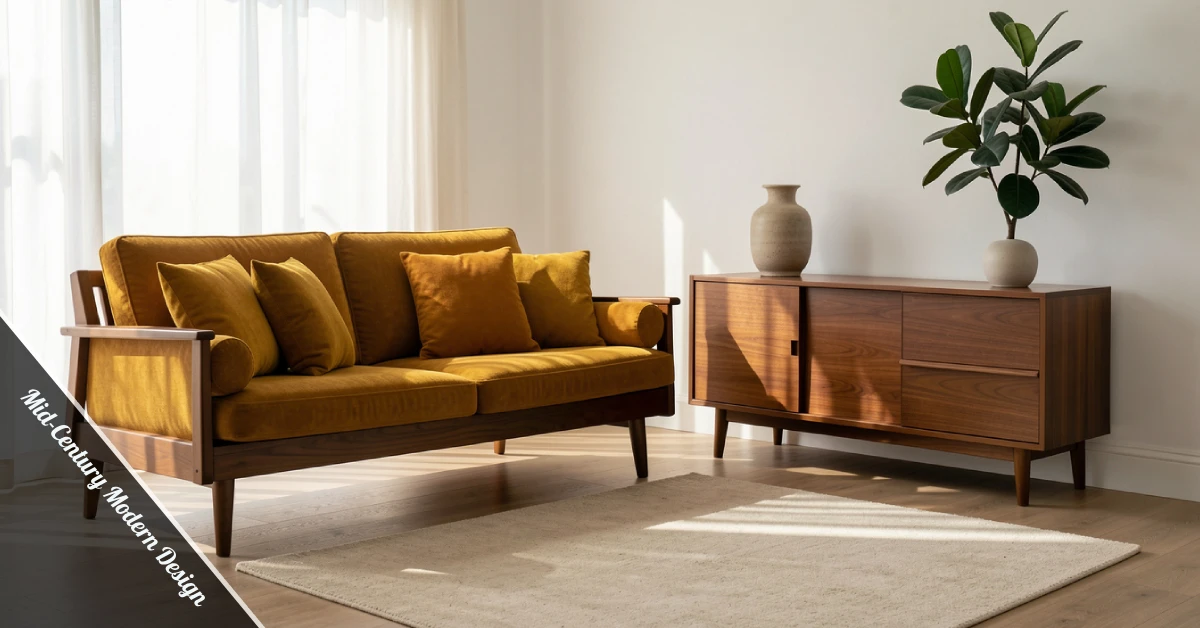
Mid-century modern design is a style that emerged between the 1940s and 1960s. It combines clean lines, organic shapes, and a strong focus on function. Key features include tapered legs, natural materials like wood and leather, and open floor plans. The style remains popular today because it works in almost any home and pairs well with both older and newer furnishings.
Why Mid-Century Modern Still Sells in 2026
Walk into any real estate listing that mentions “MCM touches,” and you will likely see higher asking prices and faster sales. That is not a coincidence.
According to a 2024 report from 1stDibs, mid-century modern is consistently the top-searched furniture style on their platform, outpacing Scandinavian and industrial styles combined. Buyers recognize the look instantly. They also trust it to age well.
The style endures because it was built around permanence. Designers of that era prioritized quality materials and functional forms over trends. That philosophy still resonates with buyers and renters who are tired of disposable furniture.
What Mid-Century Modern Design Actually Is
Mid-century modern refers to design produced roughly between 1945 and 1969. The style grew from the post-war optimism in the United States and Europe, when designers began experimenting with new materials like molded plywood, fiberglass, and plastic.
Architects and designers like Charles and Ray Eames, Eero Saarinen, and Florence Knoll led the movement. Their work focused on making well-designed furniture accessible to everyday households, not just wealthy collectors.
The term “mid-century modern” was popularized in 1984 by author Cara Greenberg in her book of the same name. Before that, most people simply called it “contemporary” or “modern.”
The Core Elements That Define the Style
If you want to identify a true mid-century modern piece, look for these characteristics:
- Clean, straight lines with gentle curves where function requires it
- Tapered or hairpin legs on furniture, keeping pieces off the floor and visually light
- Natural materials: teak, walnut, oak, leather, and wool
- Large windows and a connection between the indoor and outdoor spaces
- Minimal ornamentation; the form does the visual work
- Functional layouts with no wasted space
One hallmark that separates MCM from other styles is the “organic” shape. Designers of that era often drew from nature. The Eames Lounge Chair, for example, follows the curve of the human spine. The Tulip Chair by Saarinen mimics a flower stem.
These were not decorative choices. They were solutions to ergonomic problems. That is what makes them still relevant today.
Mid-Century Modern Colors That Actually Work
The color palette in MCM interiors is broader than most people assume. The style is not limited to white walls and walnut furniture.
Original mid-century homes often used bold, saturated colors as accents. Think olive green, mustard yellow, burnt orange, and teal. These appear on upholstery, rugs, and accent walls, while the larger surfaces stay neutral.
For walls, warm whites, soft grays, and greige tones are most common. They let the furniture and materials take center stage without competing. If you want to add a bold wall, pick one surface, usually behind a sofa or a bed, and keep everything else neutral.
The key is restraint. Choose one or two accent colors and repeat them across the room in small doses.
How to Bring Mid-Century Modern Into Your Home
You do not need to gut your home to achieve this look. A few targeted changes go a long way.
Start with furniture. One or two genuine MCM pieces, or quality reproductions, anchor the entire room. A walnut sideboard, an Eames-style chair, or a tulip-style table all read immediately as mid-century.
Next, look at your floors. Original MCM homes feature hardwood floors, often in warm tones like teak or oak. If you have carpet, consider whether an area rug in a geometric pattern could visually replace it without major renovation.
Then address your lighting. Sputnik chandeliers, arc floor lamps, and globe pendants are all period-appropriate and widely available today at various price points.
Finally, edit your accessories. MCM interiors are not cluttered. Keep surfaces clear. Display a few ceramics, a house plant, or a piece of abstract art. Less really is more with this style.
Finding Quality MCM Pieces on Any Budget
Authentic mid-century furniture can be expensive, but you have real options at every price point.
For authentic vintage pieces, check local estate sales, Facebook Marketplace, and platforms like Chairish or 1stDibs. You can often find genuine teak sideboards or walnut dressers for a fraction of retail prices if you are patient.
For licensed reproductions, brands like Article, Joybird, and Design Within Reach offer pieces made with correct proportions and quality materials. These are not knockoffs; they are reproductions made with original blueprints in many cases.
For budget options, IKEA’s LISABO and LÖVBACKEN lines carry MCM-influenced shapes at accessible prices. Pair them with vintage accessories to pull the look together without spending thousands.
Avoid cheap, fast-furniture versions with plastic legs or veneer over particle board. The proportions are almost always wrong, and they break the cohesion of the room.
Common Mistakes in Mid-Century Modern Rooms
Even well-intentioned MCM interiors miss the mark. Here are the most common errors:
- Mixing too many wood tones. MCM rooms typically use one or two consistent wood tones. Walnut and teak work together. Mixing four different finishes creates visual noise.
- Overcrowding the space. This style requires breathing room. If every surface has something on it, the room stops reading as mid-century.
- Choosing the wrong proportions. MCM furniture sits lower to the ground than contemporary pieces. If you mix a very tall modern sofa with low MCM coffee tables, the room feels off.
- Using the wrong textiles. Busy florals, heavy drapes, and thick shag rugs clash with the clean lines of MCM. Stick to wool, leather, linen, and simple geometric patterns.
- Ignoring the lighting. Many people get the furniture right and ignore the ceiling. A recessed can light setup will kill the mood of an otherwise perfect MCM room.
FAQs
What is the difference between mid-century modern and Scandinavian design?
Both styles share clean lines and a focus on function. Scandinavian design tends to be cooler in tone, using more white, light wood, and minimal color. Mid-century modern leans warmer, with darker woods like walnut and teak, and bolder accent colors. MCM also has a stronger connection to American design culture and the post-war era, specifically.
Can mid-century modern work in a small apartment?
Yes. The low profile of MCM furniture actually works well in small spaces because it keeps visual weight off the floor and makes rooms feel taller. Avoid bulky sectionals. A low sofa, a slim sideboard, and a few well-placed pieces will fill the space without crowding it.
Is mid-century modern furniture still being made?
Yes. Many original designs are still in production by licensed manufacturers. Herman Miller still produces the Eames Lounge Chair. Knoll still makes the Tulip Table. Beyond those, dozens of quality furniture brands produce MCM-inspired pieces at various price points.
How do I make mid-century modern feel current, not dated?
Mix it with contemporary elements. A clean MCM sofa pairs well with modern abstract art. Walnut furniture works alongside white concrete or terrazzo surfaces. The goal is to reference the era without recreating it wholesale. A room that feels like a museum exhibit from 1962 misses the point.
What plants work in a mid-century modern interior?
Large, architectural plants complement the style well. Fiddle leaf figs, rubber plants, snake plants, and Bird of Paradise all have the right scale and visual weight. Avoid overly delicate or ornate plants that compete with the furniture lines.