

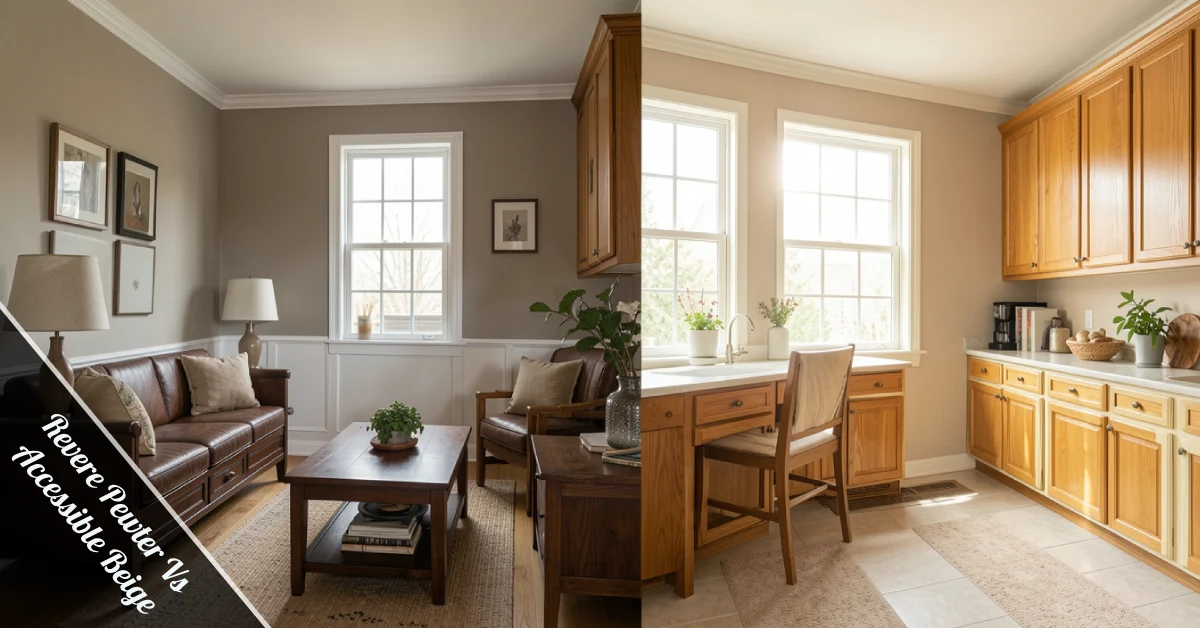
You’re standing in the paint aisle, two swatches in hand, completely frozen. Sound familiar? Picking the right greige is harder than it looks.
Both of these colors look almost identical under the store lights — and that’s exactly where the panic sets in. Trust me, you’re not alone in this.
Here’s the thing: these two popular neutrals are not the same color, wearing different brand-name tags. They behave differently on your walls, in your light, and with your furniture.
This guide breaks it all down — undertones, LRV (Light Reflectance Value), room performance, and when one clearly wins over the other.
What Is Revere Pewter? (Benjamin Moore HC-172)
Revere Pewter is a warm greige from Benjamin Moore — but calling it just “beige” sells it short. It sits right in that gray-beige middle zone.
The LRV sits around 55, which puts it firmly in mid-tone territory. It doesn’t bounce light back at you — it absorbs it.
That’s the cheat code and the catch. In bright, south-facing rooms, it looks sophisticated and expensive. In low-light spaces? It can feel heavy and a little moody.
It also carries a subtle green undertone that won’t show up on the swatch card. But once it’s on your walls and you’ve installed cream cabinets nearby, that green comes out to play.
What Is Accessible Beige? (Sherwin-Williams SW 7036)
Accessible Beige is Sherwin-Williams’ warm, soft neutral — and one of their best-selling paint colors for good reason.
Its LRV of around 58 makes it noticeably lighter and more forgiving than Revere Pewter. Three points may sound small, but your north-facing room will feel the difference.
This color is beige-forward, warm, and approachable. The gray base keeps it from looking like outdated builder beige, but beige is clearly running the show here.
It also has a green undertone, but it’s quieter and less moody about making an appearance. Most people never notice it — and that’s the point.
Revere Pewter Vs Accessible Beige: The Key Differences
Let’s get into the specifics — because “they’re both greige” doesn’t help you paint your living room.
LRV and Depth
Revere Pewter has an LRV of ~55. Accessible Beige sits at ~58. That three-point gap means Accessible Beige reflects more light, feels airier, and performs better in dim spaces.
Use Revere Pewter where you have great natural light. Give Accessible Beige the basement, the hallway, and the north-facing bedroom — it handles the dark without drama.
Undertones: The Real Drama
Revere Pewter has a warm gray base with a secondary green undertone that can surprise you. Pair it with creamy whites or warm wood, and that green gets loud.
Accessible Beige is primarily beige with a soft, muted gray base. Its green undertone is there, but it’s subtle and stays predictable across different lighting situations.
Warmth Level
Revere Pewter feels cooler because of its strong gray presence. It has warmth, but it’s the restrained, sophisticated kind — not cozy, more like a polished boutique hotel.
Accessible Beige runs warmer and softer. It’s the kind of color that makes a room feel like home immediately. Think: Sunday morning, natural light, warm coffee.
Trim Pairings
Revere Pewter loves crisp, bright whites like White Dove or Simply White by Benjamin Moore. The contrast keeps it from looking muddy.
Accessible Beige wants warm whites — Sherwin-Williams Alabaster or Greek Villa work beautifully. Creamy trims, warm wood tones, honey oak — it all flows together naturally.
Here’s a quick side-by-side breakdown:
| Attribute | Revere Pewter (BM HC-172) | Accessible Beige (SW 7036) |
| LRV | ~55 (darker, mid-tone) | ~58 (lighter, brighter) |
| Overall Tone | Greige — gray-dominant | Warm beige |
| Green Undertone | More noticeable | Very subtle, stays quiet |
| Best Lighting | South-facing, strong natural light | Forgiving in all lighting |
| Best Trim Colors | White Dove, Simply White | Alabaster, Greek Villa |
| Best With | Dark woods, cool countertops | Warm woods, cream finishes |
| Common Mistake | Low-light or north-facing rooms | Pairing with cool modern grays |
| Best Use Case | Statement neutral, well-lit spaces | Whole-house, open floor plans |
How Revere Pewter Vs Accessible Beige Looks in Different Rooms
Living Room
In a south-facing living room with large windows, Revere Pewter creates a pulled-together look that feels both modern and timeless. White trim and dark furniture? That’s the sweet spot.
In a low-light living room, it can go flat fast. Accessible Beige is the safer play here — warm, inviting, and doesn’t compete with your furniture or artwork.
Bedroom
Revere Pewter in a primary bedroom with white bedding and dark wood furniture? Feels expensive and restful. But it needs decent natural light to shine — keep that in mind.
Accessible Beige is the go-to for cozy, warm bedroom vibes. Guest rooms, kids’ rooms, primary suites — this color consistently gets positive reactions from anyone who walks in.
Kitchen
Revere Pewter is gorgeous alongside white cabinets, gray countertops, and cool backsplash tiles. It provides a neutral backdrop with real visual weight and presence.
Where it struggles is with cream or warm wood cabinets — the undertones clash. That’s when Accessible Beige steps in and does its best work alongside honey oak and butcher block.
Exterior
Revere Pewter on exteriors looks classic — especially with white trim and dark shutters on traditional or craftsman-style homes. Just check your roof color first; warm brown roofs can trigger that green undertone.
Accessible Beige on exteriors is a safe, warm neutral that coordinates with a wide range of roof colors, brick, and stone. It’s not bold — but on an exterior, that’s often exactly what you want.
Revere Pewter Vs Accessible Beige Vs Other Neutrals
Because you will inevitably start second-guessing yourself and comparing to four other colors — let’s get ahead of that.
Agreeable Gray (SW 7029) has an LRV of ~60 and sits between these two in brightness. It’s more gray-centric and reads modern — not beige-forward. Think: Revere Pewter is sophisticated greige, Accessible Beige is warm, whole-home, and Agreeable Gray is modern gray that just happens to have warmth.
Pale Oak (BM OC-20) has an LRV of ~69 — much lighter and more gray-taupe. Great if you want a barely-there neutral. Accessible Beige, by contrast, has actual warmth and presence on the wall.
Edgecomb Gray (BM HC-173) is lighter (LRV ~63) and cooler — more greige-taupe than beige. If Accessible Beige feels too warm in your space, Edgecomb Gray is worth a test.
Quick Decision Guide
Still not sure? This should make your choice easy:
| Your Situation | Best Pick |
| North-facing or low-light room | Accessible Beige |
| South-facing with big windows | Revere Pewter |
| Warm oak or honey wood cabinets | Accessible Beige |
| White cabinets, gray quartz counters | Revere Pewter |
| Whole-house open floor plan | Accessible Beige |
| Exterior with dark shutters | Revere Pewter |
| Cozy, warm bedroom vibe | Accessible Beige |
| Modern transitional living room | Revere Pewter |
So Which One Do You Actually Pick?
The right call between Revere Pewter Vs Accessible Beige depends on three things: your lighting, your existing finishes, and the feeling you want to create in the space.
Choose Revere Pewter if you have strong natural light, cool finishes like gray countertops or white cabinets, and want something sophisticated with visual weight and depth.
Choose Accessible Beige if you want a reliable whole-house neutral, have warm wood tones or cream finishes, or need a color that handles variable lighting without drama.
And here’s the most important advice in this entire article: sample both on your actual walls. Look at them in morning light, afternoon light, and under your artificial lights at night.
What looks perfect in someone else’s south-facing kitchen can look completely different in your north-facing living room. Paint is personal — trust what you see.
Final Thoughts
These two are both beautiful, versatile neutrals — and both earn their place in the best-seller category for good reasons. But they’re not the same.
Revere Pewter brings depth, gray sophistication, and a complex character that rewards good lighting. Accessible Beige delivers warmth, reliability, and that “instant cozy” quality.
Pick your light. Pick your vibe. Sample first. Then commit — because the right neutral on the right wall? That’s the ultimate design flex.
FAQs
Is Revere Pewter more gray or beige?
It’s more gray. The gray influence dominates, which is what separates it from warmer greiges like Accessible Beige. The beige is there, but the gray is running the show.
Does Accessible Beige look dated?
Not right now. Warm neutrals are having a major moment, and Accessible Beige is versatile enough that it doesn’t feel locked into any particular decade or trend.
Can I use these colors together in one home?
Technically, yes, but it’s tricky. They’re similar enough to look like a mistake rather than a contrast. If you want flow, pick one. If you want contrast, go further apart on the color spectrum.
Which color is better for resale value?
Both are crowd-pleasers. Accessible Beige edges ahead for resale because it’s more forgiving across different lighting and furniture styles — buyers can more easily imagine their own life in it.