

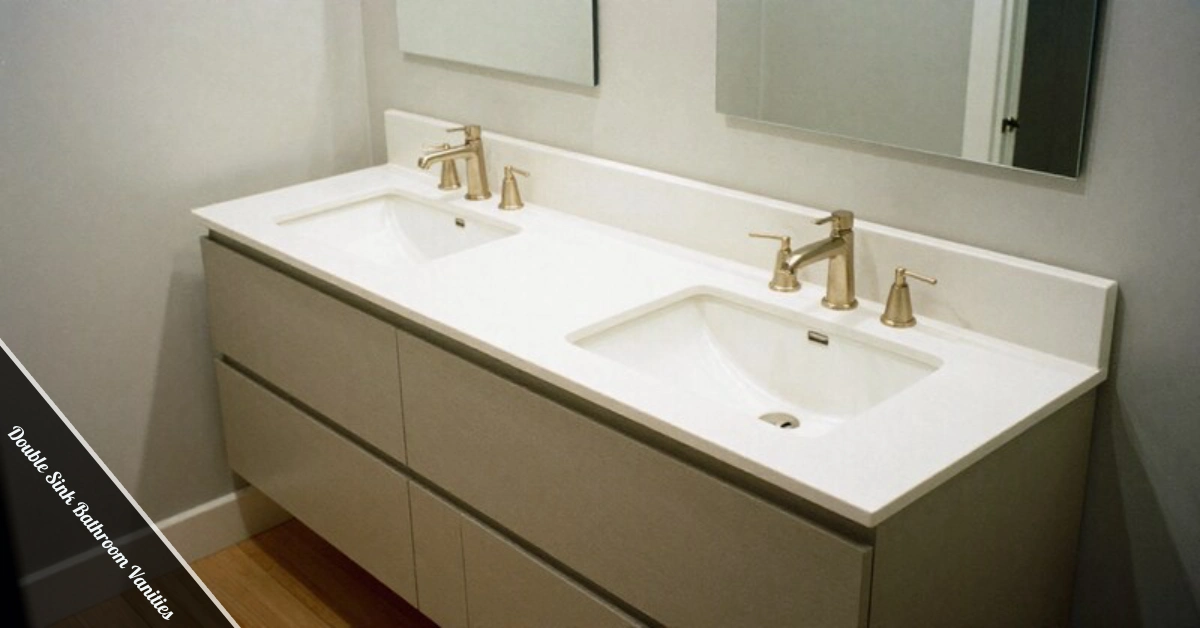
Double sink bathroom vanities range from 60 to 84 inches wide and provide separate washing stations for two people. These units combine two sinks, shared counter space, and coordinated storage in one fixture. Prices start around $800 for basic models and exceed $5,000 for premium designs with stone countertops and custom finishes.
Sharing a single sink creates bathroom bottlenecks every morning. You wait while your partner brushes teeth, applies makeup, or shaves. Double sink bathroom vanities solve this problem by giving each person dedicated space.
This guide breaks down sizes, materials, installation requirements, and cost factors. You’ll learn how to choose a vanity that fits your bathroom dimensions, matches your storage needs, and stays within budget.
Standard Dimensions for Double Sink Bathroom Vanities
Width determines whether a double vanity fits your space. Most models measure between 60 and 84 inches wide.
Common width options:
- 60 inches: fits smaller master bathrooms (minimum recommended size)
- 72 inches: provides comfortable elbow room between sinks
- 84 inches: offers maximum counter space and storage
Depth typically ranges from 20 to 24 inches. Deeper vanities hold more items but reduce floor space in narrow bathrooms.
Height standards have changed in recent years. The traditional 32-inch height gave way to 36-inch “comfort height” vanities that reduce back strain. A 2023 National Kitchen and Bath Association report found that 78% of new bathroom renovations now specify 36-inch vanities.
Measure your bathroom before shopping. You need at least 30 inches of clearance in front of the vanity for movement. Side walls should sit at least 15 inches from each sink center for comfortable use.
Materials That Affect Price and Durability
The cabinet construction determines how long your vanity survives bathroom humidity.
Solid wood costs more but resists warping when properly sealed. Maple, oak, and birch rank as top choices. Expect to pay $2,000 to $5,000 for quality wood vanities.
Plywood with veneer offers a middle ground. The layered construction handles moisture better than particle board while keeping costs between $1,200 and $3,000.
MDF (medium-density fiberboard) with laminate covers budget ranges from $800 to $1,500. These vanities work fine in powder rooms with less humidity exposure, but may swell in steamy master bathrooms.
Countertop material adds another cost layer. Cultured marble starts around $400 for a 60-inch double vanity top. Quartz runs $800 to $1,500. Natural granite or marble tops push past $2,000.
“The cabinet material matters more than most buyers realize,” says Janet Rodriguez, a certified kitchen and bath designer with 15 years of experience. “A beautiful countertop on a particle board base will fail within five years in a humid bathroom.”
Sink Basin Styles and Spacing Requirements
Basin type changes both function and maintenance.
Undermount sinks attach beneath the counter. Water and debris sweep directly into the basin without catching on a raised rim. These work best with stone or solid surface countertops.
Drop-in (self-rimming) sinks rest on top of the counter opening. Installation costs less because the rim covers rough cuts. The edge collects grime and requires extra cleaning.
Vessel sinks sit above the counter surface. They create a modern look but reduce usable counter space around each basin.
Sink spacing affects daily use. Place basin centers at least 30 inches apart. This prevents elbow bumping when two people wash simultaneously. A 60-inch vanity with 30-inch spacing leaves minimal counter space between sinks. A 72-inch model provides a more comfortable 36-inch separation.
The National Kitchen and Bath Association recommends 36 to 48 inches between sink centers for optimal comfort.
Storage Configuration and Cabinet Layouts
Storage needs vary by household. Count what you’ll store before choosing a cabinet layout.
Center drawer stacks between the sinks work well for shared items like hand towels, cotton rounds, and shared grooming tools. These typically include 2 to 4 drawers.
Side cabinets with doors provide tall storage for bottles, extra toilet paper, and cleaning supplies. Look for adjustable shelves that adapt to different bottle heights.
Pull-out organizers maximize corner space and deep cabinet areas. These cost $50 to $150 extra but prevent items from getting lost in the back.
Some vanities include electrical outlets built into drawers for hair tools. Others feature USB ports on the side panels. These upgrades add $100 to $300 to the base price but eliminate counter clutter from charging devices.
A 2024 Houzz bathroom trends study found that 64% of homeowners prioritize drawer storage over door cabinets in new vanity purchases. Drawers provide easier access and better organization for daily-use items.
Faucet Compatibility and Plumbing Considerations
Faucet holes must match your chosen fixtures. Most double sink vanities come in three configurations:
Single-hole tops require faucets where the spout and handles mount on one base. These create clean lines but limit style options.
Three-hole (widespread) tops space holes 8 inches apart. The spout and two handles install separately. This setup offers the widest range of faucet styles.
No holes work with wall-mounted or vessel sink faucets. You’ll pay extra for wall plumbing installation.
Check the faucet center measurements before ordering. Some manufacturers use metric spacing that doesn’t match standard fixtures.
“Mismatched faucet holes rank among the top three return reasons we see,” notes Marcus Chen, operations manager at a specialty bath retailer. “Measure twice before drilling anything permanent.”
Plan for plumbing access. Your wall must accommodate two drain lines and two supply lines (hot and cold for each sink). Older homes may need pipe updates to support dual fixtures. Budget $300 to $800 for plumbing modifications.
Installation Requirements and Hidden Costs
Professional installation typically runs $300 to $600 for straightforward replacements. Costs climb when you need:
Plumbing relocation: Moving drain or supply lines adds $500 to $1,200
Electrical work: Adding outlets or updating wiring costs $150 to $400
Wall reinforcement: Supporting heavy stone vanities may require $200 to $500 in structural work
Old vanity removal: Disposal and haul-away fees run $75 to $150
Wall anchoring prevents tipping. Most vanities ship with mounting brackets, but you’ll need to locate wall studs. A 72-inch vanity with a stone top weighs 300 to 400 pounds when loaded with toiletries. Drywall anchors alone won’t support this weight.
Check floor levelness before installation. Unlevel floors cause doors to swing open or prevent drawers from closing smoothly. Self-leveling compound costs $30 to $50 and fixes minor dips.
Some vanities arrive partially assembled. Others require complete assembly. Factor in 2 to 4 hours of assembly time for ready-to-assemble models.
Style Options That Match Your Bathroom Design
Cabinet finish sets the visual tone.
White painted finishes remain the most popular choice. They brighten small bathrooms and match any decor style. Expect some yellowing over 10+ years in direct sunlight.
Gray tones have gained market share since 2020. Light gray conceals water spots better than pure white. Dark gray adds drama but shows dust easily.
Natural wood stains work well in traditional and craftsman-style homes. Medium brown tones hide wear better than light or dark stains.
Matte black creates a modern appeal but requires daily wiping. Every water droplet and fingerprint shows on these surfaces.
Hardware style should match your bathroom fixtures. Brushed nickel coordinates with stainless faucets. Matte black hardware pairs with black fixtures. Chrome works with chrome faucets.
Door style ranges from flat slab (modern) to raised panel (traditional) to shaker (transitional). Your choice affects the price by $200 to $400.
Lighting and Mirror Placement Above Vanities
Task lighting prevents shadows during grooming. Plan for three light sources:
Overhead lighting provides general illumination but casts shadows under the eyes and the chin.
Side sconces mounted at eye level (66 to 70 inches from the floor) eliminate shadows. Place them 36 to 40 inches apart for a 72-inch vanity.
Mirror lighting adds focused brightness. LED strips around mirrors or backlit mirrors improve visibility.
The Illuminating Engineering Society recommends 50 to 75 foot-candles of light at the countertop for bathroom tasks. Most single overhead fixtures provide only 20 to 30 foot-candles.
Mirror width should span 70% to 80% of the vanity width. A 72-inch vanity pairs well with a 54 to 60-inch mirror. You can use one large mirror or two separate mirrors (one per sink).
Mount mirrors 3 to 5 inches above the backsplash. The center should align at eye level for primary users (typically 60 to 65 inches from the floor).
Price Ranges and Value Considerations
Budget allocation depends on quality expectations and room priorities.
Entry level ($800 to $1,500): MDF construction, cultured marble tops, basic hardware. These vanities last 5 to 7 years with normal use.
Mid-range ($1,500 to $3,000): Plywood or solid wood frames, quartz or engineered stone tops, soft-close hinges. Expect 10 to 15 years of service.
Premium ($3,000 to $7,000+): Solid hardwood, natural stone tops, custom finishes, built-in organizers. These pieces last 20+ years.
Price per square inch varies widely. Compare based on materials, not just dimensions. An $1,800 vanity with solid wood construction beats a $2,200 particle board unit.
Watch for hidden costs:
- Faucets (not always included): $150 to $600 per sink
- Mirrors: $100 to $800
- Installation: $300 to $600
- Backsplash: $50 to $300
Some retailers bundle these components. Others sell them separately. Calculate the total project cost before committing.
Maintenance Requirements for Long-Term Performance
Daily care prevents expensive repairs.
Wipe water splashes immediately. Standing water damages any wood finish over time. Keep a microfiber cloth near each sink.
Clean with pH-neutral products. Harsh chemicals strip protective sealants from wood and stone surfaces. Avoid ammonia-based glass cleaners on countertops.
Check under the sink monthly for leaks. Small drips cause mold growth and wood rot before you notice visible damage. Catch them early.
Tighten hardware annually. Drawer pulls and door handles loosen with repeated use. A quick check with a screwdriver prevents bigger problems.
Reseal natural stone countertops every 1 to 2 years. Water absorption test: drop water on the surface. If it darkens the stone within 10 minutes, apply new sealer.
“The vanities we see lasting 20+ years all receive consistent basic maintenance,” reports Sarah Mitchell, a licensed contractor who specializes in bathroom remodels. “The ones that fail early often show signs of neglected water damage.”
Final Thoughts
Double sink bathroom vanities transform morning routines from frustrating to functional. The right size, material, and storage configuration depends on your space, budget, and household needs.
Start with accurate measurements. Choose materials that match your bathroom’s humidity level. Plan for total project costs, including faucets, installation, and accessories.
A well-chosen double vanity serves your household for 15 to 20 years. The upfront investment pays returns every morning when two people prepare for their day without waiting for sink access.
FAQs
Does your bathroom meet minimum size requirements?
You need at least 96 inches of wall width for a 72-inch vanity (allows 12 inches of clearance on each side). Measure existing space carefully.
Will your plumbing support two sinks?
Older homes may need pipe upgrades. Consult a plumber before ordering if your current vanity has one sink.
What’s your actual storage need?
Count bottles, tools, and products you’ll store. Match cabinet capacity to real requirements.
Do faucets come included?
Many vanities ship without faucets. Budget an extra $300 to $1,200 for two faucet sets.
What’s the return policy for large items?
Shipping costs for returns often exceed $300. Verify measurements match your space before ordering.