

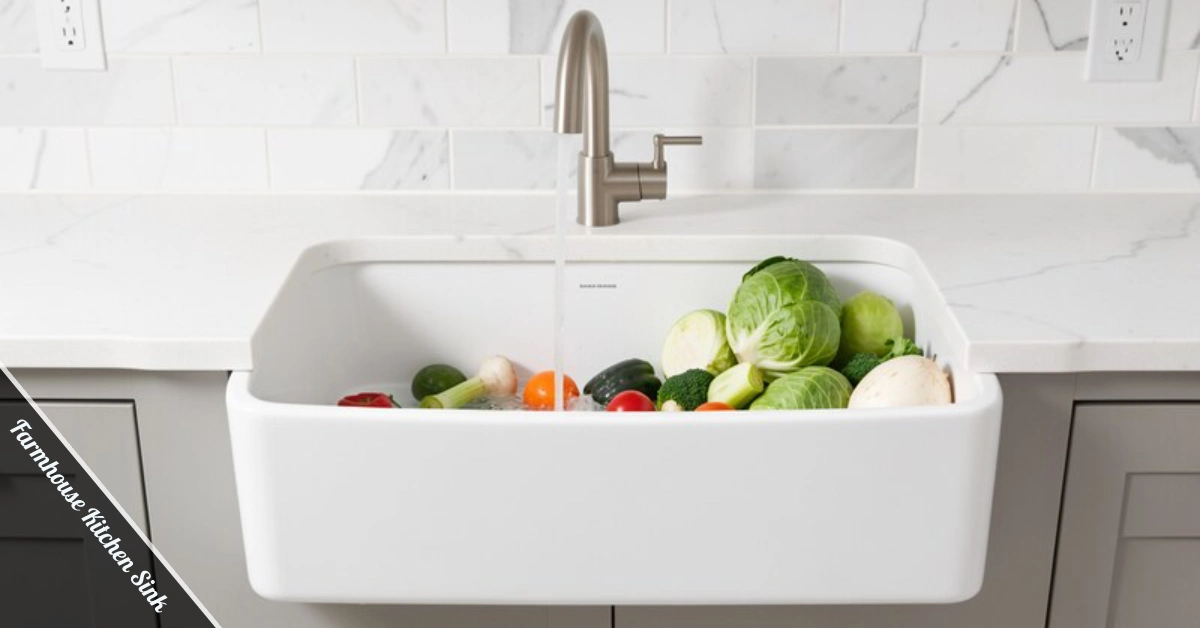
A farmhouse kitchen sink features an exposed apron front that extends beyond your cabinets, offering a deep basin (typically 8-10 inches) for oversized cookware and easier access. Available in fireclay, stainless steel, composite granite, copper, and stone materials, these sinks require specific cabinet modifications and cost between $400-$3,000 depending on material and size.
What Makes a Farmhouse Sink Different
Your standard undermount sink sits below the counter. A farmhouse sink pushes forward. The apron front eliminates the cabinet face between you and the basin. This design cuts 6-8 inches from your reach distance when washing dishes or prepping food.
The basin depth typically ranges from 8 to 10 inches. Compare that to standard sinks at 6-7 inches. You can fit full sheet pans flat. Large stockpots don’t tip. Roasting pans slide in without angling.
Cabinet modification becomes mandatory. Most farmhouse sinks need a minimum 30-36 inch base cabinet with the front rail removed. The apron sits where your cabinet door would normally mount.
Choosing Your Material: What Actually Matters
Fireclay: The Classic Choice
Fireclay dominates the farmhouse sink market for good reason. Manufacturers fire clay at 1600°F, creating a glazed ceramic surface that resists chips, stains, and scratches.
The material remains popular for its glossy finish and long-lasting durability. White fireclay sinks retail between $500-$1,200 for standard 30-33 inch models. Premium brands like BOCCHI and Latoscana offer reversible fronts (smooth or fluted patterns) at $600-$900.
Drawbacks exist. Fireclay weighs 80-120 pounds. Your cabinets need reinforcement. Drop a cast-iron skillet? The pot might chip before the sink does, but the noise carries through your entire kitchen.
Stainless Steel: The Workhorse
Stainless steel coordinates with most appliance suites and requires minimal maintenance. Commercial kitchens choose this material because it handles abuse.
Look for a 16-gauge thickness minimum. Cheaper 18-gauge models dent more easily and sound hollow. Quality stainless farmhouse sinks cost $400-$800. Premium 14-gauge options with sound-dampening pads run $900-$1,400.
The finish shows water spots. You’ll wipe it down daily. Scratches develop over time but blend into a uniform patina. Some homeowners love this lived-in look. Others find it frustrating.
Granite Composite: The Modern Alternative
Composite quartz and matte granite surfaces continue gaining popularity as homeowners move away from high-gloss finishes requiring constant wiping. These sinks blend 80% crushed granite with 20% acrylic resin.
Colors range from classic white and black to warm grays and earth tones. The matte texture hides water spots and minor scratches. Prices sit between $600-$1,100 for 30-33 inch single basin models.
Heat resistance reaches 535°F. Drop a hot pan directly from the oven? No problem. The material won’t crack or discolor. Weight matches fireclay at 70-100 pounds, requiring similar cabinet support.
Copper and Stone: The Statement Pieces
Farmhouse sinks now feature bold metallic aprons in hammered copper, brushed brass, and textured matte black finishes. These create visual depth through texture and patina development.
Copper sinks start at $1,200 and climb to $3,500 for hand-hammered artisan pieces. The metal develops a natural patina over time. Some manufacturers apply wax coatings to slow this process, but most copper enthusiasts embrace the changing finish.
Natural stone options from companies like Stone Forest offer granite, marble, and basalt in prices ranging from $2,000-$4,500. Each sink gets hand-carved, making every piece unique. The weight exceeds 150 pounds, demanding professional installation with reinforced cabinetry.
Installation Types: Matching Your Setup
Apron Front (Traditional)
The classic installation. Your sink’s front face extends to the cabinet edge. The sides mount flush to your countertop material. This method requires custom cabinet work – removing the front rail and possibly adding support brackets.
Professional installation costs $300-$600 beyond the sink price. Your countertop fabricator cuts the opening. Your plumber handles the connections. Your cabinet maker reinforces the base structure.
Retrofit Systems
Want the farmhouse look without cabinet demolition? Retrofit sinks include a thick front lip that sits on top of your existing cabinet face. The installation matches standard undermount methods.
Companies like BOCCHI and Ruvati offer retrofit models starting at $550. You save $200-$400 in installation costs. The trade-off? The sink sits slightly higher, changing your ergonomic angle by 1-2 inches.
Drop-In Farmhouse
The least common but easiest installation. These sinks drop into your countertop opening with a visible rim. No cabinet modifications needed.
Limited selection exists. Most manufacturers focus on undermount and apron styles. Drop-in farmhouse sinks typically cost $450-$750 and work best for rental properties or temporary solutions.
Size Specifications That Matter
Width: 30 vs 33 vs 36 Inches
A 30-inch sink fits standard 30-inch base cabinets, but feels cramped for families cooking multiple dishes. This size works for small kitchens, secondary prep sinks, or single-person households.
The 33-inch model dominates sales. It accommodates standard cookie sheets (18×13 inches) and full-size cutting boards. Most base cabinets measure 33-36 inches, making this the safest retrofit option.
Choose 36 inches when your layout allows. You gain workspace for washing large roasting pans and multiple cutting boards simultaneously. Expect to pay 15-20% more than comparable 33-inch models.
Depth: Finding Your Basin Sweet Spot
Standard depth runs 8-10 inches from the bottom to the rim. Shallow 7-inch models exist, but defeat the purpose of a farmhouse sink. You want that deep basin for soaking large items.
Modern farmhouse sinks are larger, deeper, and more integrated with prep areas. Some workstation models reach 11 inches deep, accommodating built-in cutting boards, drying racks, and colanders on sliding ledges.
Test your ergonomics before buying. Stand at your current counter height. Reach down 8 inches. Does your back feel strained? Taller users (6’2″+) sometimes prefer 9-inch depths to minimize bending.
Bowl Configuration: Single vs Double
Single bowls offer uninterrupted space. You can lay a full sheet pan flat. Oversized stock pots fit without juggling. This configuration suits serious home cooks who wash larger items frequently.
Double bowls split the space 50/50 or 60/40. The division lets you soak dishes on one side while using the other for prep. Families with multiple cooks appreciate the separation.
Low-divide double bowls bridge both approaches. A 5-inch divider separates the space but allows oversized items to span both sides. Expect to pay $100-$200 more than standard single bowls.
The Workstation Sink Revolution
Workstation models include fitted accessories such as cutting boards, drying racks, or colanders that slide over the basin on built-in ledges. This design transforms your sink from a cleaning station into a complete prep zone.
BOCCHI’s Contempo line ($550-$900) includes integrated ledges, a bamboo cutting board, stainless grid, and colander. The accessories stack when not in use.
Ruvati’s workstation series ($650-$1,200) adds knife holders and soap dispensers that mount directly to the sink walls. Commercial kitchens use this layout to maximize limited counter space.
The downside? Accessories need regular cleaning. Food particles collect in the ledge grooves. The extra components add $150-$300 to replacement costs if pieces break or warp.
Cabinet Requirements: The Hidden Costs
Your sink specification sheet lists the minimum cabinet size. Most 33-inch farmhouse sinks need a 36-inch base cabinet. The extra 3 inches provides clearance for the bowl walls and mounting hardware.
Cabinet reinforcement costs $200-$500, depending on your existing structure. Wood frame cabinets need additional cross-bracing. The installer removes your cabinet’s front rail (if present) and adds vertical supports on both sides.
Countertop modifications add another $100-$300. Your fabricator cuts a precise opening and finishes the edge. Granite and quartz require specialized diamond blades. Laminate counters sometimes crack during farmhouse sink installation.
Total installation budget: Sink price + $500-$1,200 for professional setup. DIY installation saves money but risks voiding warranties if cabinet support proves inadequate.
Maintenance Reality Check
Fireclay requires minimal care. Daily wiping with soap and water maintains the glaze. Avoid abrasive cleaners – they dull the finish over time. Tough stains respond to baking soda paste left for 15 minutes.
Stainless steel demands more attention. Water spots appear after every use. Brushed finishes resist visual clutter from light scuffs. Weekly cleaning with stainless steel polish prevents mineral buildup.
Granite composite forgives neglect. The matte surface hides watermarks and food stains. Monthly deep cleaning with a 50/50 vinegar solution removes any residue. Avoid bleach – it can fade darker colors over several years.
Copper develops patina naturally. Some owners apply beeswax monthly to slow this process. Others embrace the color changes. The metal has natural antimicrobial properties, reducing bacterial growth.
Popular Color Trends for 2026
Deep earthy greens, creamy whites, and moody charcoals are replacing the bright whites of years past. Sink manufacturers now offer fireclay in sage green, warm gray, and matte black finishes.
White still dominates sales at 65% of all farmhouse sink purchases. The color pairs with any cabinet style and countertop material. Resale value remains strong – neutral sinks appeal to broader buyer pools.
Matte black gained 12% market share from 2024 to 2025. The moody kitchen trend features matte black cabinetry with warm brass hardware for contrast. Black fireclay sinks from BOCCHI, and Karran cost $50-$100 more than white equivalents.
Custom colors (navy, blush pink, terracotta) exist but add 25-40% to base prices. Lead times extend 4-6 weeks for special orders. Consider resale impact – bold colors limit your buyer pool.
What Professionals Actually Recommend
Kitchen designers emphasize measuring twice. “Clients see a beautiful 36-inch farmhouse sink on Instagram and assume it will fit their 33-inch cabinet,” explains Sarah Martinez, a certified kitchen designer in Austin. “The disappointment costs them weeks in project delays.”
Plumbers prefer stainless steel for maintenance simplicity. “Fireclay looks gorgeous until someone drops a heavy pot at the wrong angle,” notes Mike Thompson, a master plumber with 20 years of experience. “We see more chips with DIY installations where cabinet support wasn’t adequate.”
Cabinet makers stress professional measurement. “That 1/4-inch discrepancy between the sink spec sheet and actual cabinet opening? That’s the difference between a perfect fit and a $500 countertop replacement,” warns Jennifer Liu, a custom cabinet builder in Seattle.
Common Installation Mistakes
Inadequate cabinet support. Fireclay and composite sinks weigh 80-120 pounds empty. Add 15-20 pounds of water during use. Insufficient bracing causes cabinet sagging within 6-12 months.
Wrong apron height. Standard apron fronts measure 8-10 inches tall. Your dishwasher door needs clearance to open. Measure the gap between your cabinet bottom and floor before ordering.
Mismatched drain placement. Farmhouse sinks position drains toward the rear (more common) or centered. Check your plumbing location before purchasing. Relocating drain lines costs $300-$800.
Countertop overhang issues. The apron extends forward, but your countertop edge might not align properly. Work with your fabricator to ensure clean sight lines.
Price Breakdown by Material and Size
- 30-inch fireclay: $450-$800 (BOCCHI, Latoscana, Nantucket)
- 33-inch fireclay: $550-$1,100 (includes reversible fronts)
- 36-inch fireclay: $700-$1,400
- 30-inch stainless: $350-$700 (16-gauge standard)
- 33-inch stainless: $450-$900 (with sound dampening)
- 36-inch stainless: $550-$1,200
- 30-inch composite: $500-$900
- 33-inch composite: $600-$1,100
- 36-inch composite: $700-$1,300
- Copper (all sizes): $1,200-$3,500
- Natural stone: $2,000-$4,500
Workstation accessories add $150-$400 to any base price.
Where to Buy and What to Avoid
Authorized dealers offer better warranties than third-party sellers. Companies like The Sink Boutique and Vintage Tub provide manufacturer support and installation guidance.
Amazon and Wayfair list competitive prices, but customer service varies. Read installation reviews, not just appearance ratings. A sink rated 4.5 stars for looks might have 2-star reviews for fit and finish quality.
Sales grew 17% from February to June 2024, but negative reviews cite fit issues and assembly challenges. Verify return policies before purchasing. Restocking fees range from 15-25% on large sinks.
Local showrooms let you see actual finishes. Photos misrepresent color depth, especially for white fireclay. What looks pure white online might appear cream or ivory in your kitchen lighting.
Making Your Final Decision
Consider your cooking style first. Daily dishwashing for a family of four? Choose durable stainless or composite. Weekend entertainers who hand-wash serving platters? Fireclay offers depth and a classic look.
Budget realistically. A $600 sink becomes a $1,200 project after installation, cabinet modifications, and countertop work. Factor these costs into your kitchen renovation timeline.
Test ergonomics if possible. Visit a showroom. Stand at a farmhouse sink display. Reach into the basin. Does the height feel comfortable? Would you want to wash dishes here every day?
Match your aesthetic but prioritize function. A gorgeous copper sink that shows every water spot might frustrate you within months. Choose materials that fit your maintenance tolerance.
Final Thoughts
Farmhouse sinks deliver practical benefits beyond their aesthetic appeal. The forward-mounted basin reduces back strain. The deep bowl handles oversized cookware that standard sinks can’t accommodate. Quality materials last for decades with minimal maintenance.
Choose based on your actual cooking habits, not just Pinterest inspiration. A $2,000 copper sink makes sense for design enthusiasts who maintain their finishes. Budget-conscious renovators find equal function in $600 composite models.
Installation matters more than most homeowners realize. Proper cabinet support prevents costly repairs later. Accurate measurements avoid expensive countertop replacements. Hire experienced installers or verify your DIY skills match the project complexity.
The right farmhouse sink transforms your kitchen workflow. The wrong choice becomes an expensive lesson in buyer’s research.
FAQs
Can I install a farmhouse sink in existing cabinets?
Yes, with modifications. Retrofit models simplify installation by mounting like standard undermount sinks. Traditional apron-front styles require removing the cabinet’s front rail and adding support brackets. Budget $400-$800 for professional cabinet modification.
Do farmhouse sinks scratch easily?
Material determines scratch resistance. Fireclay and composite granite resist scratches better than stainless steel. Copper shows scratches but develops patina that disguises marks over time. Use sink grids to protect the bottom surface regardless of material.
Why are farmhouse sinks so expensive?
Manufacturing complexity drives costs up. The exposed apron requires precise molding and finishing on all four sides. Standard sinks only finish the top rim. Premium materials like hand-hammered copper and natural stone add labor costs. Quality 16-gauge stainless steel costs more than thin 18-gauge alternatives.
How much weight can a farmhouse sink hold?
The sink itself holds substantial weight – most support 200+ pounds when properly installed. Your cabinet structure determines overall capacity. Reinforced bases handle 80-120 pound sinks plus 40-50 pounds of water and dishes without sagging. Professional installation ensures adequate support.
What faucet works best with farmhouse sinks?
Choose faucets with extended spouts (8-10 inch reach) to cover the entire basin. Wall-mount and deck-mount styles both work. Single-hole faucets offer cleaner aesthetics. Commercial-style pull-down models provide flexibility for large items. Verify your sink has pre-drilled faucet holes, or plan deck mounting separately.