

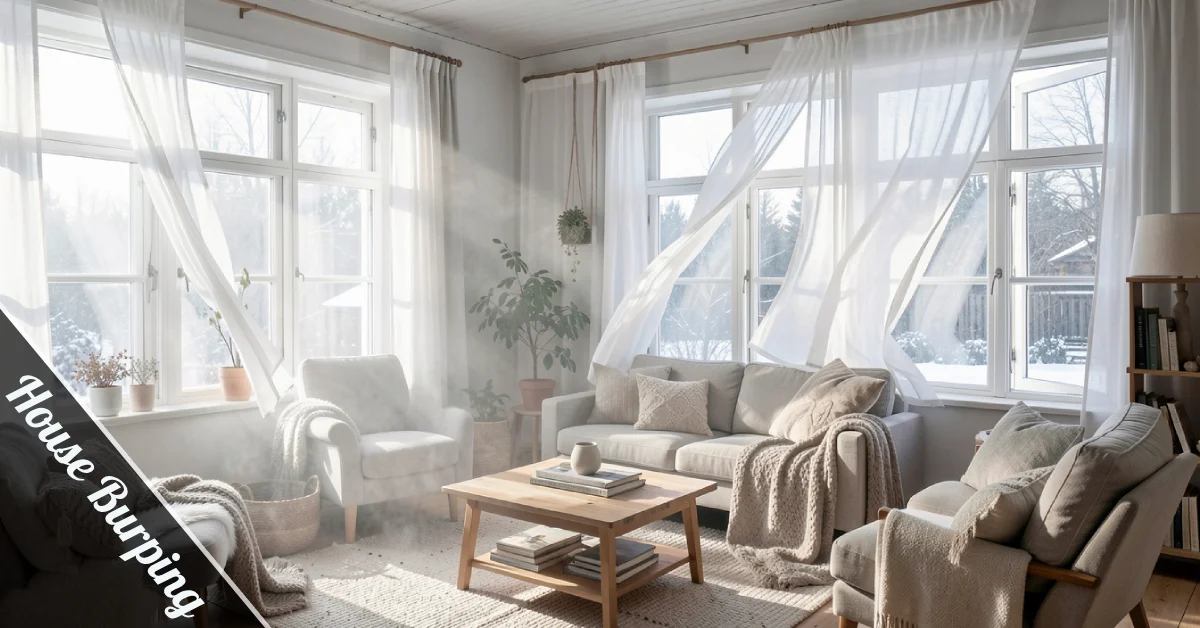
You’ve probably heard about house burping on TikTok and thought, “Wait, my house needs to what now?” Don’t worry—your home didn’t just get drenched in a fizzy drink. This is actually a legit wellness trend that’s been hiding in plain sight for decades, and it might be the simplest upgrade you make all winter.
House burping is basically cracking your windows wide open for 5-10 minutes to flush out stale, funky indoor air and bring in fresh oxygen. Sounds counterintuitive when it’s freezing outside, right? But here’s the thing: Germans have been doing this forever. They call it lüften, which translates to “airing out,” and it’s as normal as morning coffee over there.
The practice exploded during COVID when ventilation became a big deal for reducing airborne nasties. Now, with everyone spending roughly 90% of their time indoors according to the Environmental Protection Agency, this old-school move is getting a fresh look. Let’s break down why opening your windows in January isn’t as crazy as it sounds.
What Is House Burping?
House burping is the trendy American name for a German ventilation ritual that’s been around forever. Instead of letting your home marinate in yesterday’s cooking smells, pet dander, and whatever else is floating around, you throw open the windows for a quick air exchange. It’s not about leaving them cracked all day—you’re going for a fast, intentional blast of fresh air.
The German approach has two main techniques that actually matter. Impact ventilation means opening a window wide for at least five minutes, usually morning and evening, to rapidly swap indoor and outdoor air. Cross-ventilation takes it up a notch by opening windows on opposite sides of your home so fresh air flows through while pushing stale air out the other side.
Consumer Reports backs this up, noting that even five minutes a day in winter can improve indoor air quality by decreasing pollutant concentrations. Your home isn’t designed to be a sealed terrarium, despite what modern construction tries to do.
This isn’t just a wellness influencer thing. Former German Chancellor Angela Merkel called ventilation one of the cheapest and most effective ways to contain COVID-19 spread, as reported by The Guardian. The CDC echoed that guidance, emphasizing how better ventilation reduces virus particles indoors.
Does House Burping Actually Work?
Short answer: yeah, it does. Indoor air—especially in well-sealed modern homes—accumulates carbon dioxide, volatile organic compounds, and other pollutants you don’t want camping out in your lungs. Your house is basically recycling the same air over and over, and that gets gross fast.
A study published in Building and Environment links poor bedroom air quality directly to worse sleep quality. When you open windows or doors during sleep, CO2 levels drop significantly, and people sleep better. Better sleep means stronger immunity, lower obesity risk, sharper next-day brain function, and fewer workplace accidents.
Research in Eng shows natural ventilation helps reduce airborne disease transmission and lowers concentrations of harmful chemical compounds indoors. You’re not just swapping out smells—you’re actually diluting the concentration of stuff that can mess with your health. Tony Abate, chief technology officer for AtmosAir Solutions, told TODAY that bringing in outdoor air prevents mold, contaminants, and carbon dioxide buildup.
The cooler air might also soothe your nasal lining, creating the sensation of easier breathing even when air quality improvements are modest. It’s like that crisp feeling you get stepping outside on a cold morning—except you’re bringing it inside without leaving your house.
How to Burp Your House Properly
Here’s the move, and it’s stupid simple. Open windows on opposite sides of your home to create that cross-ventilation flow. Let the air blast through for 5-10 minutes—set a timer if you need to. Do this first thing in the morning, after cooking anything remotely fragrant, and after showers when humidity spikes.
That’s it. You just gave your home a reset button. Your kitchen stops smelling like yesterday’s garlic situation, and your bedroom feels less like a sealed container of human decisions.
For larger homes, you can level this up with a strategic game plan. Put one fan upstairs blowing out since warm and stale air rises naturally. Place another fan on the main floor, blowing out on the opposite side if possible. Leave a few inlet windows cracked on the other side to pull fresh air through.
For a 10,000 square foot home, assume 30-60 minutes for a solid whole-house refresh with decent airflow. If you’re doing it intentionally with fans and cross-ventilation, you can cut that to 15-30 minutes. Smaller homes? Five to ten minutes does the job perfectly fine.
The best times to house burp are when humidity and pollutants naturally spike. Morning routines, post-cooking sessions, after showers, and following social gatherings are prime windows. Lucie Rauschnabel, who grew up in New York with German parents, explained to TODAY that lüften is so integrated into the German lifestyle that it’s practically automatic.
House Burping Benefits for Sleep and Health
High-quality sleep is where this practice really pays off. When CO2 builds up in sealed bedrooms overnight, your sleep quality tanks. You might not notice it consciously, but your body does—waking up groggy, feeling unrested, struggling to focus.
Opening windows before bed or first thing in the morning resets that equation. Lower carbon dioxide levels mean your brain gets the oxygen it needs for proper rest cycles. Better sleep strengthens your immune system, reduces chronic disease risk, and improves cognitive performance the next day.
Beyond sleep, you’re reducing your exposure to volatile organic compounds from cleaning products, furniture off-gassing, and cooking emissions. These compounds accumulate in sealed homes and can irritate respiratory systems over time. A quick ventilation session dilutes these concentrations without requiring fancy air purifiers or HVAC upgrades.
The practice also tackles humidity issues that lead to mold growth. After cooking or showering, moisture hangs in the air and eventually condenses on cool surfaces. Opening windows allows that humidity to escape before it becomes a breeding ground for mold spores.
Americans spend about 90% of their time indoors, according to the Environmental Protection Agency. That means the quality of your indoor air directly impacts your health more than outdoor pollution for most people. House burping is a zero-cost intervention that addresses this reality head-on.
Are There Downsides to House Burping?
Let’s be real—opening windows in winter creates an air leak that forces your heating system to work harder temporarily. The good news? Brief ventilation sessions won’t wreck your heating bill. We’re talking 10 minutes max, not leaving windows open all day like you’re trying to air-condition the outdoors.
Placement matters here. Avoid opening windows right next to your thermostat, or your heating system will kick into overdrive, thinking the whole house is freezing. Strategic window selection keeps the temperature impact minimal while still getting the air exchange you need.
Outdoor conditions should factor into your decision, too. If local air quality is poor due to pollution or wildfire smoke, it’s smarter to wait for conditions to improve. You’re not helping anyone by bringing in air that’s worse than what’s already inside.
A 2021 study suggested lüften might negatively impact energy efficiency in Germany, which matters given how electricity costs have spiked. But the trade-off is context-dependent—if you’re in a well-insulated home with decent outdoor air, the health benefits outweigh a negligible bump in heating costs.
Tony Abate’s advice is simple: 10 minutes, no more than that is really necessary. You’re going for an air exchange, not trying to match indoor and outdoor temperatures. Quick bursts refresh your home without freezing it and may help you sleep more easily at night.
The German Practice Behind the Trend: Lüften
Germans don’t call this a “trend”—they call it common sense. Lüften has been part of German culture for generations, routinely practiced first thing in the morning, after cooking, following showers, and after social gatherings to clear moisture, odors, and built-up pollutants.
The Washington Post reports that some German leases include clauses requiring tenants to open their windows several times a day. German windows are even designed with specialized hinges that tilt or swing open multiple ways to help fine-tune airflow. This isn’t an afterthought—it’s engineered into their living spaces.
The practice gained global attention during the COVID-19 pandemic when ventilating rooms became part of Germany’s public health strategy. While Americans were panic-buying air purifiers, Germans were just… opening windows. Former Chancellor Angela Merkel’s endorsement brought scientific credibility to something they’d been doing all along.
Lucie Rauschnabel, raised by German parents in New York, told TODAY her parents thought it was hilarious that house burping is trending now. It’s just something so integrated into German lifestyle and so normalized that watching Americans discover it feels like watching someone invent the wheel.
The cultural difference is striking. Americans seal homes tightly for energy efficiency and rely on mechanical ventilation systems. Germans prioritize fresh air circulation, even if it slightly increases heating costs. Both approaches have merit, but the German method is simpler, cheaper, and doesn’t require maintenance contracts.
Conclusion
House burping isn’t rocket science—it’s just intentional ventilation with a catchy name. Five to ten minutes of fresh air can reset your indoor environment, improve sleep quality, and reduce pollutant concentrations without complicated equipment or recurring costs. Germans have been doing this forever because it works, not because it’s trendy.
Try it tomorrow morning. Open windows on opposite ends of your home, let the air flow for 10 minutes, and see how different your space feels. Your lungs will thank you, your sleep might improve, and your kitchen won’t smell like last night’s dinner. Sometimes the old-school moves are still the best ones.