

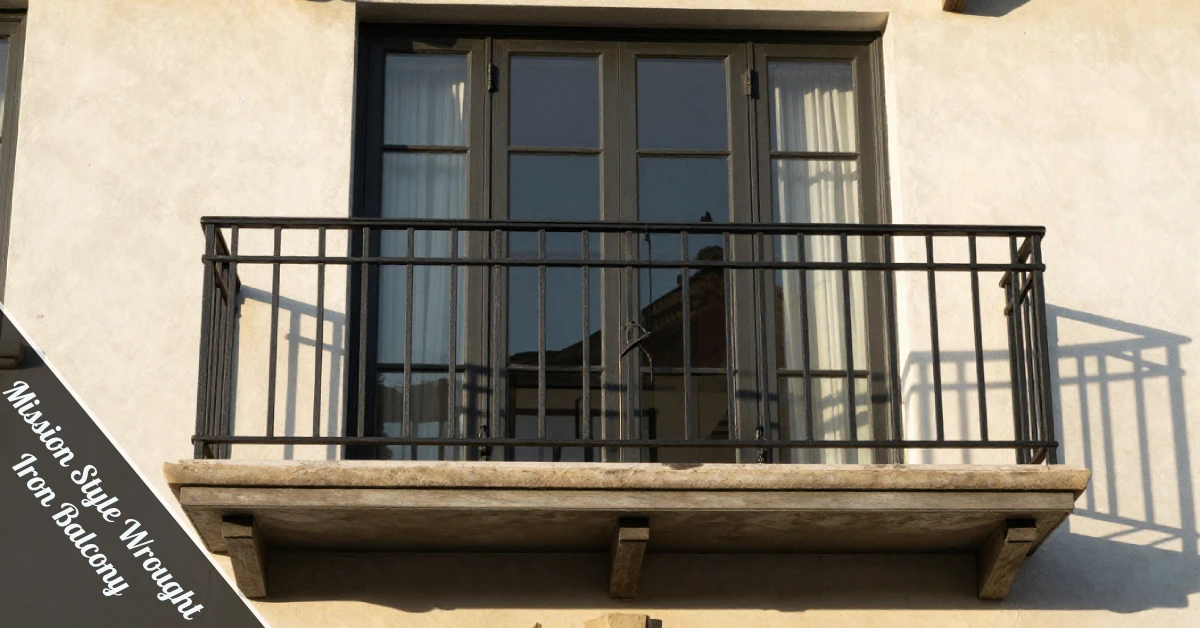
Your home’s exterior tells a story before anyone even knocks on the door. And if that story feels a little flat right now, the right balcony railing can completely change the narrative. A Mission Style Wrought Iron Balcony doesn’t just add curb appeal — it adds character, history, and a kind of quiet confidence that flashy designs simply can’t match.
This isn’t about decorating for the sake of it. This is architecture that earns its place.
What Exactly Is a Mission Style Wrought Iron Balcony?
Mission style comes from the Arts & Crafts and Mission Revival movements. Think clean geometry, honest craftsmanship, and zero unnecessary flourishes. It’s the design world’s version of “less is more” — and it works beautifully.
Instead of dramatic scrolls or heavy Victorian curls, a Mission Style Wrought Iron Balcony leans on straight vertical pickets, strong top and bottom rails, and geometric repeating patterns. The result? A railing that looks like it was always meant to be there.
It works especially well on Craftsman, Spanish-influenced, and Mission Revival homes. But here’s the thing — it also plays surprisingly well with modern renovations. If you want warmth without fussiness, this style delivers every time.
The Design Elements That Make It Instantly Recognizable
You can spot authentic Mission ironwork pretty quickly once you know what to look for. Straight vertical pickets are the foundation — no curves, no drama, just clean upward lines.
Geometric patterns are the real cheat code here. Rectangles, squares, and grid-style layouts give the railing rhythm without making it feel heavy or overcrowded. Consistent spacing between each element adds visual harmony that feels calm and intentional.
Subtle accents like small rings or minimal decorative panels can be added — but sparingly. The moment you go overboard, you’ve left Mission territory and wandered into something else entirely. Keep it disciplined, and the design stays timeless.
Which Balcony Types Work Best With This Style?
| Balcony Type | Why It Works |
|---|---|
| Juliet Balcony | Clean lines enhance the façade without crowding it |
| Small Walk-Out Balcony | Vertical lines allow airflow while feeling secure |
| Wraparound Terrace | Repeating geometric patterns unifies long runs beautifully |
| Stair & Entrance Rails | Matching ironwork creates a cohesive exterior look |
A Juliet balcony is honestly one of the best showcases for this style. Since there’s minimal depth, the geometric pattern becomes a design statement right at eye level. It’s subtle, but it hits.
For longer wraparound terraces, consistency is your best friend. Repeating the same pattern across a large distance makes the structure feel unified — not pieced together. Many homeowners also match their balcony rails with window guards and entrance gates for a fully intentional exterior look.
Wrought Iron vs. Mild Steel — What You’re Actually Buying
Here’s something most people don’t realize: when a fabricator says “wrought iron,” they usually mean mild steel. Traditional hand-forged wrought iron is rare today. Modern mild steel delivers the same classic look, but it’s stronger, easier to shape, and more budget-friendly.
You’ll also need to decide between solid bars and hollow tubes. Solid bars feel premium and carry more visual weight — ideal for high-end installations. Hollow tubes can still be structurally strong when properly engineered, and they’re often used to reduce weight on larger balconies.
Quality shows in the details. Look for smooth welds, clean joints, and consistent finishing across every section. If the seams look rough or the spacing is uneven, that’s a red flag — both for durability and for how it’ll look in five years.
Safety & Building Codes — Don’t Skip This Part
Design preferences come second to safety. Always. Guardrail height requirements vary by location, so check your local building codes before anything else. Most regions have a minimum height for upper-level balconies, and ignoring this creates expensive redesign problems later.
Baluster spacing matters too — especially if you have kids or pets. Openings need to be narrow enough to prevent accidents while still keeping that clean Mission aesthetic. It’s a balance, but a skilled fabricator can dial in the spacing without compromising the look.
Anchoring is where a lot of DIY projects go wrong. Balconies attached to stucco, masonry, or older brick walls need specialized mounting. In high-wind zones or older homes, getting a contractor or structural engineer involved isn’t optional — it’s smart.
Finishes That Actually Last Outdoors
Color sets the tone. Matte black and satin black are the go-to choices for Mission style — they complement stucco, wood, and stone without competing. Dark bronze is another solid option if you want a slightly warmer feel.
Between powder coating and traditional paint, powder coating wins for outdoor durability. It resists chipping, fading, and rust far better than standard paint systems. Paint can still work — but only with quality primer and protective layers, plus more maintenance down the line.
Coastal or humid climates need extra rust protection. A proper system includes a rust-inhibiting primer, a durable topcoat, and regular inspections at joints and mounting points. Prevention is significantly cheaper than replacement.
Realistic Maintenance — What It Actually Takes
A Mission Style Wrought Iron Balcony doesn’t demand a lot — but it does reward consistency. A simple seasonal inspection catches early rust, loose hardware, or finish damage before it becomes a real problem. Pay extra attention to corners and welded joints where moisture collects.
Small chips or scratches? Touch them up fast. Light sanding, primer, and matching paint stop rust from spreading. Most homeowners wait too long for minor damage, and that’s where the real cost creeps in.
For cleaning, mild soap and water are all you need. Skip the harsh chemicals, abrasive pads, and close-range pressure washing. All three can strip protective coatings and shorten the lifespan of your finish significantly.
What Drives the Cost Up or Down
Size is the obvious one — more linear feet, more corners, and larger panels all increase material use and labor time. Custom measurements for complex layouts push fabrication costs higher, too.
Design complexity matters just as much. A clean, straight-line Mission railing is more affordable than one with custom panels or personalized inserts. Even small decorative additions add fabrication time, so prioritize what actually matters to you.
Finish quality is where cutting corners costs you later. High-performance outdoor coatings cost more upfront but save on maintenance. Installation challenges — upper-level placement, limited access, permit requirements — can also shift the final number noticeably.
Hiring a Fabricator — What to Ask Before You Commit
Always request a quote that includes a visual drawing or mockup, finish specifications, and warranty details. A visual plan ensures everyone’s aligned on the design before fabrication starts — and saves you from expensive surprises.
Share reference photos. The term “Mission style” means different things to different fabricators, and an image communicates your expectations around spacing, simplicity, and feel far better than words alone.
Ask about lead times, coating processes, and how future repairs are handled. Knowing whether replacement parts or touch-up services are available gives you confidence — and protects your investment long after installation day.
The Bottom Line
A Mission Style Wrought Iron Balcony is the kind of upgrade that doesn’t scream for attention — it earns it. Clean geometry, honest materials, and strong craftsmanship create an exterior feature that looks better the longer you look at it.
Focus on proportion, material quality, safety compliance, and a protective finish. Get those four things right, and you’ve got a balcony that adds real architectural value — not just visual noise.
This is the design move that ages like fine architecture. No trends, no gimmicks — just a structure that belongs exactly where it stands.