

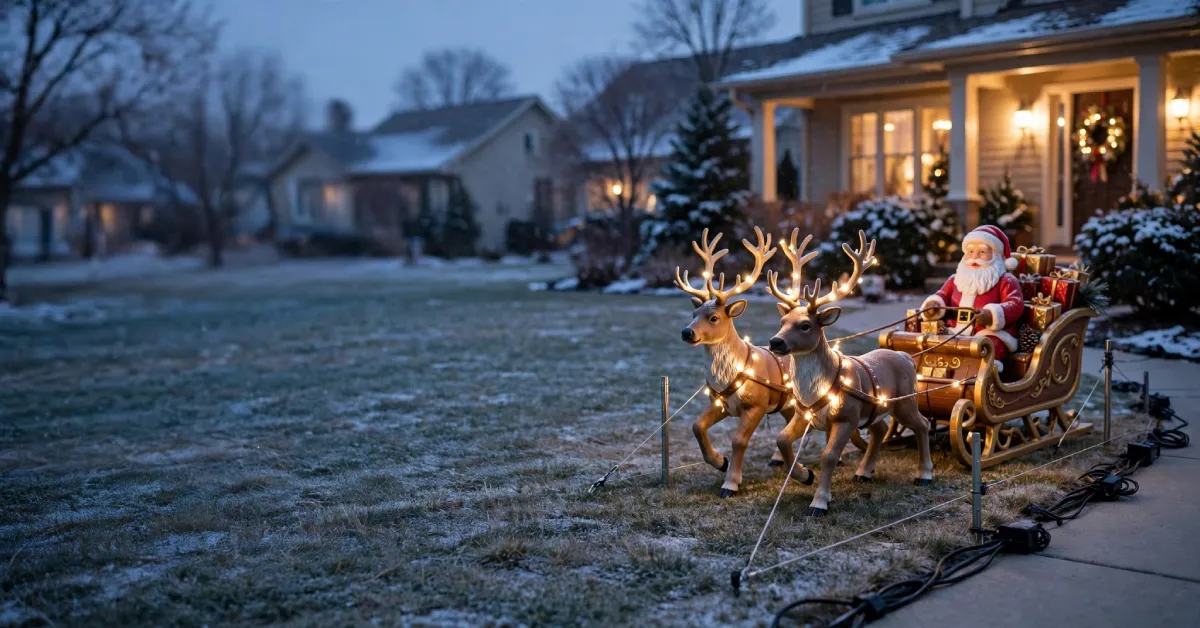
Most Santa sleigh displays fail for one of two reasons: wrong scale or wrong anchoring—not because the piece itself was bad. A 16-foot set squeezed into a 12-foot garden bed looks cramped and chaotic, no matter how much you paid for it. Factory stakes that pull out with one hand will surrender to the first real gust, leaving a deflated Santa slumped across the lawn.
This guide gives you the proportional rule, the IP-rating threshold, and the anchoring upgrade that top product pages leave out. You will move from format comparison to sizing to weatherproofing to installation, so you can buy once and display with confidence.
Match the Format to Your Yard Before You Shop
| Your situation | Recommended format | Why |
|---|---|---|
| Porch, balcony, or compact yard | Blow mold or small wireframe (4–5 ft) | Low wind exposure, easy setup, reads well at close range |
| Standard suburban lawn | Medium wireframe or 6–8 ft inflatable | Enough scale for curb appeal without overwhelming the space |
| Large lot, acreage, or exposed corner | Life-size HDPE set or large wireframe with engineered base | Statement presence; requires serious anchoring and horizontal room |
The fastest way to narrow your options is to measure your usable yard width and note your wind exposure. A sheltered porch and an open corner lot demand different engineering, not just different aesthetics.
Inflatable, Wireframe, Blow Mold, or Life-Size? The Real Trade-Offs
Inflatable Santa sleighs: fast setup, fabric lifespan
Inflatables deliver the biggest visual punch per dollar and per minute of setup. A 6–8 ft inflatable sleigh scene can dominate a lawn and store in a bin. But the material is fabric—typically rip-stop polyester—and the structure depends on a continuous blower. Wind is the enemy: even with all supplied tethers deployed, most consumer inflatables should be deflated when gusts approach 30 mph. A pinhole leak or a wet fan can end the display mid-season. Choose this if you want bold impact, have a reasonably sheltered site, and will commit to deflating before storms.
Wireframe and metal silhouette displays: steel durability and visual depth
Wireframe figures are built from a steel frame wrapped in LED rope light or string light. Because the frame is open, wind passes through rather than pushing against a solid fabric wall. That structural advantage makes wireframes the more wind-resilient format in sustained gusts, provided they are properly staked. The trade-off is storage: frames do not collapse into a small bin, and tall, narrow pieces can lean if under-anchored. Choose this if you face regular wind, want a repairable display, and have shed or garage space for rigid storage.
Blow mold sleighs: vintage glow, shell fragility
Blow molds are hollow HDPE shells lit from within, with a low centre of gravity that helps them resist wind. They handle rain and snow well, and modern HDPE is resilient to moisture. But the plastic becomes brittle in deep freezes, and a dropped or impacted shell can crack. UV exposure fades colours over time and further weakens the polymer. Choose this if you want a nostalgic look, have a sheltered placement, and will store the shells carefully in extreme cold.
Life-size HDPE sets: the IMAX option
Life-size HDPE sets are the statement pieces of the category—full-scale sleighs with reindeer, often 10 ft or longer. They demand horizontal real estate and serious anchoring. These are not plug-and-play decorations; they are installations. Choose this only if you have acreage or a commercial-scale frontage and are prepared to build a sub-base.
Format comparison at a glance
| Format | Setup effort | Wind resilience | Repairability | Storage footprint | Typical lifespan |
|---|---|---|---|---|---|
| Inflatable | Low–moderate | Low–moderate (deflate in storms) | Patching possible; fan vulnerable | Moderate (bin + blower) | Shorter fabric life |
| Wireframe | Moderate | High when anchored | High (steel, replaceable lights) | Bulky but nestable | Many seasons |
| Blow mold | Low | Moderate–high (low profile) | Low–moderate (shell cracks) | Rigid, space-hungry | Many seasons with care |
| Life-size HDPE | High | Depends entirely on base | Moderate | Very large | Long with maintenance |
What Size Santa Sleigh Fits Your Yard? A Proportional Rule That Works
Santa should occupy roughly one-third of the yard’s width, not more than half. The display should be proportional to the space it is occupying, not to you standing next to it in the store. A sleigh under 6 ft long often lacks curb appeal from the street; a 16-foot unit in a 12-foot bed is a common and expensive mistake.
Porch and compact yard: 4–5 ft
A 4–5 ft figure suits a porch, balcony, or narrow frontage. At this scale, a blowmould or small wireframe is usually the better choice: lightweight, easy to secure, and readable at close range.
Standard suburban lawn: 6–8 ft
A 6–8 ft sleigh or scene is the usual fit for a standard lawn. This is the sweet spot for visibility without crowding. A medium wireframe or a 6–8 ft inflatable both work here, depending on your wind exposure and storage capacity.
Large lot and acreage: 10+ ft
Ten feet and above is for acreage, commercial frontage, or a corner lot with long sightlines. At this scale, you are no longer decorating; you are building a display. Plan for an engineered base and a crew to install.
The one-third rule and viewing-distance test
Before buying, measure the usable width of the bed or lawn where the sleigh will sit. Divide by three. That is your target sleigh length. Then walk to the street and look back: if the sleigh reads as a small prop rather than a focal point, size up. If it crowds the house or blocks a window, size down.
Sizing lookup table
| Usable yard width | Target sleigh length | Best format fit |
|---|---|---|
| Under 10 ft | 4–5 ft | Blow mold or small wireframe |
| 10–20 ft | 6–8 ft | Medium wireframe or inflatable |
| 20–30 ft | 8–10 ft | Large wireframe or life-size |
| 30+ ft | 10–16 ft | Life-size HDPE with sub-base |
Weatherproofing: What “Weather-Resistant” Actually Means for Outdoor Sleighs
IP ratings explained in 60 seconds
The IP (Ingress Protection) rating tells you what a product survives. The second digit covers water. IP44 means protection against splashing water from all directions—adequate for covered porches, eaves, and sheltered patios, but not for continuous heavy rain or standing water. IP65 means dust-tight and protected against low-pressure water jets from any angle—the more reliable target for open, unsheltered yards. If a product carries no IP rating, treat it as indoor-only.
Inflatable fabric vs. HDPE vs. powder-coated steel
Thin polyester inflatable fabric is the most vulnerable to freeze-thaw cycling and UV degradation. HDPE—used in bmouldsolds and life-size sets—resists moisture and handles snow load well, but becomes brittle in extreme cold. Powder-coated steel wireframes resist rust, but untreated wire will corrode. For an exposed site, IP65 and HDPE or powder-coated steel are the durable choices.
Storm protocol: when to deflate, disassemble, or bring inside
- Inflatable, gusts approaching 30 mph: deflate and bring the fabric inside. The blower and fan are not designed for sustained wind-driven rain.
- Blow mould, heavy wet snow: brush snow off gently with a soft broom; do not use a shovel. Ice can crack the shell.
- Wireframe, ice storm: disconnect power and check for ice load on the frame. Do not attempt to straighten a frozen frame.
- Any format, standing water at the plug: kill power at the GFCI before touching the connection.
IP-rating decision table
| Placement | Minimum rating | Recommended rating |
|---|---|---|
| Covered porch / under eaves | IP44 | IP44 |
| Open lawn, occasional rain | IP44 | IP65 |
| Fully exposed, wind-driven rain | IP65 | IP65 |
| No rating stated | Do not use outdoors | — |
How to Secure a Santa Sleigh in Wind (Without Trusting the Box Stakes)
The stake upgrade every installer should make
Factory stakes are frequently plastic and short. If you can pull the stake out with one hand, wind can do it better. Replace them with 9-inch heavy-duty steel tent stakes or 12-inch J-hook rebar stakes driven deep into the ground. Reviewers of steel stake upgrades report secure anchoring until gusts reach roughly 30 mph—and they still bring decorations in beyond that point. For soft or frozen soil, rebar holds better than a smooth peg.
Building a hidden H-frame sub-base for heavy sets
For a large life-size set or a tall wireframe, a ground stake alone is not enough. Build a pressure-treated 4×4 H-frame that exceeds the sleigh’s footprint by at least 6 inches on all sides. Bolt or lag the frame together, set it on level ground, and anchor the frame itself with rebar before attaching the display. The base is hidden by the sleigh body and any surrounding greenery, but it provides the structural rigidity that keeps a 10-foot piece upright in a gust.
Inflatable-specific anchoring: ropes, sandbags, and tension
Use every supplied rope, stake, and sandbag—not just the two at the front. Tall inflatables need tethers on at least three sides. Tension the ropes so the fabric does not flap; a loose tether chafes and tears. If your yard has no soil for stakes (patio, deck, gravel), use weighted sandbags on the base loops and cross-tie to a fixed anchor such as a fence post. Do not rely on a single anchor point.
When wind is too strong: a go/no-go threshold
If sustained wind is forecast above 30 mph, deflate inflatables and bring them in. For wireframes, check that every stake is seated and consider laying tall, narrow pieces down if gusts are predicted above 40 mph. A deflated display for one night is cheaper than a replacement piece.
Power, Lighting, and Cord Management for a Clean Display
Cord routing that does not look temporary
Plan the outlet route before placing the sleigh. Do not run cords across walkways, driveways, or anywhere a foot or tree will cross. Use a GFCI-protected outdoor outlet and a cord cover where the cable meets the ground. Cord routing is a safety decision, not an afterthought—wet cords and trip hazards are the most common causes of holiday-display injuries.
Solar vs. low-voltage vs. plug-in
Solar works for small accent lights but rarely powers a blower or a large LED array through a cloudy December. Low-voltage systems are safer for long runs and easier to hide. Plug-in is the most reliable for inflatables and large wireframes, provided you have a nearby GFCI outlet and a cord long enough to route away from traffic.
Lighting temperature and the North Pole look
Warm white (approximately 2700K–3300K) creates the traditional, cosy glow associated with Santa displays. Cool white (5300K–6500K) reads modern and crisp but can feel clinical against a classic sleigh. Choose one temperature and carry it through the sleigh, the reindeer, and any supporting greenery. Mixed temperatures make a display look assembled rather than designed. Styling the Sleigh So It Reads From the Street
The one-main-piece rule
A sleigh should be the focal point. One main piece, supported by two or three secondary elements, reads more clearly from the street than a lawn crowded with competing characters. Pair the sleigh with a small group of reindeer, some greenery, and a consistent warm-white light string. Stop there.
Supporting pieces that add depth without clutter
Reindeer at varying heights create depth. A simple gift-box cluster at the runner level adds foreground interest. Greenery or garland softens the transition between the sleigh and the ground. Avoid adding inflatables, projectors, and blowmoulds in the same sightline unless you are deliberately building a maximalist scene.
Backdrop and contrast considerations
A dark house facade makes a lit sleigh pop; light siding can wash out white or warm-white LEDs. If your backdrop is light, choose a wireframe with brighter output or a blomouldld with a stronger internal bulb. If the backdrop is dark, a warm-white inflatable or wireframe will have the most visual separation.
DIY vs. Buy: What a Santa Sleigh Really Costs in Time and Money
DIY plywood sleigh: realistic budget and skill check
A basic plywood sleigh can be built from two to three sheets of exterior-grade plywood, plus reinforcement and fasteners. Material costs in current builds range from roughly $40 to $100, depending on plywood thickness and whether you buy a pre-cut kit or pattern. You will need a jigsaw, a drill, exterior paint or sealant, and a plan for weatherproofing the edges. This is a weekend project for a confident beginner, not a one-hour assembly.
Hidden costs of DIY
The sticker price of lumber is not the all-in cost. Add exterior sealant or paint, LED lights, fasteners, stakes or a base, and storage space for a rigid wooden piece. If you do not already own the tools, the tool cost alone can exceed the price of a store-bought blmouldold. Wood also requires annual inspection and resealing to survive freeze-thaw cycles.
When buying is the cheaper decision
Buying is the cheaper decision when you value your time, lack woodworking tools, or need a weatherproof finish out of the box. A powder-coated wireframe or a modern HDPE blow mould will outlast an untreated plywood build in a wet climate. Compare all-in cost per season, not sticker price: a $90 DIY sleigh that lasts two seasons costs more per year than a $200 mould that lasts ten.
FAQs
What size Santa sleigh should I buy for a standard front yard?
A 6–8 ft sleigh or scene is the usual fit for a standard suburban lawn. A 4–5 ft piece suits a porch or compact yard, and 10+ ft is appropriate for acreage or commercial visibility.
How do I keep a Santa sleigh from blowing over?
Replace factory stakes with heavy-duty steel tent stakes or rebar. Use all supplied ropes and sandbags on inflatables, and build an H-frame sub-base for large rigid sets.
Can an inflatable Santa sleigh stay outside in the rain?
Most IP44-rated inflatables handle light splash but are not designed for heavy rain, snow, or high wind. Check the label; if the rating is IP44 and the site is exposed, deflate or bring the piece in during severe weather.
Is wireframe or inflatable better for a windy location?
Wireframe steel frames generally handle sustained wind better than fabric inflatables because wind passes through the open frame. Inflatables rely on a blower and fabric skin and are more vulnerable to fatigue and deflation in gusts.
Do I need a special outlet for an outdoor Santa sleigh?
Use a GFCI-protected outdoor outlet and route cords away from walkways. Most consumer displays use standard UL-listed plugs, but exposed connections should be covered and kept off the ground.
How long does a Santa sleigh yard decoration last?
Powder-coated wireframes can last many seasons with occasional repainting. Moulds can last many years with careful storage but may crack if dropped or exposed to extreme cold. IP44 inflatables typically have a shorter fabric lifespan and require dry storage.
Can I leave a blow mould Santa sleigh out all winter?
Blowmouldss tolerate rain and snow well, but deep freezes make the plastic brittle. Secure them against wind, brush off heavy wet snow, and inspect for cracks before storage.