

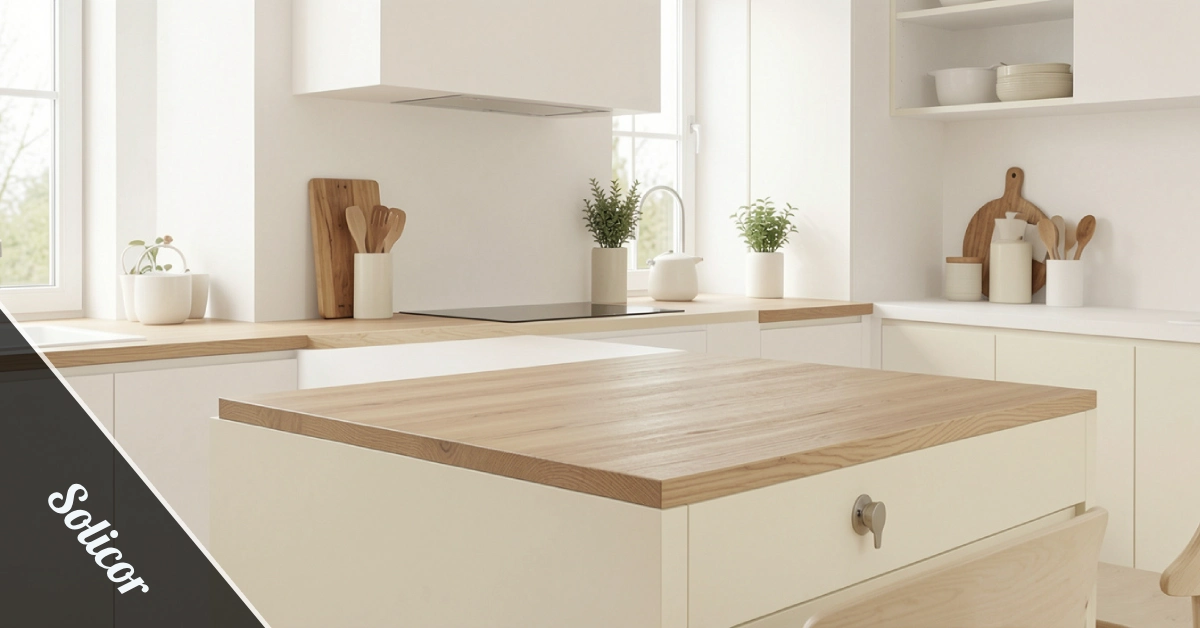
You know that feeling when a room looks almost right, but something is off? Nine times out of ten, it’s the details — the edges, the surfaces, the little things nobody names but everyone notices.
That dark line running along the edge of your laminate countertop? That’s the culprit. It’s the visual “tell” that breaks the illusion of a clean, modern interior. And it’s exactly the problem that color-through laminate was built to solve.
In this guide, we’re breaking down what makes this material a smart home upgrade — where it fits, how to use it right, and why it’s becoming the go-to choice for homeowners who want a high-end look without a high-end budget.
So, What Exactly Is Solicor?
Solicor is a color-through laminate where the core matches the surface color — so cut edges stay clean, crisp, and consistent, with no dark laminate line showing through.
Standard laminate has a decorative layer on top of a brown or black core. The moment you cut it, that core is exposed. For surfaces with hidden edges, that’s fine. But the second you want open shelving, exposed cabinet panels, or a floating desk? That dark line becomes impossible to ignore.
Solicor flips that entirely. The color runs all the way through the material, so every cut edge looks intentional. It’s a simple idea with a genuinely big impact on how a room feels.
It also goes by a few related names — solid color core laminate, color-through laminate, or solid core laminate. Different labels, same core design principle: edges that don’t break the look.
The Three Types You’ll Actually Encounter
Not all Solicor products are the same, and confusing them is the number-one buying mistake. Think of it in three buckets based on how structural the panel needs to be.
Standard Sheet Laminate (HPL)
This is the classic version — a laminate sheet bonded to a substrate like MDF or plywood. It’s the right call for countertops, cabinet doors, furniture panels, and backsplashes where you need a clean finish on an engineered base. Lightweight, easy to work with, and fits right into any standard woodworking workflow.
Compact Laminate
Thicker and self-supporting, compact laminate doesn’t need a substrate underneath it. That makes it ideal for partitions, restroom dividers, wall panels, and heavy-use furniture. It handles moisture better, holds up in high-traffic spaces, and is the smarter pick for commercial-style setups in the home — think gym walls, laundry rooms, or a busy mudroom.
This is the specialist tier — built for environments where chemical spills, staining agents, and aggressive cleaners are part of daily life. Unless you’re fitting out a home lab or a clinical workspace, you probably won’t need it. But it’s worth knowing it exists if your project has unusual demands.
One important note: Don’t confuse “Solicore” (a door-core product) with Solicor laminate. They sound nearly identical but are completely different product families. Always double-check the spec sheet before ordering.
How It Stacks Up Against the Alternatives
Here’s the honest comparison most buying guides skip over. No hype, just what actually matters when you’re making a decision:
| Feature | Solicor Laminate | Regular Laminate | Solid Surface |
|---|---|---|---|
| Edge appearance | ✓ Clean, color-matched | ✗ Dark/brown core visible | ✓ Seamless |
| Durability | High for daily use | Moderate | High |
| Repairability | Limited | Limited | ✓ Can be sanded & repaired |
| Cost | Mid-range | Budget-friendly | Higher |
| Best for | Exposed edge designs | Hidden-edge setups | Seamless joining |
| Heat tolerance | Good (use trivets) | Good (use trivets) | Good |
The short version: if your edges are visible, this beats regular laminate every time. If you need seamless joins or in-place repairs, solid surface might be a better fit. If you need both affordability and clean aesthetics, this is your sweet spot.
Where Does It Work Best Inside Your Home?
The real beauty of color-through laminate is how many problems it quietly solves across different rooms. Here’s where it makes the biggest difference.
Kitchen countertops and backsplashes are the obvious starting point. The exposed edges on an island or peninsula are on display every single day. A clean, color-matched edge makes the whole kitchen feel more custom — without the custom price tag of stone or solid surface.
Open shelving and built-ins are where this material really earns its keep. When shelves are floating, and every edge is visible, standard laminate would show that brown line on every single shelf. Color-through laminate keeps it looking intentional and minimal from every angle.
Home offices and desk setups are the underrated use case. A wall-length desk with clean exposed edges, no visible core lines, and a matte finish? That’s a setup that looks like it cost twice what it did. Pair it with matching cabinet panels, and you’ve got a workspace that actually motivates you to sit down.
Bathroom vanities work well too, especially with compact laminate for the moisture-heavy zones. The wall panels, the vanity face, the mirror surround — all can carry the same color-through finish for a spa-like consistency that most bathrooms miss entirely.
5 Practical Tips Before You Buy or Install
Sample first, always. Colors look different under natural light vs. showroom lighting — get physical samples and check them in your actual space.
Match your finish to the room’s traffic. Matte hides fingerprints in busy kitchens. Gloss looks sharp in low-traffic areas but demands more upkeep.
Choose compact laminate for wet or high-traffic zones. A sheet laminate on a substrate isn’t built for constant moisture exposure.
Don’t rush the edge finishing. The whole point is clean edges — sloppy cuts or rushed bonding will undercut everything. Plan your fabrication steps carefully.
Order a project package — surface sheets, matching edge strips, and adhesive together. It prevents mismatched batches and surprise costs.
Pro move: Save the exact product code and finish name from the Wilsonart catalog the moment you choose your selection. Reordering the same batch months later gets tricky if you’ve only saved a photo.
Keeping It Looking Sharp — Maintenance Made Simple
One of the biggest wins with color-through laminate is how little it asks of you day-to-day. A soft cloth and a mild cleaner handle 99% of what life throws at it. Wipe, rinse, done.
Skip the harsh abrasives — they dull the finish over time, especially on matte surfaces. If you’re in a high-traffic area, a microfiber cloth and a pH-neutral cleaner are your best friends. No special products, no elaborate rituals.
For lab-grade or healthcare-adjacent environments, always follow the specific chemical resistance guidelines listed for that product line. Those surfaces are built tough, but the right cleaner still matters for long-term performance.
What Does It Actually Cost?
When people search for laminate pricing, they’re usually confused by how wide the range is. And honestly, that confusion makes sense — there are real variables at play.
Sheet size, finish type, whether it’s standard or compact laminate, and whether your color is in stock or special order all move the number. Shipping can add a surprising amount, too, especially with large sheets that need freight handling.
The smart approach: get a project quote that bundles surface sheets, edge strips, and delivery together. It prevents last-minute surprises and makes sure every element matches. Two quotes for the “same” material can look very different based on what’s included — so always compare apples to apples.
The Bottom Line
If your project has visible edges — and most modern home designs do — then color-through laminate is one of the smartest material choices you can make. It’s not a gimmick. It solves a real, visible problem that standard laminate just can’t address without thick edging or cover trim. Choose the right category first: sheet laminate for most interior applications, compact laminate for wet or heavy-use zones, and lab-grade only when the environment actually demands it. Sample your colors in real light, plan your edge finishing carefully, and get a bundled project quote before you lock in your build schedule.
The result? A space that looks like you spent more, thought harder, and sweated the details — even if the material bill tells a much friendlier story. That’s the design cheat code most people never figure out. Now you know.