

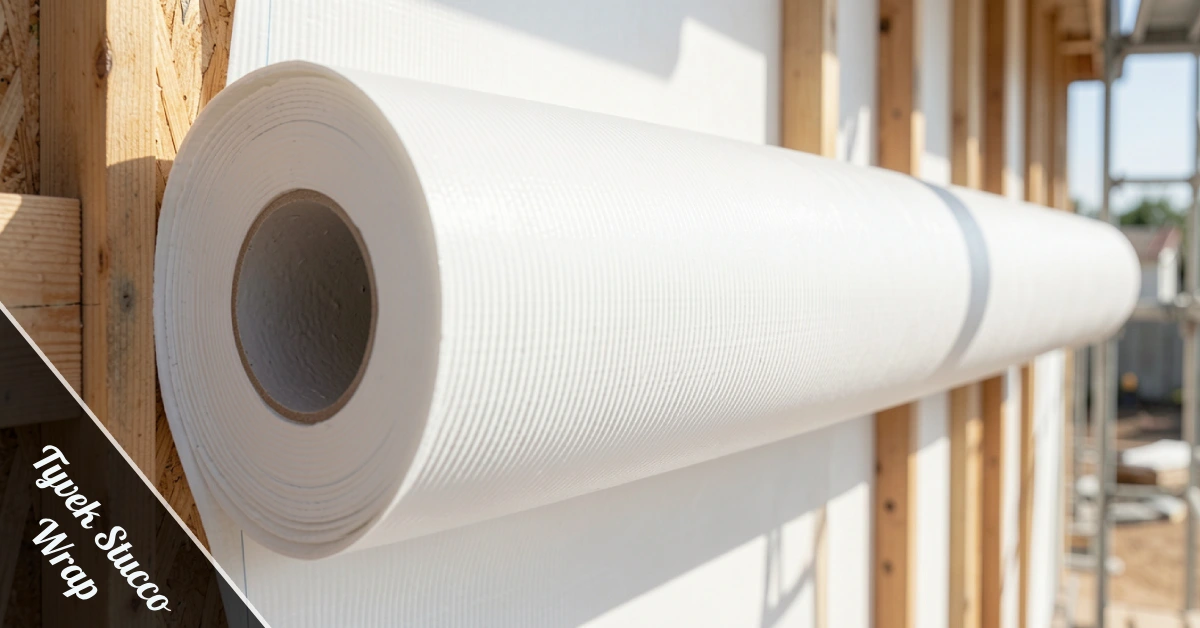
Your stucco wall looks solid. But behind that hard exterior, moisture is quietly doing damage — unless you’ve got the right protection working for you.
That’s where Tyvek Stucco Wrap comes in. It’s the unsung hero of high-performance exterior wall systems.
Whether you’re a homeowner doing your homework, a contractor prepping for a new build, or an architect spec’ing out an envelope system, this guide gives you the full picture — no filler, no fluff.
What Is Tyvek Stucco Wrap, Exactly?
Tyvek Stucco Wrap is a weather-resistant barrier made by DuPont. It’s specifically engineered for stucco and EIFS (Exterior Insulation and Finish System) applications, giving your wall a breathable, water-shedding layer that keeps bulk water out while letting trapped moisture vapor escape.
Think of it as a one-way gate for moisture. Water can’t get in, but vapor can get out.
What sets it apart from basic building wraps is its engineered, grooved surface. Those grooves create a drainage plane — a channel that moves water away from the wall cavity fast.
No pooling. No saturation. No silent rot behind your stucco facade.
It’s made from high-density polyethylene using a non-woven, non-perforated structure. That gives it flexibility and toughness — it won’t tear during installation or buckle under rough weather over time.
Why Builders and Homeowners Love It: The Real Benefits
This isn’t just a wrap. It’s a system upgrade. Here’s what it actually does for your building.
1. Moisture Control That Actually Works
The grooved drainage plane isn’t cosmetic. It’s functional. When water sneaks behind your stucco — and it will — those grooves redirect it downward and out before damage can start.
Combine that with its vapor-permeable design, and you’ve got a wall that breathes. Moisture vapor escapes. Mold doesn’t get a foothold.
2. Energy Efficiency You’ll Feel in Your Bills
Tyvek Stucco Wrap is an excellent air infiltration barrier. It seals up gaps that let conditioned air escape and outside air sneak in. Less air leakage = less strain on your HVAC system = lower energy bills every month.
Over a few years, those savings can offset a good chunk of the initial cost.
3. Durability That Goes the Distance
High-density polyethylene is tough. Tyvek Stucco Wrap resists punctures and tears during installation, which is exactly when most wraps get damaged. And once it’s up, it holds its own against UV exposure for up to six months — handy during long construction timelines.
It’s also compatible with every stucco type: traditional three-coat systems, one-coat stucco, and EIFS. You don’t need a different product depending on the finish you’re applying.
4. Better Indoor Air Quality
By controlling airflow across the wall assembly, Tyvek Stucco Wrap helps maintain a more consistent indoor temperature. That consistency reduces humidity fluctuations inside the home, which directly improves air quality and occupant comfort.
Tyvek Stucco Wrap vs. Other Building Wraps: Side-by-Side
Not all house wraps are created equal. Here’s how Tyvek stacks up against standard building wrap and traditional felt paper.
| Feature | Tyvek Stucco Wrap | Standard Building Wrap | Felt Paper |
| Drainage Plane | ✓ Grooved surface | ✗ Flat surface | ✗ None |
| Vapor Permeability | High | Medium | Low |
| UV Resistance | Up to 6 months | 2–3 months | Weeks |
| Tear Resistance | Excellent | Good | Poor |
| Best For | Stucco / EIFS | General siding | Traditional builds |
| Cost | Higher upfront | Moderate | Low |
The drainage plane alone makes Tyvek Stucco Wrap the clear choice for any stucco or EIFS system.
How to Install Tyvek Stucco Wrap: Step-by-Step
Installation isn’t complicated, but it does need to be done right. One wrinkle, one missed overlap, and you’ve handed water the exact opening it needs.
Step 1 — Measure and Cut
Measure your wall carefully. Cut the wrap to size, allowing for overlaps at each course.
Step 2 — Fasten to Studs
Starting at the bottom and working up, fasten the wrap to wall studs using staples or nails. Each course should overlap the one below by at least 1 to 2 inches. Keep it smooth — no wrinkles.
Step 3 — Seal the Seams
Use a proprietary Tyvek tape or compatible adhesive to seal all joints and seams. This step is non-negotiable. Unsealed seams are where air and water infiltration happen, and where most failed installations trace back.
Step 4 — Flash Windows and Doors
Properly flash every window and door opening before applying stucco. Flashing is what bridges the gap between your wrap and the window frame, keeping bulk water out of the rough opening.
Step 5 — Apply the Stucco
Once everything’s secured and sealed, apply your stucco directly onto the Tyvek surface. The grooved texture gives the stucco something to grip.
Common Mistakes to Avoid
- Leaving the wrap exposed longer than 6 months — UV degrades it past that point
- Skipping tape on seams — even small gaps invite moisture and air intrusion
- Installing over wet sheathing — always let everything dry first
- DIY without experience — improper installation creates more problems than it solves
If you’re not 100% confident in the process, bring in a professional. The cost of a botched install — rotted sheathing, mold remediation, stucco repair — is way higher than hiring right.
Pros and Cons of Tyvek Stucco Wrap: The Honest Breakdown
No product is perfect. Here’s the straight talk on what you gain and what to watch for.
| PROS | CONS |
| ✅ Engineered grooved drainage plane | ❌ Costs more than standard wraps |
| ✅ Breathable — lets moisture vapor escape | ❌ Professional install strongly recommended |
| ✅ UV-resistant up to 6 months | ❌ High humidity may cause stucco aesthetic issues |
| ✅ Works with all stucco types | ❌ Tears must be patched immediately |
| ✅ Reduces HVAC load, saves energy |
Cost Considerations: Is Tyvek Stucco Wrap Worth the Price?
Let’s be real — Tyvek Stucco Wrap costs more upfront than standard building wrap or felt paper. That’s a fact. But when you’re building or renovating, the cost you want to avoid isn’t the material cost — it’s the repair cost.
Water damage behind stucco can mean sheathing replacement, mold remediation, and full re-stucco jobs. A quality moisture barrier pays for itself the first time it prevents that scenario.
Think of it as insurance with a building benefit. You’re paying a small premium today to avoid a massive bill later.
For long-term builds, high-humidity climates, and EIFS applications especially, the value is undeniable.
Frequently Asked Questions
Can I use Tyvek Stucco Wrap in a humid climate?
Yes. It’s designed precisely for that scenario. The vapor-permeable structure lets moisture vapor exit the wall cavity while blocking liquid water from getting in. Just note that in very high-humidity regions, some aesthetic impact on stucco is possible over time.
What if the wrap tears during installation?
Patch it immediately using Tyvek tape. Cover an area larger than the actual tear to create a proper seal. Don’t wait — an unpatched tear becomes an entry point for everything you’re trying to keep out.
Does it need to be painted or coated?
No. Tyvek Stucco Wrap isn’t meant to be painted or coated. Its job is protection, not aesthetics.
Who should use it?
Architects, builders, contractors, and homeowners working on any stucco or EIFS project. If you’re serious about building envelope performance, this wrap belongs in your spec.
The Bottom Line
Tyvek Stucco Wrap isn’t the flashiest part of a build. You’ll never see it once the stucco goes on. But it’s doing the most important work — quietly protecting your wall assembly from the moisture and air that cause real, expensive damage.
It drains better, breathes better, and holds up longer than any standard wrap in the game. For stucco and EIFS systems, it’s the smart call every single time.