

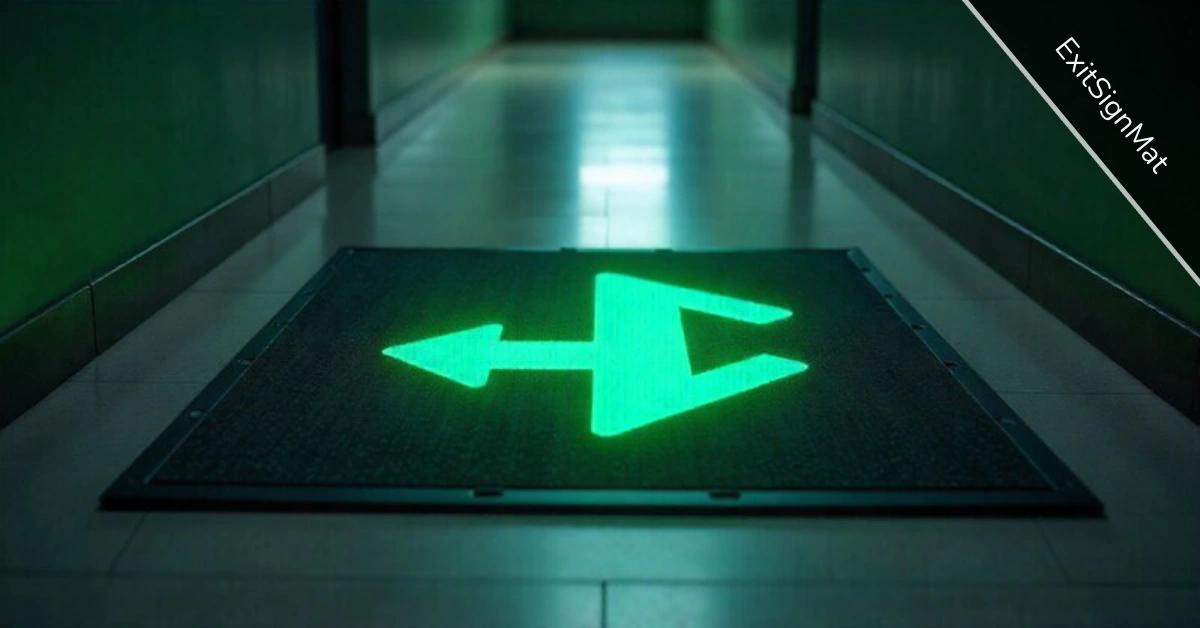
Exit sign floor mats are supplemental safety devices that mark emergency egress routes at floor level. While not typically required by OSHA or NFPA codes, they enhance visibility during evacuations, particularly in smoke-filled or dark conditions, and must meet slip-resistance standards when used.
What Exit Sign Floor Mats Actually Do
Exit sign floor mats sit directly on walking surfaces and display exit symbols, directional arrows, or both. They serve as ground-level guidance when wall-mounted exit signs become hard to see.
Most people look down when they walk, especially during emergencies. Smoke rises and obscures ceiling-mounted signs. Power failures darken hallways. In these situations, floor-level marking provides a backup navigation system.
These mats don’t replace standard exit signs. OSHA requires illuminated exit signs at specific locations under 29 CFR 1910.37. Floor mats add another layer of guidance. They work best in buildings with long corridors, complex layouts, or populations that include people with mobility challenges.
The key advantage is positioning. Your eyes naturally track the path ahead at floor level. A glowing mat catches attention immediately. Wall signs require you to look up and scan the space, which takes more time during stressful moments.
Code Requirements You Need to Know
No federal code mandates exit sign floor mats in most commercial buildings. OSHA focuses on illuminated exit signs, emergency lighting, and clear egress paths. NFPA 101 Life Safety Code similarly emphasizes wall-mounted signage and adequate lighting.
However, several codes allow or encourage supplemental floor marking. IBC Section 1024 permits photoluminescent exit path markings in stairwells of high-rise buildings. Some jurisdictions require glow-in-the-dark guidance in buildings over 75 feet tall.
The distinction matters for facility managers. You can’t skip required exit signs and install only floor mats. Wall-mounted illuminated signs remain mandatory. Floor mats supplement your existing system.
If you choose to install floor mats, they must meet slip-resistance standards. OSHA’s walking-working surfaces rule (1910.22) requires floors to be kept free from hazards. Any mat you place must have a coefficient of friction rating of at least 0.5 on both dry and wet surfaces.
State and local codes vary. New York City has specific photoluminescent marking requirements for high-rises. California requires certain markings in exit stairwells. Check with your local building department before purchasing.
Material Types and Performance Standards
Photoluminescent Mats
Photoluminescent materials absorb light and re-emit it slowly over time. These mats charge under normal lighting and glow when darkness falls. They don’t need batteries or wiring.
Quality photoluminescent mats glow for 6 to 8 hours after full charging. UL 1994 certification verifies this performance. The standard tests how long a mat maintains minimum brightness levels. Look for products that meet UL 1994 and have adequate luminance (typically 30 millicandelas per square meter after 10 minutes).
These mats work best where ambient light keeps them charged. They’re not ideal for dimly lit areas or spaces that stay dark during business hours. Charging requires exposure to at least 54 lux for about one hour.
The material itself is usually vinyl or rubber with embedded phosphorescent particles. Higher-quality versions use strontium aluminate, which outperforms older zinc sulfide compounds.
LED-Illuminated Mats
LED mats contain small lights within the mat structure. They plug into electrical systems or run on batteries. Some connect to emergency power circuits.
The advantage is consistent brightness regardless of ambient light. LEDs produce clear, sharp visibility and can incorporate motion sensors or smart controls. They’re better for areas without reliable lighting or where maximum visibility is critical.
Drawbacks include installation complexity and maintenance needs. You need electrical connections or battery replacement schedules. LEDs eventually dim and require replacement, typically after 50,000 hours of use.
Hardwired LED mats should connect to emergency power systems to remain functional during outages. Battery-powered versions need a quarterly inspection to verify charge levels.
Standard Printed Mats
Non-illuminated mats use reflective or high-contrast printing. They rely on existing light to remain visible. They cost less and require no power source.
These work in well-lit areas where power outages are rare. They’re suitable for buildings with reliable emergency lighting systems. The printing should use retroreflective materials that bounce light back toward its source, improving visibility under a flashlight or emergency lighting.
Durability depends on the base material. Commercial-grade rubber lasts longer than vinyl in high-traffic areas. Expect 3 to 5 years of service life with proper maintenance.
Slip Resistance and Safety Certification
Any mat on a walking surface creates a potential trip hazard. The edges must be beveled, and the mat must stay in place. More importantly, the surface must provide adequate traction.
ASTM D2047 measures slip resistance using the Static Coefficient of Friction (SCOF) test. Acceptable mats should have an SCOF of 0.5 or higher. Values above 0.6 indicate excellent slip resistance.
Material affects performance. Rubber naturally provides better grip than vinyl. Textured surfaces outperform smooth ones. Some mats include raised patterns or embedded grit for added traction.
Wet conditions reduce slip resistance. Choose mats rated for wet use if they’ll sit near entrances or in areas subject to spills. Commercial kitchens and healthcare facilities need higher wet-surface ratings.
Look for UL certification marks, NFPA compliance labels, or ASTM test results in product documentation. Avoid uncertified products in liability-sensitive environments.
The backing matters too. Mats should have non-slip undersides or adhesive backing to prevent sliding. Loose mats create trip hazards and defeat their safety purpose.
When Floor Mats Make Sense for Your Building
Not every building benefits equally from exit sign floor mats. Consider them if you manage:
High-rise buildings with long corridors. People may need to travel 100 feet or more to reach an exit. Floor-level guidance helps maintain direction.
Healthcare facilities. Patients with limited mobility look down more than up. Many can’t move quickly and need clear, continuous guidance.
Industrial facilities with visibility challenges. Warehouses, factories, and distribution centers have high ceilings and potential for smoke or dust conditions. Floor mats provide redundant guidance.
Educational institutions. Schools and universities have high occupant loads and include children who may not recognize standard exit signage.
Multi-level entertainment venues. Theaters, cinemas, and arenas have darkness as a normal condition. Floor mats visible in low light serve a constant duty.
Skip floor mats in small buildings with simple layouts. A 3,000-square-foot office with clear sightlines to exits doesn’t need supplemental floor marking. Standard exit signs and emergency lighting provide adequate guidance.
Also, skip them in areas where they’ll accumulate dirt or damage quickly. Loading docks, outdoor pathways, and areas with forklift traffic will destroy mats rapidly.
Installation Location and Spacing Guidelines
No code specifies exact spacing for supplemental floor mats. Use common sense and prioritize high-value locations.
Place mats immediately in front of exit doors. This marks the final step of egress clearly. The mat should sit 2 to 3 feet from the door to remain visible as people approach.
Install mats at corridor intersections where people must choose a direction. The directional arrow should point toward the nearest exit. If two exits are equidistant, choose the one with greater capacity.
In stairwells, place mats at each landing. They should indicate whether to continue down or exit through a door. This prevents confusion during evacuation.
Long corridors benefit from mats every 50 to 75 feet. This maintains visual continuity. People should always see the next guidance marker as they move.
Integrate floor mats with your emergency lighting system. If the mats are non-illuminated, verify that the emergency lights provide adequate illumination. Photoluminescent mats should sit where ambient light keeps them charged.
Common mistakes include placing mats under furniture, in areas blocked by equipment, or pointing arrows in confusing directions. Walk through your facility and verify clear visibility from normal occupant positions.
Clean the floor surface before installation. Dust and debris prevent adhesive backing from bonding properly. Some facilities use additional anchoring methods in high-traffic zones.
Maintenance Requirements and Lifespan
Exit sign floor mats need regular attention to maintain effectiveness.
Photoluminescent mats require clean surfaces to absorb and emit light properly. Dirt blocks light absorption. Use pH-neutral cleaners and soft brushes. Avoid abrasive pads that scratch the surface and damage phosphorescent particles.
Check glow performance quarterly. Turn off the lights in the area and verify the mat glows brightly. Weak glow indicates the material is degrading and needs replacement.
LED mats need electrical checks and bulb replacement. Inspect connections annually. Test functionality monthly by triggering emergency mode. Replace batteries according to manufacturer schedules, typically every 3 to 5 years.
All mat types suffer from foot traffic wear. Inspect monthly for edge curling, delamination, or fading. Replace mats when the exit text or arrows become hard to read.
Expected service life varies by material and traffic. Rubber mats in moderate traffic last 5 to 7 years. Vinyl mats last 3 to 5 years. High-traffic areas may need replacement sooner.
Keep replacement mats on hand for quick swaps. A worn mat with illegible markings provides no value during emergencies.
Document inspection dates and maintenance actions. This creates records for insurance and liability purposes. It also helps you plan replacement budgets.
Cost Analysis and Alternatives
Exit sign floor mats range from $30 to $300 per unit, depending on size, material, and features.
Basic printed mats without illumination cost $30 to $75. They work for well-lit areas with low-priority needs. Expect to replace them every 3 to 5 years.
Photoluminescent mats range from $100 to $200. The UL-certified versions that meet performance standards sit at the higher end. They have minimal operating costs since they need no power.
LED mats cost $150 to $300. Add installation costs if hardwiring is required. Ongoing costs include electricity (minimal) and eventual LED replacement.
Compare this to alternatives. Photoluminescent floor tape costs $15 to $40 per roll but requires more labor to install and doesn’t provide the same visual impact. Painted floor markings cost less upfront but require repainting every 1 to 2 years in high-traffic areas.
Wall-mounted signs cost $20 to $150 each. Illuminated exit signs cost more upfront but are code-required, so that comparison isn’t entirely fair.
For most facilities, the ROI comes from reduced liability risk and improved occupant confidence rather than measurable cost savings. An evacuation that goes smoothly has value that’s hard to quantify until an emergency occurs.
Budget approximately $500 to $2,000 for a typical facility to add supplemental floor mats at key locations. Larger buildings with complex layouts may spend $5,000 to $10,000.
Selection Checklist for Facility Managers
Before purchasing exit sign floor mats, assess your actual needs.
Do you have visibility challenges? Long corridors, complex layouts, or areas where smoke or darkness could obscure wall signs suggest that floor mats add value.
What’s your occupant profile? Facilities serving elderly, disabled, or very young populations benefit more from floor-level guidance.
What’s your lighting situation? Reliable emergency lighting reduces the need for illuminated mats. Frequent power issues or poor emergency systems increase the value of photoluminescent or LED mats.
What’s your traffic level? High traffic requires commercial-grade materials with superior durability. Low traffic allows less expensive options.
What certifications do you need? If local codes require specific standards, verify products meet them before ordering. UL 1994 certification matters for photoluminescent mats. ASTM slip ratings matter in all environments.
What’s your budget? Balance upfront costs against maintenance and replacement expenses. Cheaper mats may cost more over their lifecycle.
Who installs and maintains them? Simple adhesive-backed mats need minimal skill. LED mats may require electrician’s involvement.
Request samples before ordering in quantity. Test them in your actual environment. Verify visibility, durability, and ease of installation.
Check vendor reputation and warranty terms. A 1-year warranty is standard. Some commercial-grade products include 3 to 5-year warranties.
Consider ordering a few extra mats for quick replacement. High-visibility locations shouldn’t wait for shipping when mats wear out.
Finally, remember that floor mats supplement your exit strategy. They don’t replace proper planning, employee training, or code-required safety equipment. Use them as one tool in a comprehensive emergency preparedness program.