

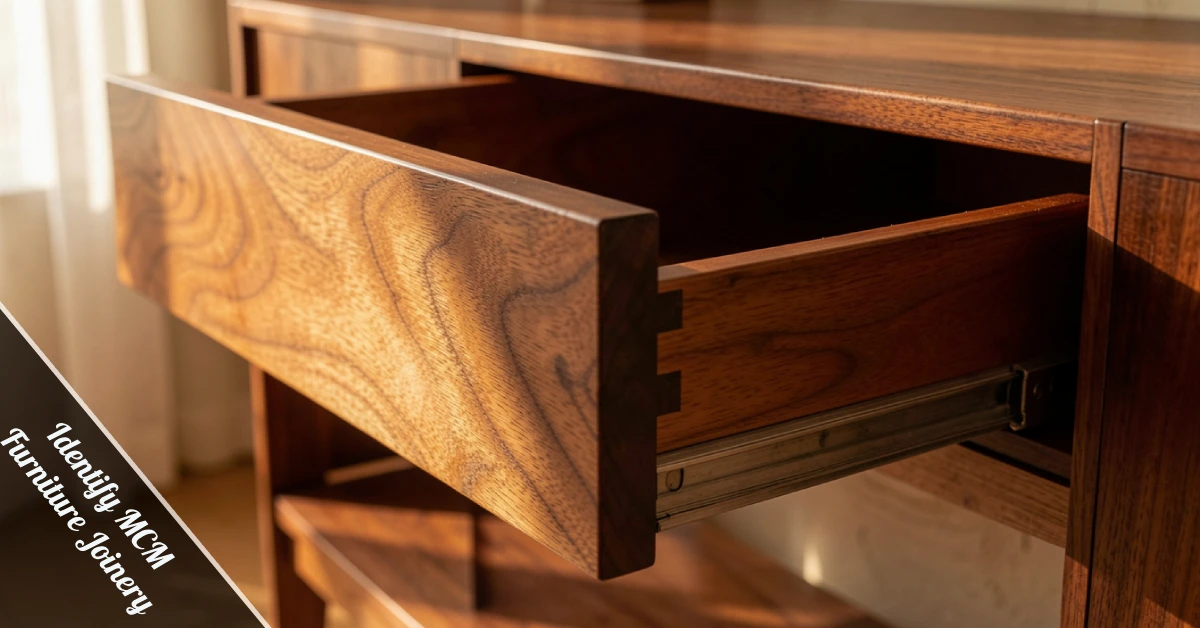
You walk into an estate sale. There’s a walnut sideboard sitting in the corner, legs tapered just right, grain pattern almost hypnotic. Is it the real deal — or a clever knockoff? Knowing how to identify MCM furniture joinery is literally your cheat code here.
Mid-Century Modern furniture isn’t just furniture. It’s a whole era of craftsmen who said, “Let’s make things that actually work and look incredible doing it.” The joinery — those hidden connections holding everything together — tells the real story.
This guide breaks down exactly what to look for, material by material, joint by joint. No fluff, no guesswork.
Why Joinery Is Your Best Authenticity Clue
Most people look at legs and surface finish first. Smart collectors flip the piece over immediately.
Authentic MCM construction used joinery methods that modern mass production simply doesn’t bother with anymore. Dovetail joints, mortise-and-tenon connections, and hand-fitted dowels weren’t accidental — they were deliberate choices made by craftsmen who took great pride in their work.
Here’s the thing: fakes usually look fine on top. It’s underneath and inside where they fall apart — literally. Drawers are your first stop. Pull one out and look at the corners. Real dovetail joints have that unmistakable interlocking finger pattern, cut with precision and usually showing slight hand-finishing marks.
Reproduction pieces? They’ll have staples, glue blocks, or simple butt joints. Dead giveaway.
Reading the Wood — Teak, Walnut, and Rosewood
The wood itself talks. You just have to listen.
Teak and walnut were the go-to materials for high-quality MCM pieces. Both have distinctive grain patterns that wrap continuously around edges — on a genuine piece, the grain flows from the top surface around to the side without interruption. That’s called bookmatched or continuous grain, and faking it properly is expensive.
Rosewood showed up on luxury items — rich, dark, with a dramatic grain that’s hard to replicate convincingly. Oak was more utilitarian, appearing in Scandinavian pieces built for everyday durability rather than showroom drama.
Now check the veneer. Real MCM veneers feel solid and sit flush — no bubbling, no peeling edges. If the veneer lifts at a corner and you see particle board underneath, walk away. Authentic pieces used veneer over solid wood or quality plywood, never over compressed sawdust.
One more check: thickness. Period veneers were typically thicker than modern ones. Run your fingernail gently along an edge — you should feel a definite layer, not a paper-thin skin.
Molded Plywood and Fiberglass — The Innovation Signature
This is where MCM furniture gets genuinely exciting.
Designers like Charles and Ray Eames weren’t just making chairs — they were engineering them. Molded plywood became their signature material, bent and shaped under heat and pressure into organic curves that no traditional joinery could achieve.
On a genuine molded plywood piece, look at the layers from the edge. They should be thin, tightly compressed, and absolutely uniform — no gaps, no separation, no visible glue lines bleeding through. The curve should feel smooth and continuous, not forced or cracked at stress points.
Fiberglass pieces — like early Eames shell chairs — have their own tells. Real period fiberglass has a slightly rough texture on the underside, almost like coarse fabric pressed into resin. Later reproductions feel smoother and more plastic-like. That texture difference is subtle but completely reliable once you know it.
Stamps, Labels, and Maker Marks — The Paper Trail
Authentic pieces left evidence. Find it.
Herman Miller and Knoll both used stamps, labels, and embossed marks on their pieces. For an Eames lounge chair, the Herman Miller logo appears on the underside of the seat shell — usually a foil label or molded stamp. For Knoll pieces, look for an embossed signature or a rectangular label on chair bases and table undersides.
Danish manufacturers often used circular paper labels with the maker’s name and country of origin. These aged in predictable ways — slight yellowing, edge curling — that’s actually a good sign. A label that looks brand new on a supposedly 1960s piece should raise questions immediately.
Italian pieces from the period sometimes carried engraved metal plaques rather than paper labels. These should show oxidation consistent with age — not shiny, not freshly polished.
Don’t just look for the label. Look at how it’s attached and how it’s aged. Context matters as much as presence.
Spotting Restoration vs. Original Condition
Restored doesn’t mean fake. But you need to know what you’re buying.
A piece in original condition will show what collectors call honest wear — slight surface scratches, a natural patina on wood or leather, and hardware with consistent age marks. This kind of wear develops evenly across a piece over decades. It can’t really be faked convincingly.
Heavy refinishing is the red flag. If the wood grain looks flattened under thick lacquer, if the color is suspiciously uniform, if the hardware looks polished while the wood looks aged — someone went overboard with restoration. That’s not necessarily bad, but it does affect value significantly.
Check joints under strong light. Refinished pieces often show drips or pooling in joinery gaps. Original finish stays where craftsmen put it — clean lines, intentional coverage, no accidental fills.
Leather on chairs like the Eames lounge develops a specific crinkle pattern over time that restoration leather simply doesn’t have yet. That crinkle is your friend.
Hardware Details That Confirm the Era
The right screw tells a story.
Original MCM hardware — drawer pulls, hinges, leg brackets — was made from solid brass, chrome-plated steel, or cast aluminum. It has weight to it. Modern reproductions often use lighter zinc alloys that feel hollow when you tap them.
Screws are particularly revealing. Period-correct pieces used slotted screws, not Phillips head. If you open a drawer and see Phillips head screws holding the drawer bottom in place, someone has been inside that piece after the original construction — either for repair or during reproduction manufacturing.
Plastic drawer glides are an automatic modern tell. Period hardware used wooden runners or simple metal guides. Clean, quiet, and completely devoid of plastic.
Where to Hunt Without Getting Burned
The right source changes everything.
Estate sales remain the best hunting ground for genuinely authentic pieces. Families selling inherited furniture rarely know — or inflate — the full value of what they have. Arrive early, bring a flashlight, and get comfortable getting on your knees to inspect the undersides properly.
Trusted vintage dealers cost more upfront but offer something estate sales can’t: provenance documentation. A good dealer can tell you where a piece came from, who owned it, and whether any restoration work was done. That paper trail has real monetary value when you eventually resell.
Online marketplaces work, but only with detailed photos. Ask specifically for close-ups of drawer joints, maker marks, veneer edges, and hardware. Any seller uncomfortable with those requests is telling you something important.
Quick Reference — What to Check Every Time
| Inspection Point | Authentic MCM Sign | Reproduction Red Flag |
|---|---|---|
| Drawer corners | Hand-cut dovetail joints | Staples or butt joints |
| Veneer edges | Flush, solid, continuous grain | Peeling, particle board beneath |
| Maker marks | Period-consistent aging | Brand new labels on old pieces |
| Hardware | Slotted screws, solid brass | Phillips screws, plastic glides |
| Molded plywood layers | Tight, uniform, no gaps | Visible glue lines, separation |
| Leather (if applicable) | Natural crinkle pattern | Uniform, unbroken surface |
| Overall wear | Even, honest patina | Inconsistent aging across the piece |
The Collector’s Mindset
The more pieces you handle, the faster your eye develops.
Reading about how to identify MCM furniture joinery is the starting point — but there’s no substitute for actually opening drawers, flipping chairs, and running your hands across veneer edges in person. Each genuine piece teaches you something the next inspection confirms.
The market has fakes. It has over-restored pieces sold as original. It has genuinely undervalued treasures sitting next to overpriced reproductions. Your advantage is knowledge — specifically, knowing that authenticity lives in the details most buyers never think to check.
Build your eye deliberately. Handle pieces at museums, galleries, and estate sales, even when you’re not buying. That tactile memory compounds into something genuinely valuable over time.
When you finally identify MCM furniture joinery correctly on a piece, the seller hasn’t priced properly — that’s when the work pays off.