

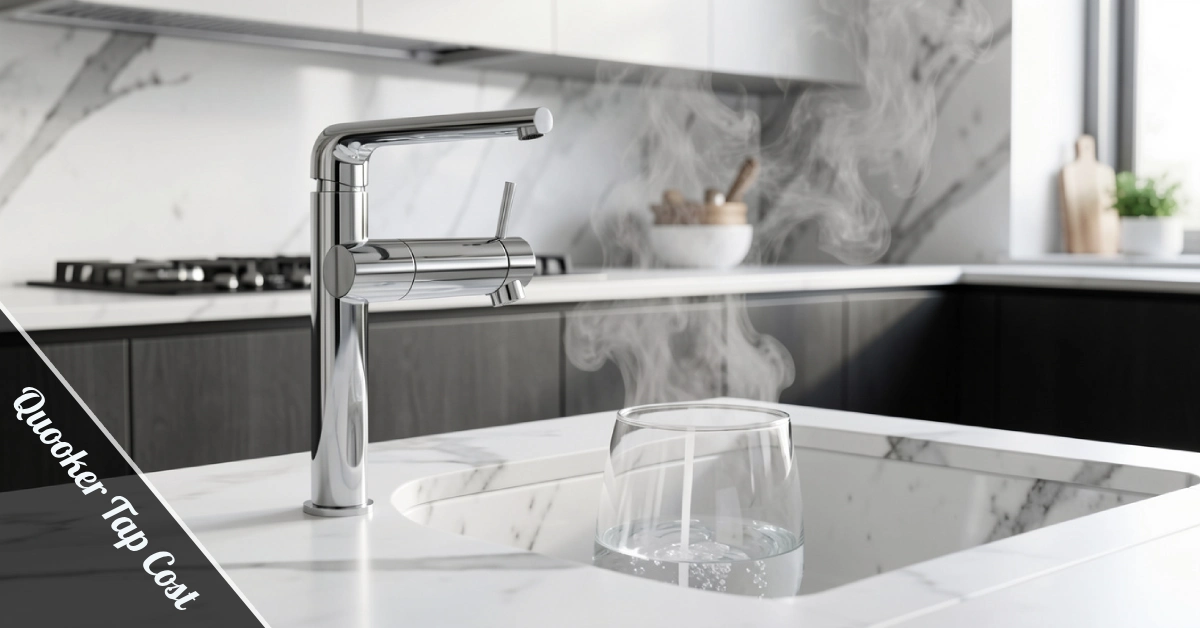
You’ve seen it in showroom kitchens and Instagram reels — the sleek tap that delivers boiling water on demand. But before you fall in love, let’s talk real numbers and real expectations.
The Quooker tap cost surprises most homeowners. It’s not just a tap — it’s a full system, and the price honestly reflects every bit of that.
This guide breaks down every expense: purchase price, installation, running costs, and maintenance — no surprises, just straight facts.
Whether you’re mid-renovation or just curious, this is everything you need to decide confidently.
What Does a Quooker Tap Actually Cost?
The Quooker tap costs start at around £1,250 for entry-level models — and that price includes the three-litre under-sink tank. Depending on the model, finish, and add-ons you choose, prices can climb comfortably past £2,420.
Quooker offers five main model lines: Flex, Classic, Front, Fusion, and Nordic. Each comes in multiple finishes — brushed steel, chrome, and matte black — so there’s a style for every kitchen.
Want more capacity? Upgrading to the seven-litre COMBI tank adds around £300 to your total — and delivers 15 litres of hot water at 60°C for bigger households.
The Quooker CUBE add-on brings sparkling and chilled water for an extra £1,150.
Quooker Models & Price Breakdown
Here’s a quick look at what you’re spending per model — before installation or any add-ons are factored in.
| Model | Starting Price | Tank Size | Sparkling Water? |
| Nordic | ~£1,250 | 3L | No (add CUBE) |
| Classic | ~£1,380 | 3L | No (add CUBE) |
| Fusion | ~£1,500 | 3L / 7L | Optional |
| Flex | ~£1,700 | 3L / 7L | Optional |
| Front | ~£1,900+ | 7L COMBI | Optional |
Prices vary by finish, too. Brushed gold and matte black typically cost more than standard chrome. Always double-check live pricing on the official Quooker UK website before committing, as models update regularly.
Every system ships with the tank included. That matters — some competitor brands sell the tap and the tank separately, so compare like-for-like before you buy.
Quooker was invented by Henri Peteri in 1970 — the world’s very first boiling water tap.
Installation Costs: Don’t Skip This Part
Installation is where many buyers get caught off guard. You’ll need a qualified plumber, and in most cases an electrician too — the tank needs a dedicated power supply nearby. Budget between £150 and £400 for a proper professional fit.
If your kitchen already has an existing boiling water tap or plumbing roughed in, you’re lucky. Retrofitting costs significantly less than a brand-new first-time install in an older or traditional kitchen.
Under-sink space is critical — you need clearance for the tank itself plus room for regular servicing access. Measure before you order anything.
Some kitchen fitters bundle Quooker installation into a wider project quote — always ask upfront to compare total costs.
Mid-renovation is genuinely the smartest time to fit one. Tradespeople, connections, and access are already on-site — saving you money.
How Much Does a Quooker Tap Cost to Run?
Running costs are a major concern — especially with UK energy bills still elevated. The good news: according to Scienceofproperty’s analysis, a Quooker tap costs around £68.48 per year to run on average across all models.
That figure covers both standby insulation energy and the actual cost of heating the water you dispense. It’s a surprisingly manageable number for what you’re getting.
The tank stays hot using just 10 watts on standby — roughly the same draw as a Wi-Fi router. Annually, standing alone costs around £11–£12. Based on Ofgem’s Q3 2026 energy price cap of 25.73p/kWh, a 1,600W model costs about 10.29p to heat a full 3-litre tank each time.
Here’s how Quooker stacks up against rival boiling water tap brands on annual running cost:
| Brand | Annual Standby Cost | Annual Heating Cost | Total/Year |
| Quooker | £23.65 | £30.73 | £68.48 |
| Hyco | £41.39 | £30.73 | £72.13 |
| Fohen | £67.77 | £30.73 | £98.50 |
| Qettle | £82.78 | £30.73 | £113.52 |
Data sourced from Tapmagic’s brand comparison. Quooker’s vacuum insulation technology is the clear winner — it keeps standby costs nearly 70% lower than Qettle, and about 65% lower than Fohen.
Quooker vs Kettle: Which Is Actually Cheaper?
A kettle wins on pure per-use running cost — boiling a single cup costs roughly 1.28p. A Quooker tap? Just 0.25–0.30p per cup. But a kettle has zero standby cost, while a Quooker quietly ticks over at 10W throughout the day.
For heavy users — families brewing multiple cups of tea and coffee daily — the Quooker makes solid financial sense over time. Light users may still prefer the kettle.
The real saving isn’t always financial. It’s time, worktop space, and never standing over a kettle watching water boil again.
According to data from Idealhome, traditional kettles waste around 50% of their energy due to overfilling habits.
Maintenance & Servicing: The Hidden Costs Worth Knowing
Owning a Quooker isn’t a ‘set it and forget it’ situation. You’ll need to descale the tank regularly — every one to three months, depending on your local water hardness. Limescale buildup kills energy efficiency fast.
Filter replacements are part of the deal, too. A blocked filter slows flow and quietly increases your running costs. Check yours monthly and replace when the flow drops noticeably.
Quooker taps are engineered to last up to 20 years with proper, consistent care.
Annual servicing by a qualified engineer is optional but genuinely worth it. Service call costs typically sit between £80–£150, depending on your region — cheap insurance for a £1,500+ system.
Keep the tank insulation intact and the under-sink cabinet well-ventilated. Both directly affect how much energy your tap uses.
How Does Quooker Compare to Other Boiling Water Taps?
The boiling tap market has expanded fast. Brands like Qettle, Franke, InSinkErator, and Fohen all compete — often with lower upfront prices that look tempting at first glance.
Qettle starts from around £545, and InSinkErator’s entry model starts from just £334. But as the running cost table above clearly shows, you’ll pay significantly more year-on-year to keep those taps hot compared to a Quooker — the upfront saving evaporates.
Franke’s Minerva Helix 4-in-1 tap sits at £1,062 — cheaper upfront than Quooker, but without the same vacuum insulation tech that keeps annual running costs so low.
If long-term efficiency matters to you, Quooker’s superior heat retention technology genuinely earns its premium price point.
Is the Quooker Tap Cost Worth It Long Term?
The Quooker tap cost is genuinely high upfront. But spread across 15–20 years of daily use, the maths shift firmly in your favour.
Think about everything it replaces: a kettle, a sparkling water machine, possibly a water filter. That’s three appliances folded into one sleek tap with no worktop clutter — for a kitchen renovation, it’s a hard argument to beat.
As Stephen Johnson, Managing Director at Quooker UK, has noted: unlike energy-hungry kettles, Quooker taps use very little electricity — and the running cost data backs that claim up completely.
For homeowners mid-renovation, the timing is perfect. Installation is cheaper when plumbers and electricians are already working on-site — you avoid call-out fees and scheduling delays entirely.
Property developers also love it — a Quooker tap is a premium detail buyers genuinely notice.
It adds perceived kitchen value well above its ticket price, particularly in competitive property markets where premium finishes make a real, measurable difference to buyer interest.
Frequently Asked Questions
Is it cheaper to boil a kettle or use a Quooker tap?
For low daily usage, a kettle is still cheaper to run. But if your household boils water frequently throughout the day, a Quooker tap’s per-cup cost of 0.25–0.30p beats a kettle’s 1.28p comfortably.
How long do Quooker taps last?
With regular descaling and filter changes, a well-maintained Quooker tap can last up to 20 years — making the upfront investment far more palatable when you break it down annually.
Do Quooker taps need a plumber to install?
Yes — a qualified plumber is required for the water connections, and most installs also need an electrician for the dedicated power supply. Don’t attempt a DIY fit on a system this complex.
Can I add sparkling water to any Quooker model?
Yes — the Quooker CUBE accessory can be added to most models for an additional £1,150. It delivers both chilled and sparkling water.
The Bottom Line
The full Quooker tap cost — system, tank, installation, and annual running expenses — is a genuine investment. But when you compare it honestly against the competition, both on purchase price and long-term running costs, it consistently justifies the spend.
You’re looking at roughly £1,250–£2,420 to buy, £150–£400 to install, and around £68 per year to run. Compare that to competitors costing up to £113 annually just to operate — Quooker’s premium makes real financial sense.
For a kitchen upgrade that earns its place every single day, the Quooker tap is one of the smarter moves available.