

You’ve probably already sat on one in-store, felt that “sinking into a cloud” moment, and thought: “But will it still feel like this in two years?“ That’s exactly the right question to be asking before spending $2,199 to $3,000+ on a sofa.
Most product pages won’t answer it. Neither will a 5-minute showroom visit. So this West Elm Harmony Sofa review is built on something different — real owner experiences from people who have lived with this sofa daily, through movie nights, holiday gatherings, kids jumping on it, and years of regular use.
By the end of this guide, you’ll know whether the Harmony fits your lifestyle, which fabric to choose, which configuration makes sense for your room, and what nobody tells you before you buy. Let’s get into it.
What Exactly Is the West Elm Harmony Sofa?
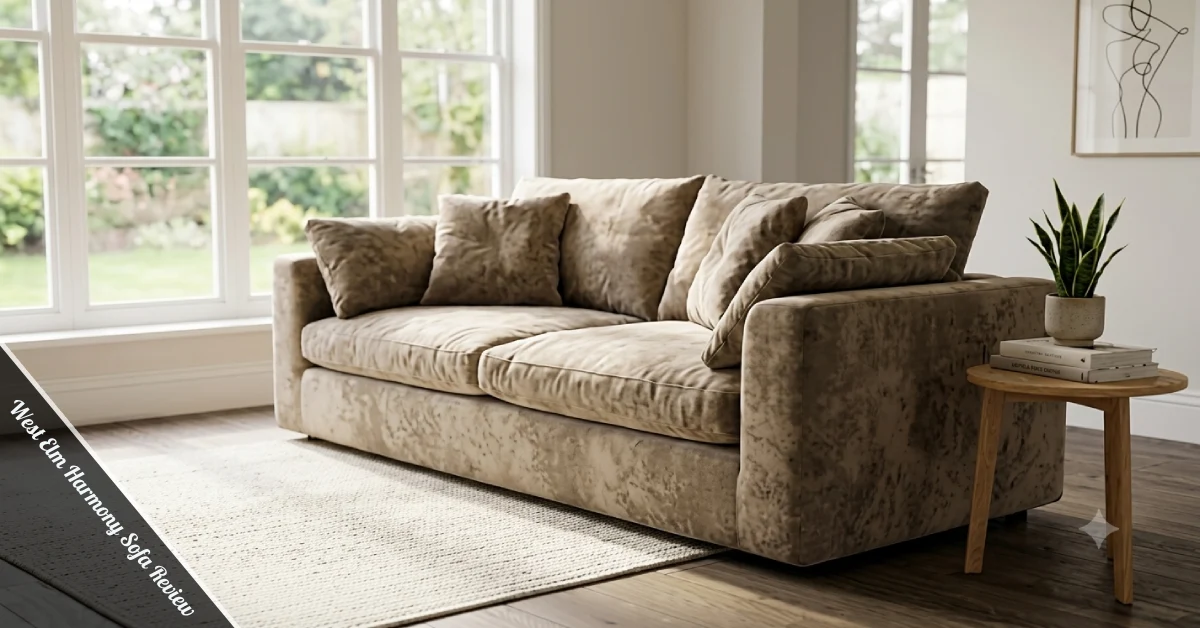
The Harmony is West Elm’s flagship lounge sofa — a deep-seated, feather-down-filled couch designed around comfort over structure. It sits low to the ground, with a boxy silhouette and cushions that feel more “melt into” than “sit upright on.” It’s available as a standard sofa, a loveseat, a chaise configuration, and a full modular sectional.
The Harmony Sofa is GREENGUARD Gold Certified, meaning it meets strict chemical emission standards — something worth noting if you have kids or are sensitive to off-gassing from new furniture.
Key Specs and Features at a Glance
| Feature | Detail |
| Seat Depth | 34 inches (standard) / 38 inches (extra deep) |
| Cushion Fill | Feather-down blend with foam core |
| Price Range | $2,199–$3,000+ (sofa); $3,500–$5,500+ (sectional) |
| Fabric Options | 100+ options incl. Distressed Velvet, Dune, Crypton performance fabrics |
| Configuration Options | Sofa, loveseat, chaise, full sectional (modular) |
| Firmness Level | Soft to medium-soft (lounge-forward design) |
| Certification | GREENGUARD Gold Certified |
| Leg Finish | Dark walnut or natural wood (option dependent) |
What makes those specs matter in practice: the 34-inch seat depth is significantly deeper than most standard sofas, which hover around 22–24 inches. If you’re buying a sofa to lounge, nap, or curl up with a book, that extra depth changes everything. If you need upright support for desk work or dining, that same depth might feel too cavernous.
Why Do So Many People Love the Harmony Sofa?
Cloud-Like Comfort That Draws You In
This is where the Harmony really shines. The feather-down blend cushions create that famous “cloud sofa” feeling — soft, yielding, and genuinely hard to get up from. One owner who’s 5’9″ described the 34-inch deep seats as “feeling like the sofa is hugging you.” Several long-term owners mention that after switching from firm traditional sofas, they genuinely can’t go back.
One interior designer who has specified the Harmony Sofa in five separate client projects keeps returning to it for the same reason: comfort is the one thing clients never complain about. Four years of daily use and guests still comment on how good it feels to sit on. That’s not a coincidence.
A Design That Works in Any Room
The Harmony’s boxy, low-profile silhouette is the kind of design that disappears into a room — in a good way. It doesn’t compete with your art, your rugs, or your windows. Whether your home runs traditional, mid-century modern, or contemporary minimalist, the Harmony reads as intentional rather than dominating. Pair it with a statement rug, and you’ve got a living room that looks genuinely curated.
The 100+ fabric options make this easier. You’re not locked into beige. From deep navy velvet to a warm terracotta weave, there’s a configuration that fits most design directions — which is part of why it remains one of West Elm’s best-selling sofas year after year.
Modular Flexibility for Any Space
The Harmony’s modular system means you can build a configuration around your actual room — not the other way around. Start with a sofa and chaise. Add a loveseat later when you move to a bigger apartment. Reconfigure when you rearrange the room. This flexibility makes the higher upfront price easier to justify, since you’re not starting from scratch every time your space changes.
For families in larger American homes, the full sectional configuration (typically running 110–130 inches) is a genuine statement piece that fills a room properly without feeling overcrowded.
Built to Handle Real Life — Kids, Pets, Daily Use
With the right fabric choice (more on that in a moment), the Harmony handles real family life surprisingly well. Owners report that the cushion covers — though not slipcover-style — can be spot-cleaned effectively on most fabric options. Crypton performance fabric in particular has a loyal following among owners with dogs and kids, with multiple reviewers noting that liquid spills bead up rather than absorb immediately.
The frame itself is solid. Long-term owners with 3–4 years of daily use report no wobbling, no sagging base, and no structural complaints. The cushions are a different story — but we’ll get to that.
What Are the Real Downsides of the Harmony Sofa?
The Pillow Management Problem
Here’s the thing nobody warns you about before you buy: the Harmony comes loaded with back cushions and throw pillows. After one movie night with the family, those pillows are on the floor, wedged behind the sofa, or stacked in a corner. It takes maybe 2 minutes to straighten everything out — but if you value a consistently tidy living room, this becomes a daily ritual.
Practical fix: Owners who love the Harmony but hate the pillow chaos typically keep just two or three throw pillows instead of the full complement. The back cushions do double duty as lumbar support, so you don’t actually lose comfort by reducing the decorative pillow count. Also worth noting: velvet and textured fabrics help pillows stay in place better than smooth linen weaves, where everything slides the moment someone sits down.
No Easy-Wash Slipcover Option
Unlike some competitors — Pottery Barn offers slipcover styles on select pieces — the Harmony doesn’t have a true washable slipcover option. Most cushion covers can be unzipped and spot cleaned, but throwing them in the washing machine is risky. Owners report that machine washing can distort the cushion cover shape, making re-insertion frustrating.
Practical fix: If washability is a top priority (think: toddlers, heavy pet use), choose a Crypton fabric from the start. It resists stains at the surface level, which reduces how often you’ll need a deep clean in the first place. For annual deep cleans, professional upholstery cleaning is the safest route.
It’s an Investment — Not a Budget Pick
It’s expensive. Let’s not sugarcoat that. A standard three-seat Harmony starts around $2,199 and climbs quickly with fabric upgrades or sectional add-ons. A full sectional in a performance fabric can clear $5,000 with ease.
Practical fix: Watch West Elm’s “Buy More Save More” sale events — these happen multiple times a year and can take 20–30% off the total purchase price. Applying for the West Elm credit card at checkout also adds a first-purchase discount. Buying the sofa and a chaise together (rather than separately) typically lands you in a better discount tier.
Which Fabric Should You Pick for the Harmony Sofa?
Why Distressed Velvet Is a Fan Favourite
If you scroll through Harmony Sofa reviews and owner photos, distressed velvet shows up constantly — and for good reason. The chenille yarn construction gives it a subtle sheen and tactile depth that reads as luxurious without being fussy. It’s also more forgiving of everyday wear than you’d expect from a velvet: minor scuffs brush out easily, and the textured pile hides surface dust better than flat fabrics.
For households with moderate pet and kid activity, distressed velvet strikes a good balance between looking great and being practical. It’s not as stain-resistant as Crypton, but it’s significantly more forgiving than flat linen or cotton weaves.
Watch Out for the Colour Confusion
This is a specific problem that catches buyers off guard: the Dune and Sand colourways look almost identical online, but read noticeably differently in real lighting. Dune tends to pull slightly cooler and greyer in warm-toned rooms; Sand reads warmer and more golden. Multiple owners have ordered based on the online swatch only to receive a sofa that looked completely different against their existing walls and flooring.
The fix is simple but inconvenient: request fabric swatches before you order. West Elm will send them for free. Hold them against your walls and floors in both natural daylight and evening lamp light. The 10 minutes this takes could save you weeks of return logistics.
Quick fabric guide by use case:
- Families with kids and pets: Crypton performance fabric — maximum stain resistance
- Style-first, moderate activity: Distressed Velvet — beautiful, durable, forgiving
- Formal or low-traffic rooms: Belgian Linen or Twill — elegant but requires more careful maintenance
- Hot climates or warm households: Performance Basketweave or Twill — breathes better than velvet
Is the West Elm Harmony Sofa Right for Your Home?
I genuinely think this is the most useful section of this review. The Harmony isn’t a universal sofa — it’s genuinely excellent for certain lifestyles and a poor fit for others. Here’s how to self-assess quickly.
Best For…
- People who prioritise lounging, movie nights, and weekend relaxation over upright posture
- Taller individuals (5’8″ and above) who finally want a sofa deep enough to sit back fully
- Open-plan living rooms and family rooms where a large sectional anchors the space
- Design-conscious homeowners who want a statement piece that also happens to be extremely comfortable
- Households in the US with moderate-to-active family use (especially with the Crypton fabric)
- Anyone planning to keep a sofa for 5–10 years and wants to invest in quality
Think Twice If…
- You prefer an upright seated posture — for desk work, eating, or formal entertaining
- You’re petite or shorter than 5’4″ and find deep sofas make it hard to sit back and still touch the floor
- You have elderly family members who need to push up easily — the low seat height can make standing difficult
- Your living room is under 200 sq ft, and a deep sectional would overwhelm the space
- You need machine-washable upholstery for heavy daily messes
- You’re furnishing a formal sitting room rather than a casual family room
How Does the Harmony Sofa Compare to Similar Sofas?
The Harmony sits in a competitive segment — premium cloud-style sofas with modular options. Here’s a straight comparison with two popular alternatives.
| Feature | West Elm Harmony | Arhaus Kipton | Pottery Barn Sectional |
| Price Range | $2,199–$5,500+ | $3,000–$6,500+ | $2,500–$5,000+ |
| Firmness | Soft/medium-soft | Medium | Medium/medium-firm |
| Fabric Options | 100+ (incl. Crypton) | Limited premium options | 60+ (incl. performance) |
| Modularity | Yes — full modular | Limited | Yes — modular |
| Washable Covers | No slipcover option | No slipcover option | Some slipcover styles |
| Best For | Lounging, families, style | Formal look + durability | Traditional homes, upright seating |
The Arhaus Kipton is a legitimate competitor if you want slightly more structured support and are willing to pay more. The Pottery Barn sectional is a better fit if you need a firmer sofa for formal settings or value slipcover washability. For the combination of deep comfort, design flexibility, and modular options, the Harmony holds its own at the price point — especially during West Elm sale events.
Final Verdict
After digging through years of real owner feedback, the West Elm Harmony Sofa earns its reputation. Here’s the short version:
- The Harmony is built for comfort and loungeability — but requires regular cushion maintenance to keep looking its best.
- Distressed velvet is the standout fabric choice for most households; Crypton is the right pick for maximum stain resistance.
- It’s a genuine long-term investment, and consistent owner feedback over multiple years backs that up.
- It’s not the right sofa for upright seating, petite users, or formal sitting rooms.
If comfort is your top priority and you’re happy to fluff cushions every few days, the Harmony is genuinely one of the best sofas you can buy in this price range. If you need something firm and formal, look elsewhere.
FAQs
Is the West Elm Harmony Sofa worth the price?
For most buyers who prioritise comfort and long-term durability, yes. Long-term owners consistently rate the Harmony highly even 3–4 years in. The frame holds up, and the feather-down cushions retain their feel longer than foam-only options. The main caveat: if you need a firm, upright sofa, you’re paying a premium for comfort characteristics you’ll never use.
How deep are the seats on the Harmony Sofa?
The standard configuration has a 34-inch seat depth. An extra-deep option extends this to 38 inches. For reference, most traditional sofas run 22–24 inches. This is a genuinely significant difference in how the sofa feels — and it’s the main reason taller users love it, and shorter users occasionally find it awkward.
Do the Harmony Sofa cushions sag over time?
The feather-down blend cushions will lose some loft over time and require regular fluffing — this is normal for any down-fill cushion. Owners who fluff and rotate cushions weekly report that the sofa looks and feels great even after several years. Owners who don’t maintain the cushions report a somewhat deflated appearance within 12–18 months. It’s not so much a quality problem as a maintenance expectation.
Is the Harmony Sofa good for families with kids and pets?
With the right fabric, yes. Crypton performance fabric is the top recommendation for households with significant spill and mess risk. Distressed velvet is a strong second choice for moderate activity. Avoid flat linen or cotton weaves if kids and pets are a daily reality.
Can you wash West Elm Harmony cushion covers?
The cushion covers can be unzipped for spot cleaning, but machine washing is risky. The high heat and agitation of a washing machine can distort the cover shape, making it difficult to re-insert the cushion properly. Professional upholstery cleaning is the recommended approach for deep cleans.
What is the firmness level of the Harmony Sofa?
Soft to medium-soft. This is a lounge-forward sofa, not a posture-support piece. On a firmness scale of 1–10 (with 10 being the firmest), most owners place the Harmony around a 4–5. If you want something closer to a 7–8, look at the Arhaus Kipton or Pottery Barn’s firmer sectional options.
How does the Harmony compare to the Arhaus Kipton?
The Kipton is slightly firmer and more structured, which some buyers prefer for everyday seated use. The Harmony is softer and better for deep lounging. The Kipton also carries a higher price tag. Both are quality pieces — the choice comes down to comfort preference and budget.