

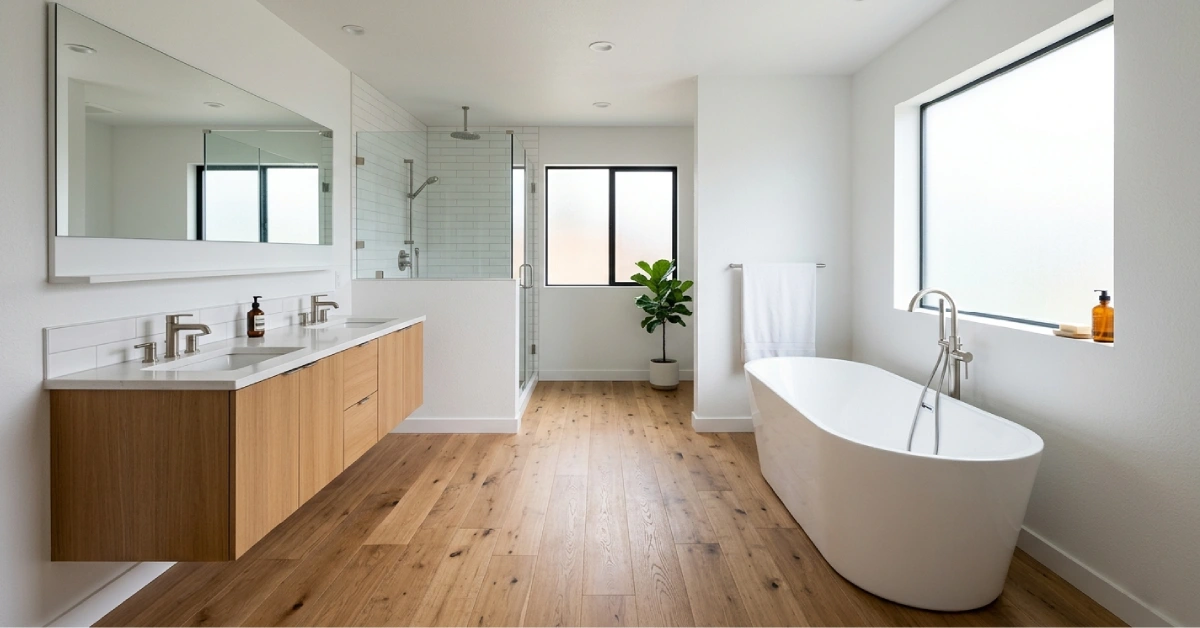
Yes, you can install wood flooring in a bathroom, but the type you choose matters. Engineered hardwood is the safest option because its layered plywood core resists moisture better than solid wood. With proper ventilation, regular maintenance, and quality sealing, wood floors can last for years in a bathroom.
Solid hardwood is a higher-risk choice and best avoided in full bathrooms.
Why Homeowners Still Want Wood Floors in a Bathroom
Walk into any bathroom with wood flooring, and you immediately feel the difference. It’s warmer underfoot than tile. It looks richer than vinyl. It gives a room a character that cold ceramic simply cannot match.
That appeal keeps growing. According to the National Wood Flooring Association, wood remains one of the most sought-after flooring choices in home renovation projects, including spaces traditionally reserved for tile.
But wood and moisture are not natural partners. That tension is what this article is here to address. You’ll learn exactly which wood types work, what fails, how to protect your floors, and how to make the smartest choice for your specific bathroom.
The Real Risk: What Water Does to Wood Floors
Wood is hygroscopic, meaning it absorbs and releases moisture from the surrounding air. When humidity levels in your bathroom spike, the planks swell. When the air dries out, they contract. Over time, that repeated movement causes cupping, warping, cracking, or gaps between planks.
Solid hardwood takes the hardest hit. Because it is one single piece of wood from surface to base, there is nothing to stop moisture from travelling through the entire plank.
Bathrooms have high humidity, far more so than other rooms in your house. Steam from hot showers does not just fog your mirror. That moisture settles directly onto your flooring.
Beyond humidity, bathrooms present four active water threats:
- Splashes from the sink, tub, and shower
- Standing water from wet feet or bathing children
- Plumbing leaks and pipe bursts
- Water that pools in uneven subfloor areas
None of these is hypothetical. Every bathroom deals with them every single day. Bathrooms used regularly by young children carry an elevated version of these risks, as playtime splashing can introduce significantly more water onto the floor than typical adult usage.
Chemical residues add another layer of risk. Toothpaste, facial cleansers, and hair dyes left on the surface can eat into polyurethane finishes and cause permanent discolouration. These products are mildly acidic, and if they sit unnoticed on the floor, they can dull the protective coating far faster than plain water.
Wood Flooring in Bathroom: Which Types Actually Work
Not all wood flooring carries the same risk in a bathroom. Here is a clear breakdown.
Solid Hardwood
Solid hardwood is a single-piece plank with no protective core layers. It is beautiful, refinishable multiple times, and genuinely durable in dry areas. In a bathroom, however, it is the weakest choice.
Solid hardwood is susceptible to swelling, warping, and water damage due to its natural structure, making it a poor fit for moisture-prone rooms.
If you are committed to solid hardwood, powder rooms and half-baths with limited shower exposure are the safest application. Even then, you need to stay on top of sealing and maintenance.
Engineered Hardwood
Engineered hardwood is built differently. The top layer is a real wood veneer, which gives it the look and feel of solid wood. Below that, multiple layers of cross-bonded plywood form a stable core.
The core layers of engineered hardwood stabilise the planks, preventing excessive expansion or contraction in humid environments.
This makes engineered hardwood far more practical for bathroom use. It handles humidity better, moves less with temperature changes, and is available in finishes designed specifically for wet areas.
That said, engineered hardwood is water-resistant, not waterproof. Extended standing water will still cause damage.
Waterproof Engineered Hardwood
The best option for a full bathroom with showers and bathtubs is waterproof engineered hardwood. These products use a hyper-dense core and multi-dimensional sealing on every edge of each plank.
Waterproof engineered wood flooring combines a real wood veneer with a waterproof core, resulting in a product that looks like solid wood but performs better in wet conditions.
Several manufacturers now offer this product with residential warranties of 50 years or more. It is the most practical wood-look solution for high-moisture bathrooms.
If Real Wood Feels Like Too Much Commitment: The Alternatives
If the ongoing maintenance of real wood does not fit your lifestyle, wood-look porcelain tile and luxury vinyl plank (LVP) are the primary alternatives. Both replicate the aesthetic of timber while offering 100% waterproof performance. Porcelain tile is incredibly durable and scratch-resistant, while LVP provides a softer, warmer feel underfoot and is generally more budget-friendly. Neither can be refinished or provide the exact organic texture of real timber, but they eliminate almost all moisture-related risk from the outset.
Best Wood Species for Bathroom Flooring
The species of wood matters as much as the construction type. Dense-grain woods resist moisture penetration far better than softer, more porous species.
Best choices:
- White Oak: One of the top-rated species for bathroom use. Its tight grain pattern limits water penetration even through minor knots or surface variations.
- Teak: Naturally high in oil content, which makes it more water-resistant than most other species.
- Maple: Dense and hard, though it benefits from more frequent refinishing in humid conditions.
- Walnut: Rich, dense grain with strong durability, though it needs a quality finish to perform in bathrooms.
- Hickory: Hard and durable—ranking high on the Janka hardness scale—though some professionals advise caution with hickory in high-moisture areas. White Oak, while slightly lower on the same scale, is often preferred for its superior moisture resistance.
Species to avoid:
- Pine: Too soft and porous; absorbs moisture quickly.
- Fir: Similar density issues to pine.
- Any softwood with an open grain structure.
White oak is one of the best wood floors for a bathroom. It handles humidity better than maple, and its graining helps prevent water from penetrating through knots or cracks.
Finishes and Coatings That Protect Wood in Bathrooms
The finish on your wood floor is your first line of defence against moisture. A worn or thin finish will allow water to reach the wood beneath, leading to staining, swelling, and eventual rot.
Aluminium oxide finish: A factory-applied option on many prefinished planks. It creates a hard surface layer that resists scratches and water absorption. This is one of the most protective coatings available for bathroom wood floors.
Polyurethane finish: Applied in multiple coats, polyurethane creates a durable, waterproof barrier on the surface. Water-based polyurethane dries faster and has lower odour; oil-based versions tend to be slightly more durable.
Moisture-cure urethane: A professional-grade option that bonds extremely tightly to the wood surface and offers superior water resistance. It is harder to apply and has a strong odour during application.
A well-maintained finish also prevents mould and mildew. Once moisture penetrates a worn finish, it settles into the wood grain and, combined with soap scum and organic debris, creates an ideal environment for fungal growth. Keeping your finish intact is the single most effective way to keep the floor hygienic.
Seal the edges of your floor using silicone or a similar sealant around the perimeter to prevent water from seeping underneath, and consider a moisture barrier underlayment during installation.
One simple test to check your floor’s finish: drop a few water droplets on the surface. If they bead up and sit on top, your finish is doing its job. If they absorb into the wood within a few minutes, it is time to reapply a topcoat.
How to Protect Wood Flooring in a Bathroom Every Day
Installing the right floor is only part of the job. How you manage your bathroom environment makes a significant difference in how long those floors last.
Follow these daily and routine habits:
- Wipe up water immediately. Never leave puddles or spills sitting. This applies equally to splash zones near the tub, sink, and toilet.
- Use bath mats with a solid rubber or vinyl backing. This prevents moisture from wicking through the mat and trapping dampness against the wood surface. Standard fabric-backed mats are a common culprit in premature floor failure.
- Run an exhaust fan during and after every shower. Leave it running for at least 15 to 20 minutes after you finish to draw humidity out of the room. Consider this a non-negotiable prerequisite for any bathroom with wood flooring. In cases where natural ventilation is limited, or humidity remains high despite fan usage, a standalone dehumidifier can further stabilise the environment.
- Check your plumbing and condensation regularly. A slow leak under the sink or behind the toilet can go unnoticed for weeks. Equally, a cold toilet tank can collect condensation on humid days, dripping down onto the floor. Wipe these drips promptly and ensure all pipe openings are thoroughly caulked.
- Maintain bathroom humidity between 30% and 50%. A basic hygrometer costs very little and allows you to monitor the moisture level in the room.
- Reapply finish or topcoat every one to two years in high-traffic areas to maintain water protection as the surface wears down.
Using recommended wax or urethane touch-up coats every one to two years provides added protection as floors age, replenishing water resistance before damage can occur.
Installing Wood Flooring in a Bathroom: Key Steps to Get Right
Even the best floor material will fail if the installation is wrong. These are the most important steps for a bathroom installation.
Check and correct floor slope. Before any material arrives, use a 4-foot level across the subfloor. If water pools in any low spot, apply a self-levelling compound to create a perfectly flat plane. Standing water will destroy even the most waterproof floor, and a sloped subfloor guarantees that puddles form in the same spots every time.
Verify your warranty covers bathroom use. Many manufacturers explicitly exclude water-heavy environments from their coverage. Get written confirmation from the supplier that your specific product is warranted for bathroom installation. If the warranty has moisture-related exclusions, consider that a red flag.
Acclimate your flooring first. Before installation begins, leave the planks in the bathroom for 48 to 72 hours. This allows the wood to adjust to the room’s humidity and temperature, reducing expansion after installation.
Leave expansion gaps and consider plank width. Wood floors expand and contract with changing humidity levels. Leave at least half an inch of expansion space around the perimeter of the floors during installation. To further minimise the visual impact of seasonal gaps, opt for narrower planks or a herringbone pattern, which helps distribute movement more evenly across the installation.
Seal the subfloor. Use a moisture barrier membrane on the subfloor before laying the planks. This is especially important if your bathroom sits above a concrete slab or in an area with high groundwater levels.
Seal all edges and seams. Use silicone sealant along the baseboards, around the toilet base, and at the edges of any shower or tub surround. These are the entry points where water is most likely to sneak underneath.
Avoid floating installation near wet zones. Glue-down installation creates a tighter bond with the subfloor and leaves less room for water to travel beneath the planks.
Solid Hardwood vs. Engineered Hardwood in a Bathroom
Here is a direct comparison to help you choose:
| Feature | Solid Hardwood | Engineered Hardwood |
|---|---|---|
| Moisture resistance | Low | Moderate to high |
| Best bathroom type | Powder rooms only | Full bathrooms with care |
| Expansion/contraction | High | Low to moderate |
| Refinishing | 2 to 5 times | 1 to 2 times |
| Cost | Higher | Moderate |
| Waterproof options | No | Yes |
You can refinish solid hardwood anywhere from two to five times. Engineered hardwood can be refinished as well, though less often, perhaps twice.
The refinishing advantage is worth noting. Both flooring types allow you to sand back surface damage and apply a fresh finish, which extends the life of the floor significantly compared to materials like vinyl or tile.
Note on refinishing logistics: Refinishing a bathroom floor requires a different approach to sanding. The compact layout of most bathrooms makes large drum sanders impractical. Refinishing is usually done with handheld or edging sanders, which is slower and requires more precision than sanding a large living area. Factor this into your long-term maintenance planning before you commit to a floor that will eventually need sanding.
Does Wood Flooring Add Value in a Bathroom?
Design-wise, yes. Wood floors in a bathroom create a spa-like atmosphere that resonates with buyers and guests alike. They photograph well, they feel warm and natural underfoot, and they pair with almost every bathroom style from modern to rustic.
From a practical standpoint, the value depends on how well the floor is maintained. A well-kept wood floor in a bathroom will hold its appeal for decades. A neglected one can become a liability.
If you are renovating with resale in mind, use engineered hardwood or waterproof engineered hardwood, maintain it properly, and it becomes a genuine selling point rather than a risk for the next owner.
FAQs
Can you put wood flooring in a bathroom with a shower?
Yes, but use waterproof engineered hardwood rather than standard engineered or solid hardwood. Seal all edges around the shower surround with silicone, use bath mats inside and outside the shower area, and run ventilation during and after every shower.
What happens if water gets under wood flooring in a bathroom?
Standing water beneath wood planks causes the subfloor and the planks themselves to absorb moisture, leading to warping, mould growth, and structural damage. This is why proper sealing during installation and prompt cleanup of spills are both critical.
Is engineered hardwood or luxury vinyl better for a bathroom?
Luxury vinyl is fully waterproof and requires less maintenance. Engineered hardwood offers a more authentic wood appearance and can be refinished. If low maintenance is your priority, luxury vinyl is safer. If you want the look and feel of real wood, go with waterproof engineered hardwood and maintain it properly.
How long will wood flooring last in a bathroom?
With waterproof engineered hardwood and proper maintenance, 20 to 30 years is a reasonable expectation. Some products carry 50-year warranties. Solid hardwood in a bathroom has a shorter, less predictable lifespan, depending entirely on moisture management.
Do I need a special underlayment for wood flooring in a bathroom?
Yes. Always use a moisture barrier underlayment beneath engineered hardwood in a bathroom. This prevents ground moisture from rising into the planks and gives you an extra layer of protection against minor spills or leaks.