

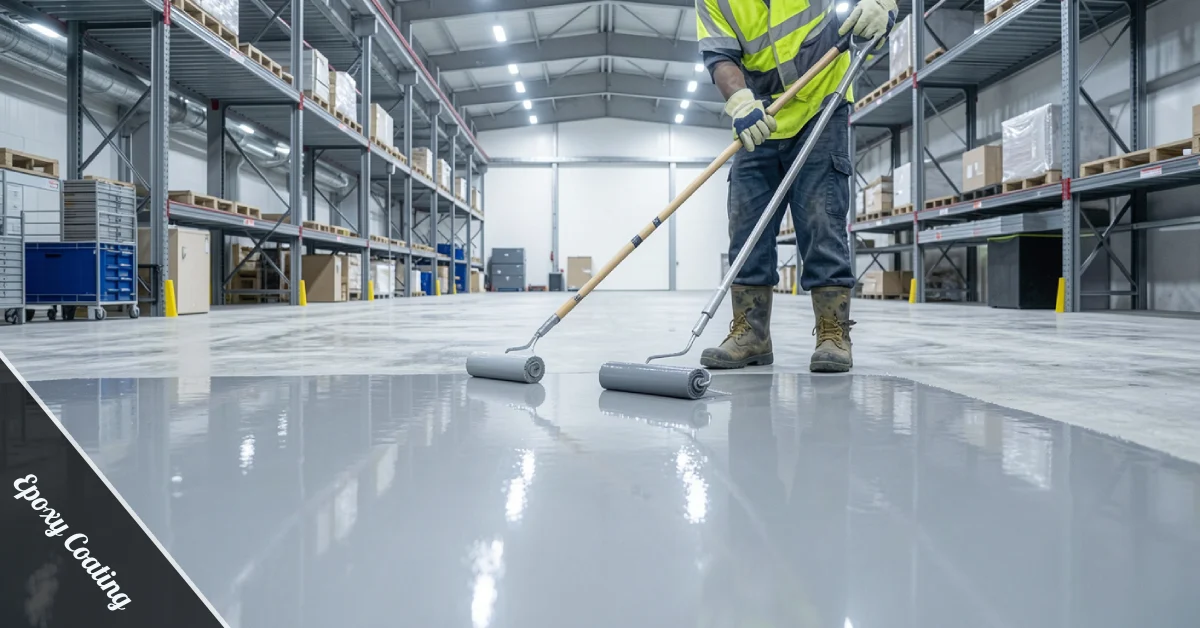
Epoxy coating is a two-part protective finish made from a resin and a hardener. When mixed, the two components react chemically to form a hard, durable film that bonds tightly to concrete and metal. It resists chemicals, moisture, and heavy wear, making it one of the most reliable protective coatings available for industrial and commercial use.
Garage floors, industrial pipelines, aircraft hangars, food processing plants. All of them use epoxy coating for the same basic reason: it works. But the term covers a wide range of products with different formulations, uses, and performance levels.
If you want to understand what epoxy coating actually is, which type fits your project, and what to expect once it cures, this guide covers it all.
The Chemistry Behind Epoxy Coating
Epoxy coating is a thermoset polymer system. It has two parts: Part A, the epoxy resin, and Part B, the hardener, usually a polyamine or polyamide compound. When you combine the two, a chemical reaction called crosslinking begins. The result is a tough, rigid film that bonds strongly to the substrate.
The base resin in most commercial epoxy coatings is bisphenol A diglycidyl ether (DGEBA), first developed in the 1940s by chemists Pierre Castan and Sylvan Greenlee. Once cured, the coating forms a dense molecular network that resists chemicals, impact, and moisture.
This is what separates epoxy from standard paint. Paint dries by solvent evaporation. Epoxy cures through a chemical reaction. That difference in mechanism is what produces a far harder, more resistant final film.
Main Types of Epoxy Coating
Not all epoxy coatings work the same way. The three main categories are based on solvent or solid content. A fourth category, powder coatings, is used specifically for steel infrastructure.
| Type | Solids Content | VOC Level | Best Use |
|---|---|---|---|
| Water-based | 40–60% | Low | Interior residential and light commercial floors |
| Solvent-based | 50–70% | High | Primers, thin-film industrial applications |
| 100% Solids | 100% | Zero | Heavy industrial floors, chemical exposure zones |
| Powder / FBE | 100% | Zero | Steel pipelines, rebar, and underground infrastructure |
Water-based epoxy is easier to apply and clean up. Lower VOC emissions make it safer for indoor use. The trade-off is a thinner cured film and less chemical resistance compared to 100% solids options.
Solvent-based epoxy penetrates surfaces more deeply and offers good adhesion on difficult substrates. It releases more volatile organic compounds (VOCs) during application, so proper ventilation and protective gear are required.
100% solids epoxy contains no solvents or water. The applied thickness equals the cured thickness. It builds film quickly, handles heavier chemical exposure, and is the standard choice for industrial floors, secondary containment areas, and warehouses.
Fusion-bonded epoxy (FBE) is a dry powder coating applied to steel surfaces, particularly pipelines and rebar. It is electrostatically sprayed onto a preheated steel surface, melts on contact, and cures as the steel cools. The oil and gas industry uses FBE extensively for pipeline corrosion protection because it forms a continuous, pinhole-free barrier.
What Makes Epoxy Coating Durable
Epoxy’s strength comes from its crosslinked molecular structure. Once cured, it does not dissolve in water or most organic solvents. It handles a wide range of chemical exposure without breaking down. That is why it appears in pharmaceutical facilities, battery rooms, and food processing plants.
Key properties that define its performance:
- Adhesion strength: Epoxy bonds mechanically and chemically to properly prepared concrete and steel, often reaching tensile adhesion values above 300 psi.
- Chemical resistance: It withstands acids, alkalis, fuels, and solvents, though resistance varies by formulation.
- Abrasion resistance: Thick film coatings (above 10 mils) resist heavy foot and vehicle traffic without wearing through quickly.
- Waterproofing: Epoxy is non-permeable at the correct application thickness. It stops moisture from reaching the substrate.
- Temperature range: Standard formulations perform well between 35°F and 140°F (2°C to 60°C). Specialty versions handle higher temperatures.
One real limitation is UV resistance. Standard epoxy coatings chalk and yellow under prolonged sunlight. For outdoor use or areas with direct sun exposure, a polyurethane or polyaspartic topcoat is applied over the epoxy base to handle UV degradation.
Where Epoxy Coating Gets Used
Epoxy coating adapts to different substrates and exposure conditions, which is why it crosses so many industries.
Concrete floors are the most familiar use. Warehouses, garages, commercial kitchens, and pharmaceutical plants rely on epoxy floor coating for cleanability, chemical resistance, and durability. Coating thickness typically ranges from 10 to 30 mils for most commercial floor systems.
Steel and metal surfaces need corrosion protection, especially in marine and industrial settings. Epoxy primer coats are standard on structural steel, storage tanks, and piping systems because they bond well to prepared metal and block moisture and oxygen from reaching the steel.
Pipeline infrastructure uses fusion-bonded epoxy extensively. FBE provides a continuous barrier against corrosion and has become the dominant coating system for new oil, gas, and water pipelines because of its consistent application quality and strong adhesion.
Marine structures such as piers, piles, and seawalls use epoxy coatings formulated to adhere to wet substrates and cure underwater. These coatings must resist wave action and sustained saltwater immersion.
How to Apply Epoxy Coating
Surface Preparation Comes First
Surface preparation is the single most important step in the entire process. The leading cause of epoxy coating failure is inadequate or improper surface prep. Even a flawlessly mixed and applied coating will fail on a contaminated or poorly profiled substrate.
For concrete, shot blast or grind the surface to open the pores and remove surface laitance. For steel, abrasive blasting to at least SSPC-SP 6 (commercial blast) is the standard starting point. Remove all oils, dust, and existing loose coatings before proceeding.
Check for moisture before applying any coating. Tape a 3-foot square sheet of plastic film to the floor and seal the edges. After 24 hours, check the underside. If condensation has formed, address the moisture vapor issue before proceeding. Applying epoxy over a high-moisture concrete slab is a common cause of blistering and adhesion failure.
Here is the full application sequence:
- Prepare the surface. Grind or blast concrete. Abrasive-blast steel. Remove all contamination.
- Moisture test. Use the plastic sheet method or a calcium chloride test kit.
- Mix components at the manufacturer’s specified ratio, typically 2:1 or 1:1 by volume. Mix for at least 2 to 3 minutes and scrape the sides and bottom of the container.
- Apply the primer coat using a squeegee or roller. The primer seals the substrate and prevents outgassing in subsequent coats.
- Apply the base coat within the product’s recoat window. This is where most of the system thickness is built up.
- Apply the finish coat. For UV-exposed areas, use a polyurethane or polyaspartic topcoat. For interior industrial floors, an epoxy finish coat is standard.
- Allow full cure time. Most systems allow foot traffic within 24 hours but require 7 days at 70°F (21°C) for full chemical resistance. Lower temperatures slow cure time significantly.
How Long Does Epoxy Coating Last
A correctly specified and applied epoxy floor in a commercial or industrial setting should last 10 years or more with proper maintenance. In light-duty residential applications, such as a garage floor, a well-prepared system commonly lasts 5 to 10 years before needing a refresh coat.
Lifespan depends on four main factors: substrate quality, coating thickness, exposure conditions, and maintenance routine. A floor exposed to daily forklift traffic and chemical spills will need attention sooner than a lightly used warehouse floor.
When epoxy ages, it does not have to be removed entirely. A finish coat can be reapplied over a well-bonded existing system after cleaning and light surface abrading. This extends the floor’s life without full removal, which also keeps old material out of the waste stream.
Safety and VOC Risks Worth Knowing
Epoxy coating is safe when used correctly, but it carries real risks during application. Liquid epoxy resins can cause skin sensitization and contact dermatitis. Repeated skin contact with uncured resin is a recognized occupational health concern.
Solvent-based products release VOCs during application and curing. In enclosed spaces, this requires forced-air ventilation and appropriate respiratory protection. 100% solids and water-based formulations produce far fewer fumes, which is why they have replaced solvent-based products in many indoor settings.
Once fully cured, epoxy coatings are generally inert and safe for surface contact. For food processing or potable water contact areas, look for products that comply with NSF/ANSI Standard 61 or equivalent certification.
For any indoor application, wear chemical-resistant gloves, eye protection, and ensure the space is ventilated throughout both the application and the cure period.