

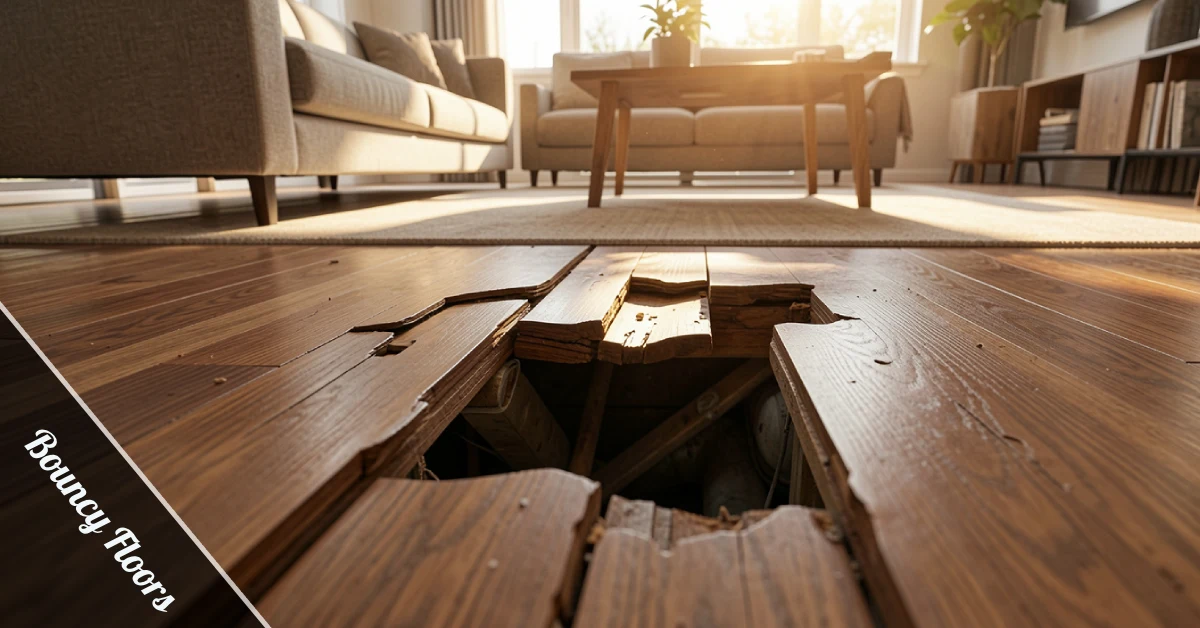
You step into your living room and feel it — that subtle spring under your feet, like the floor has opinions. Bouncy floors are one of those home issues people notice but often ignore.
That’s a mistake you don’t want to make. Some bounce is totally normal. But sometimes it’s your home quietly waving a red flag.
In this guide, you’ll learn exactly why floors bounce, what the warning signs actually mean, and which fixes are worth your time and money.
Bouncy Floors at a Glance
| Aspect | What You Need to Know |
|---|---|
| What It Means | Floor deflection or flex under weight |
| Common Causes | Weak joists, long spans, poor support, loose subfloor |
| Normal or Not? | Slight bounce = usually fine. Strong bounce = check it. |
| Warning Signs | Sagging, wall cracks, sticking doors, furniture vibrations |
| Fix Options | Reinforce the subfloor, add blocking, sister joists, and install support posts |
| Repair Cost | Low for minor fixes; higher for structural repairs |
| When to Worry | If bounce gets worse or other structural signs appear |
What Bouncy Floors Actually Mean
Every floor flexes a little. That slight give under your feet is called floor deflection, and it’s built into the design. Wood-framed floors especially have this natural flex.
The real question is how much flex you’re dealing with. A barely noticeable give in a large room with hardwood or laminate is pretty standard. When you can feel the floor dip and spring back hard, something else is going on.
Material matters here. Wood joists flex more than concrete slabs. Tile and stone floors don’t bend easily, so if there’s too much movement below them, they crack instead. That’s your early warning system right there.
Understanding normal flex versus excessive bounce is the cheat code to knowing when to act.
Main Causes of Bouncy Floors
Bouncy floors don’t just happen out of nowhere. The problem almost always starts below the surface, in the bones of the floor.
Over-spanned or undersized floor joists are the most common culprit. Joists are the horizontal beams that hold your floor up. Space them too far apart or make them too thin for the span, and they bend more than they should under normal foot traffic.
Weakened joists are another big factor. Moisture, wood rot, and termites can quietly eat away at joist strength over the years. You might not see the damage, but you’ll feel it every time you walk across the room.
Support structures beneath the floor matter too. Beams or posts in your crawl space or basement that have shifted or were poorly installed to begin with can leave the entire floor without enough support underneath.
Subfloor problems are also a frequent reason. If the subfloor layer directly under your flooring is too thin, loosely attached, or not properly secured to the joists, it creates that springy, unstable surface feeling.
Heavy loads play a role as well. Large appliances, heavy furniture, or major renovations put extra stress on floors not designed for that weight. Over time, that extra pressure increases deflection noticeably.
Old vs New Homes: Why Both Get Bouncy
Old homes bounce because materials age. Wood joists weaken after years of moisture exposure. Foundations settle and shift support structures. That spring underfoot is often just the house showing its age.
New homes, though? They bounce for different reasons. Modern construction often uses lighter materials and wider joist spacing to cut costs and speed up builds. Everything might meet building codes and still feel less solid than you’d expect.
Open floor plans are a big driver in newer construction. Large open spaces need longer joist spans. Longer spans naturally flex more, even when everything is built correctly. It’s physics, not a flaw.
Warning Signs You Shouldn’t Ignore
Not all floor movement is harmless. There are specific signs that tell you the bounce is part of a bigger structural problem worth addressing right away.
Visible sagging or uneven patches in the floor are a clear signal. If one area sits noticeably lower than the rest, the support system underneath that section is likely failing.
Cracks in walls or ceilings near doors, windows, or corners point to structural stress. Foundation settlement causes pressure across the whole frame of the home, and drywall cracks are often where it shows first.
Sticking doors and windows are another solid clue. When the structure shifts even slightly, door and window frames go out of square. They don’t close cleanly anymore.
Furniture rattling or lamps shaking when you walk across the room tells you the floor lacks adequate support. That level of vibration is beyond normal flex. When two or more of these signs show up together, stop ignoring them.
Are Bouncy Floors Actually Dangerous?
Honestly, it depends. A slight springy feeling in a wood-framed home is usually just the nature of the build. It’s more annoyance than danger.
But when the bounce gets pronounced or comes with warning signs, you’ve got a real safety issue developing. Excessive movement means the floor isn’t properly supported. That leads to more structural damage over time.
Ignoring it compounds the problem. Small deflection grows. Joists take more stress. Walls start to feel it. What’s a manageable fix today can turn into a serious structural project later. Catching it early keeps the cost and the risk low.
How to Fix Bouncy Floors: From Easy to Structural
The fix depends on what’s causing the problem. Start simple, and escalate only if needed.
For loose subfloors, tightening panels with screws and construction adhesive is a quick and affordable first move. It reduces movement and stabilises the surface without major work.
Adding blocking or bridging between joists is a solid next step. Small pieces of wood or metal installed between the beams stop them from twisting or shifting. Weight distributes more evenly, and bounce drops noticeably.
Sistering joists is the go-to fix for more serious issues. You attach a new, full-length piece of lumber right alongside the damaged or weak joist. It restores rigidity without tearing out the old beam entirely.
When the problem is a lack of support from below, installing adjustable steel posts or new support beams in the crawl space or basement is the right call. These add direct vertical support exactly where the floor needs it most.
If foundation settlement is the root cause, underpinning is the professional solution. Push or helical piers are driven deep into stable soil or bedrock, then attached to the foundation to stabilise and, where possible, lift it back into position.
Minor subfloor fixes are doable as a DIY weekend project. Anything involving joists, foundation, or structural supports should go to a qualified professional. Getting it wrong creates bigger problems than the original bounce.
Repair Options Side by Side
| Repair Method | Best For | DIY Friendly? | Cost Range |
|---|---|---|---|
| Secure loose subfloor | Springy surface panels | Yes | Low |
| Blocking/bridging | Twisting or shifting joists | Moderate | Low–Medium |
| Sistering joists | Weak or damaged joists | Moderate | Medium |
| Steel support posts | Insufficient below-floor support | No | Medium–High |
| Underpinning (piers) | Foundation settlement | No | High |
When to Call a Professional
Call a pro when you see sagging, growing cracks, or the bounce is getting worse over time. Structural engineers and foundation specialists can find the root cause fast and give you a clear repair path.
Professionals also have the right tools. Crawl space access, joist assessment, and foundation inspection all require experience and equipment that most homeowners don’t have at home.
Delaying structural repairs always costs more later. A foundation inspection now is a fraction of what full joist replacement or foundation repair costs if the damage keeps spreading unchecked.
What This All Comes Down To
A little spring in your step is fine. A floor that dips, vibrates your furniture, or comes with cracking walls is telling you something important. Bouncy floors are easy to ignore because they seem minor. The structural problems behind them are not.
Identify the cause early. Whether it’s a simple subfloor fix or a foundation issue, acting sooner saves money, stress, and safety risk. Your floor holds everything up. It deserves the same attention you give to anything else in your home.