

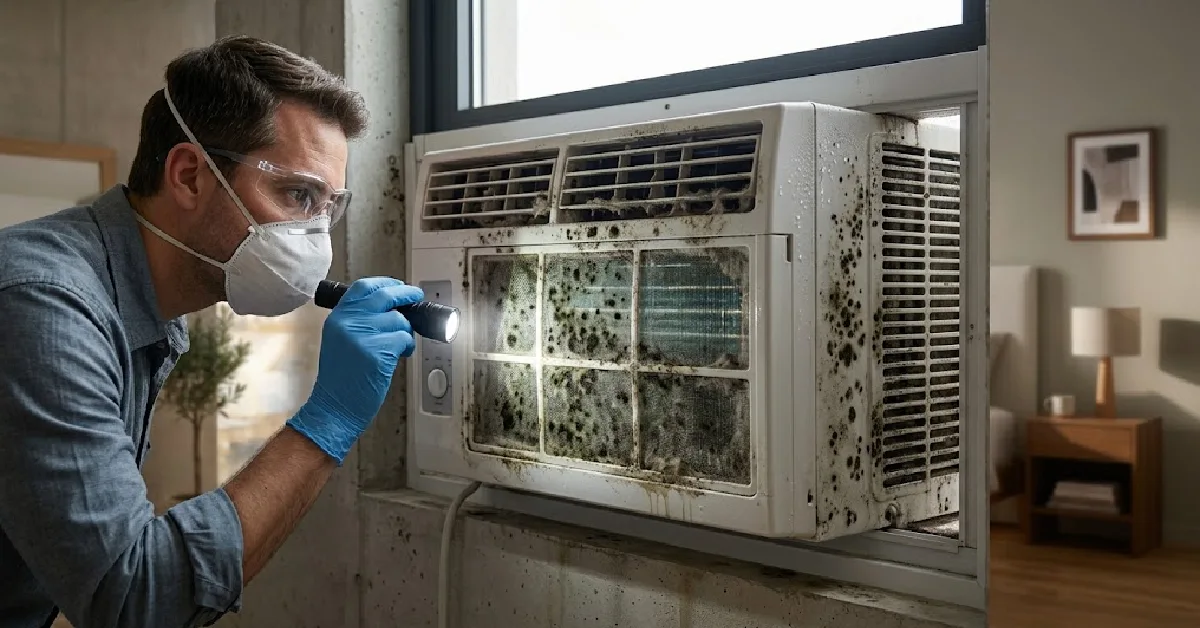
An air conditioner with mold circulates fungal spores through every room in your home. Mold grows inside AC units when moisture, dust, and poor drainage combine. Symptoms include a musty smell, worsening allergies, and respiratory irritation.
You can clean minor mold yourself, but widespread contamination requires a licensed HVAC technician. Prevention starts with regular filter changes and humidity control.
Why Your Air Conditioner Is a Perfect Place for Mold
Your AC unit does something useful and dangerous at the same time. It pulls warm, humid air across cold coils, removes the moisture through condensation, and blows cooled air back into your rooms. That process creates a consistently wet environment inside the unit.
Dust, pollen, and other organic debris settle on coils, filters, and drain pans, giving mold a food source. The most common molds found in HVAC systems are Cladosporium (often black or green, growing on damp surfaces), Aspergillus (airborne and allergy-triggering), and Stachybotrys (black mold, which grows in extremely damp conditions).
Add these organic particles to the dark, enclosed spaces inside ductwork, and you have exactly what mold needs to grow. According to a NIOSH report, nearly 47% of residential buildings in the United States show visible mold or detectable mold odor. A large portion of that problem traces back to HVAC systems.
Mold does not stay put. Every time your AC runs, it pushes air through any contaminated component and carries spores into your living space. Within hours, spores can settle on walls, furniture, and bedding throughout the house. Upholstered pieces like a pull-out sofa bed absorb airborne spores quickly and are very difficult to fully clean once contaminated.
Warning Signs You Have an Air Conditioner With Mold
Most people do not know their AC has a mold problem until their health starts to suffer. These are the clearest signs to watch for.
Smell:
- A musty or stale odor that appears only when the AC turns on
- A smell that gets stronger near vents or registers
- An odor that disappears briefly when you change the filter, then returns
Visual signs:
- Black, green, grey, or white spots on or around vent covers and louvers
- Discoloration on the drip pan or evaporator coil
- Visible fuzzy growth on the filter
Health-related signals:
- Allergy symptoms that clear up when you leave the house
- Worsening congestion, sore throat, or coughing at home
- Recurring headaches that start after the AC comes on
If you smell something musty but cannot see anything, do not assume you are imagining it. Mold inside ductwork is common and seldom visible without removing panels or using a camera.
Window AC recall note: Certain Midea U/U+ window air conditioners sold between 2020 and 2025 were recalled because a defective drain plug can allow water to collect inside the unit. Standing water creates a mold risk. Check your model number and contact the manufacturer if your unit is affected. A redesigned drain plug or refund may be available.
Health Effects of Mold in Your AC Unit
Breathing mold spores from a contaminated AC is not a minor inconvenience. The CDC confirms that mold can cause a stuffy nose, sore throat, coughing, wheezing, burning eyes, and skin rashes in otherwise healthy people. For those with asthma, allergies, or weakened immune systems, the effects are often far more serious.
According to research reviewed by the EPA, building dampness and mold raise the risk of respiratory and asthma-related health outcomes by 30 to 50 percent. That figure applies directly to homes with moldy HVAC systems because a running AC continuously introduces spores into breathable air.
Specific health effects include:
- Allergic reactions: Sneezing, runny nose, itchy eyes, skin irritation
- Respiratory infections: Sinusitis, bronchitis, and in severe cases, pneumonia
- Asthma flares: Shortness of breath and chest tightness triggered by spore exposure
- Fatigue and brain fog: Reported by people with prolonged exposure, particularly to black mold varieties
- Eye and skin irritation: Redness, burning, and rashes from airborne contact
- Itchy sinuses and difficulty breathing: Common in sensitive individuals
- Chronic inflammation of the airways: A risk with repeated, long-term exposure
Children, elderly adults, and anyone with a compromised immune system face the greatest risk. A 2024 study in the Journal of Occupational and Environmental Hygiene found that HEPA filtration reduces airborne spore levels by 90% during active remediation, underlining how seriously professionals treat mold in enclosed spaces.
“If mold appears on the inside of the evaporator coil, it’s important to have an HVAC professional perform a thorough coil cleaning. The best way to prevent mold growth is to install a UV lamp that consistently shines on the coil.” — Mike Lea, co-owner, Lea Heating & Air Conditioning
What Causes Mold to Grow in an Air Conditioner
Understanding the cause helps you target the right fix. These are the most common reasons mold takes hold in an AC unit.
1. Poor drainage. The drip pan collects condensation from the evaporator coil. If the drain line clogs, water pools in the pan. Standing water inside any AC component is the fastest path to mold growth. A blocked or poorly designed drain plug can cause the same problem, which is why some window AC models have been recalled.
2. Oversized or undersized units. A unit that is too large for the space cools air too quickly without fully removing humidity. A unit that is too small runs constantly without ever fully drying the air. Both create moisture problems that invite mold.
3. Dirty filters and coils. Dust and debris on filters and coils give mold spores an organic surface to colonise. A clogged filter also restricts airflow, which can cause the evaporator coil to freeze. When the frozen coil melts, it releases excess moisture into the unit and raises humidity.
4. High indoor humidity. The EPA recommends keeping indoor humidity below 60%. For the best mold prevention, aim for 30% to 50%. In humid climates or poorly ventilated homes, indoor humidity can regularly exceed that threshold, giving mold a constant food supply.
5. Infrequent maintenance. AC units that go months without cleaning, filter changes, or professional inspections are significantly more likely to develop mold colonies before anyone notices.
How to Clean Mold From Your Air Conditioner
The right approach depends on the type of system and how far the mold has spread. These steps work for a standard window, portable, or split unit. Central AC ductwork almost always requires a professional.
What you need:
- Screwdriver
- Gloves, safety glasses, and an N95 mask
- HEPA vacuum with a brush attachment
- Mild dish soap, an EPA-registered mold cleaner, or a 1:1 white vinegar and water solution
- Specialised coil cleaner for metal fins
- Clean cloths
- A plastic bag for disposal
Steps:
- Turn off and unplug the unit before touching anything. For central systems, switch off the breaker.
- Remove the front grille and air filter. Place the filter in a plastic bag if it shows mold. Dispose of it and replace with a new filter.
- Use the HEPA vacuum to remove loose dust, debris, and spores from interior surfaces.
- Mix a cleaning solution. For light mold on hard surfaces, a 1:1 mixture of white vinegar and water is effective. Mild dish soap is also an option. If using bleach, dilute one cup into one gallon of water, but only if the manufacturer allows it.
- Wipe all interior hard surfaces, the drip pan, and the coil area with the cleaning solution. For dirty metal fins, use a specialised coil cleaner. Do not apply liquid to electrical components or the control panel.
- Allow the unit to dry completely before reassembling and running. A fan directed at the interior for 30 to 60 minutes speeds this up.
- Run the unit on fan-only mode for 10 minutes and check for any remaining odor before resuming normal cooling.
For central AC systems, the EPA recommends shutting the system off immediately when mold is detected to stop spore spread. Sheet metal ducts can be professionally cleaned. Fibreglass-lined or flexible ducts that contain mold often need full replacement because the porous material cannot be fully sanitised.
In severe cases, a remediation contractor may need to cut out sections of contaminated drywall near vents or the air handler before treating the space. Once the area is fully dry and cleared, you can patch the hole in the wall as part of restoring the room.
The EPA does not recommend applying biocide sprays or surface treatments inside ductwork as a standard approach. Any duct cleaning should follow NADCA (National Air Duct Cleaners Association) standards.
For more on maintaining your AC system, see our guide on [annual HVAC maintenance checklists].
Prevent Mold Before It Starts
Cleaning mold is reactive. These steps stop it from growing in the first place.
- Change your filter every 1 to 3 months. High-traffic homes or households with pets need monthly changes. A clean filter keeps debris off the coil, removing mold’s primary food source.
- Check and clear the drain line regularly. Pour a cup of diluted white vinegar down the condensate drain line once a month during the cooling season to prevent algae and mold buildup.
- Keep indoor humidity below 60%. Aim for 30% to 50% for the best protection. Use a digital hygrometer (under $15 at most hardware stores) to monitor levels. A whole-home dehumidifier handles persistent humidity problems far better than the AC alone.
- Schedule annual professional maintenance. A licensed HVAC technician cleans the evaporator coil, inspects the drain pan, checks refrigerant levels, and spots early mold growth before it spreads. In humid climates, twice-a-year servicing is better.
- Consider a UV-C germicidal lamp. These units are installed near the evaporator coil and emit UV-C light that continuously kills mold spores. They are one of the most effective long-term prevention tools available.
- Run the fan after cooling. In humid weather, run the fan-only mode for 30 to 60 minutes before shutting the unit off. This dries the coils and blades, reducing moisture buildup. Do not run the AC on “auto” in humid weather; continuous fan operation keeps air moving over the coil.
- Install or maintain exhaust fans. Use exhaust fans in bathrooms and kitchens to remove moisture at the source.
- Keep vents open and unobstructed. Good airflow prevents humidity from concentrating in closed-off rooms.
- Consider a whole-home air purifier. An air purifier can reduce airborne mold spores and improve overall indoor air quality.
- Inspect after storage. If you have not run a window or portable AC in a while, open it and check for visible mold before first use.
When to Call a Professional for AC Mold
DIY cleaning is appropriate for small, visible patches on hard surfaces in window or portable units. In these situations, always call a licensed HVAC technician or certified mold remediation contractor:
- Mold is visible inside the ductwork or on the air handler
- You smell mold but cannot locate the source
- Cleaning the unit does not eliminate the smell within a few days
- A household member has asthma, a respiratory condition, or a weakened immune system
- The mold covers more than a few square inches, or it has a dark greenish-black colour
- Your AC system is more than 10 years old and has never been professionally cleaned
Professional remediation for a single-zone duct system typically runs between $450 and $1,000. Whole-home duct remediation in high-humidity regions can reach $3,500 or more, depending on the extent of contamination and duct material.
A professional can deep-clean coils and drain pans, sanitise ductwork, fix airflow and drainage issues to prevent mold from returning, and recommend air quality improvements tailored to your home.
It is also worth noting that the same HVAC neglect that leads to mold often causes broader system problems. If you find your heat not working in the house around the same time you notice mold signs, a full HVAC inspection is the right starting point for both issues.
FAQs
Can a moldy air conditioner make you sick?
Yes. Mold spores circulated through an AC system can trigger allergic reactions, respiratory infections, asthma attacks, and prolonged fatigue. Sensitive individuals, including children and older adults, are at higher risk. Symptoms often improve noticeably when the moldy unit is cleaned or when the person leaves the home for several days.
What does mold in an air conditioner look like?
It appears as black, green, grey, or white fuzzy patches, most often on the filter, evaporator coil, drain pan, or around vent covers and louvers. Black mold varieties tend to look darker and slicker than typical dust. A musty smell without visible growth usually means mold is deeper inside the unit or ductwork.
What types of mold grow in air conditioners?
The most common types are Cladosporium, Aspergillus, and Stachybotrys (black mold). Cladosporium often appears black or green on damp surfaces. Aspergillus can become airborne and trigger allergies. Stachybotrys grows in extremely damp conditions and is associated with water damage.
Is it safe to run an AC with mold in it?
No. Running a moldy AC actively spreads spores throughout your home with every cycle. The EPA recommends shutting the system off as soon as mold is detected, particularly in central AC systems, to limit further contamination.
How often should I clean my air conditioner to prevent mold?
Change filters every one to three months, clean the drain pan and drain line once a month during cooling season, and schedule a full professional inspection and coil cleaning at least once a year. Homes in humid climates may need more frequent servicing.
Can I use bleach to kill mold in my AC?
You can use a diluted bleach solution (1 cup per gallon of water) on hard, non-porous surfaces inside a window unit. However, the EPA cautions that bleach cannot penetrate porous materials and is not recommended for use inside ductwork. For coils, evaporator components, or internal insulation, use an EPA-registered antimicrobial product, a 1:1 white vinegar and water solution for light mold, or have a professional handle the cleaning.