

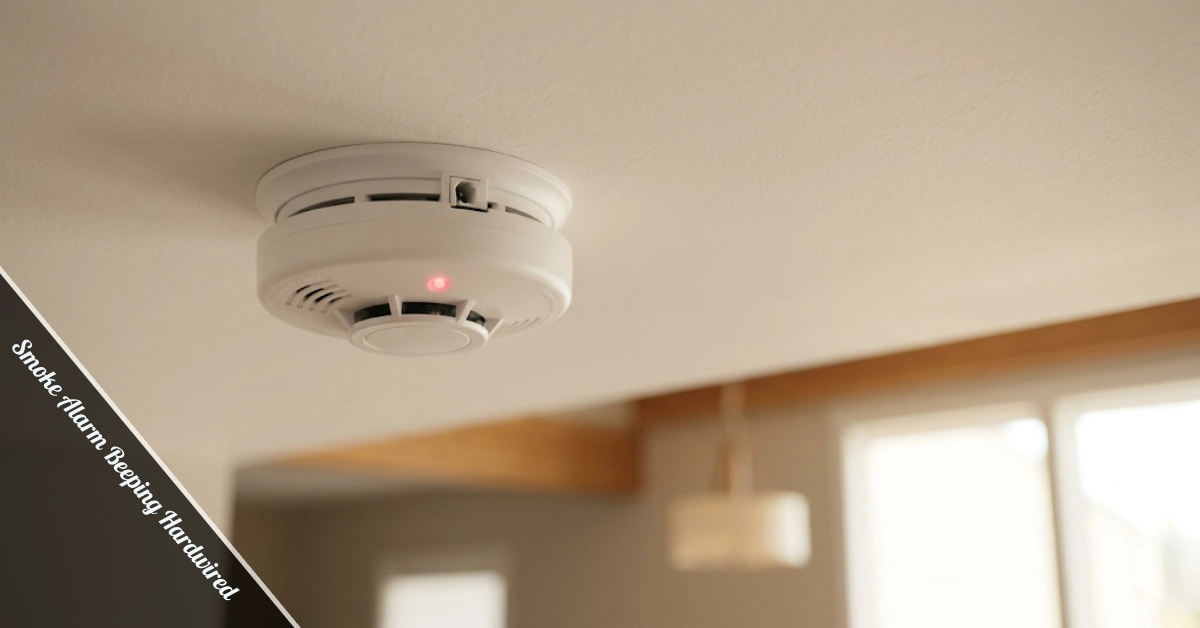
A hardwired smoke alarm beeps mainly because of a low or dead backup battery, accumulated dust in the sensor, an ageing unit past its 10-year life, or a loose wiring connection. Less commonly, temperature changes, electrical surges, or sensor faults trigger beeping. Replace the backup battery first, then reset the unit. If beeping continues, clean the sensor or replace the alarm.
There it is again: that short, sharp chirp from the ceiling, once every 30 to 60 seconds. You know your smoke alarm is wired directly into your home’s electrical system, so why is it still beeping?
It’s a question thousands of homeowners ask every year. The answer is almost always fixable, and usually within 15 minutes. This guide explains every reason a hardwired smoke alarm beeps, what each beep pattern means, and exactly how to stop it, step by step.
Why a Hardwired Smoke Alarm Still Has a Battery
Many people assume that because their smoke alarm is wired into the home’s power supply, it has no battery. That assumption leads to a lot of unnecessary confusion.
Hardwired smoke alarms carry a backup battery. Its job is to keep the alarm working during a power outage. When that battery gets weak, the alarm starts chirping, even though AC power is running to it just fine.
This is the most common cause of beeping in hardwired units. The backup battery, typically a 9-volt or AA alkaline cell, has a lifespan of roughly 6 to 12 months and needs regular replacement.
Replacing it is simple. Turn off the circuit breaker for the alarm, detach the unit from its mounting bracket, disconnect the power connector, swap in a fresh battery, reconnect the unit, and restore power. Then press the test button to confirm it works.
What Beep Patterns Tell You on a Hardwired Alarm
Not all beeps mean the same thing. Knowing the pattern saves you time and helps you respond correctly.
- One chirp every 30 to 60 seconds: Low or dead backup battery. Replace it immediately.
- One chirp every 30 to 60 seconds after a new battery: Residual fault stored in the processor. Reset the unit by cutting power at the breaker, pressing the test button, and restoring power.
- Three beeps, pause, three beeps: Smoke or fire detected. Treat this as a real emergency. Evacuate first, then investigate.
- Four beeps, pause, four beeps: Carbon monoxide alert if the unit is a combination alarm. Leave the building and call emergency services.
- Continuous chirp every 30 seconds with no battery inside: The alarm has reached the end of its service life and needs to be replaced.
- Chirping across multiple connected alarms: A loose neutral wire or a failing unit in the chain may be triggering all of them.
“If it has a 9-volt battery, it needs to be changed,” says Battalion Chief Tom Kane of Philadelphia Firefighters’ and Paramedics’ Union, Local 22. “The NFPA recommends replacing smoke detectors every 10 years, including hard-wired alarms. Some models may last as little as 5 years.” (Source: BobVila.com, December 2024)
7 Common Reasons Your Hardwired Smoke Alarm Won’t Stop Beeping
1. Dead or Weak Backup Battery
This is the cause behind the majority of hardwired smoke alarm beeping complaints. Even with a direct power connection, the backup battery drains over time.
If the battery is loose, inserted incorrectly, or expired, the alarm will chirp to warn you. Always check the battery first before investigating anything else.
2. Residual Charge After Battery Replacement
Some alarms store error conditions in their processor memory. Even after you replace the battery, the unit may keep chirping for several minutes because it’s still holding the old fault.
To clear this, cut power at the breaker, remove the alarm from the bracket, disconnect the harness, hold the test button for 15 seconds, then reconnect and restore power. This discharges any remaining residual charge and clears the fault.
3. Dust and Debris Inside the Sensor Chamber
Over months and years, dust, pollen, insects, and fine particles build up inside the sensor chamber. This interferes with the ionisation or photoelectric sensor and triggers intermittent false alarms or chirping.
One overlooked source of this problem is a mould-affected air conditioning unit. An AC system with mould growth can push spores, fine particles, and excess moisture through your home’s vents directly toward nearby alarms. If your smoke alarm sits close to a vent and keeps triggering without explanation, it is worth checking whether your AC unit may be the source. Our guide on air conditioners with mold covers what to look for and how to address it before repositioning your alarm.
Use a can of compressed air or a soft vacuum attachment to clear the sensor vents. Do this every six months as part of routine maintenance.
4. Alarm Has Exceeded Its Service Life
Smoke alarms do not last forever. Most models carry a service life of 8 to 10 years from the date of manufacture, not the date of installation.
When a unit approaches or exceeds that range, it starts chirping to signal the end of its functional period. Check the manufacture date on the label at the back of the unit. If the alarm is more than 10 years old, replace it, regardless of how well it seems to be working.
According to a 2024 NFPA report, working smoke alarms cut the risk of dying in a home fire by 60 per cent. An alarm that chirps due to age or malfunction cannot be trusted to perform reliably when it counts.
5. Electrical Interference or Power Fluctuations
Hardwired alarms sit on your home’s electrical circuit. Power surges, brownouts, or a tripped breaker can cause the alarm to behave erratically and chirp without a clear trigger.
Check your electrical panel for tripped breakers. If the circuit has tripped, reset it. If surges are frequent in your area, consider a surge protector for the circuit.
Some older homes also have wiring issues that cause intermittent power delivery to the alarm. A licensed electrician can inspect the connections if problems persist.
6. Temperature Extremes or Humidity
Smoke alarms are calibrated to work within a temperature range of 40°F to 95°F (4°C to 35°C). If the alarm is installed near a vent, outside wall, or an attic-adjacent ceiling, temperature swings or condensation can trigger false beeping.
If your home’s heating system has also been unreliable lately, rooms that drop below 40°F during cold spells can push the alarm outside its safe operating range. Our guide on heat not working in your house covers the most common causes and fixes, which may help you rule out a heating fault as a contributing factor.
High humidity, especially in bathrooms or kitchens, can mimic smoke particles in the sensor and set the alarm off. Relocate the unit if it sits within three feet of a heat register, ceiling fan, or area prone to steam.
7. Loose Wiring or Interconnection Issues
In a hardwired interconnected system, all units share a common wire. If one alarm has a loose connection or develops a fault, the entire system can chirp.
A loose white neutral wire is a known cause of echoing chirps across linked units. Carefully check connections at the back of each unit. If you are not comfortable working around wiring, have an electrician inspect the circuit.
How to Stop a Hardwired Smoke Alarm from Beeping: Step by Step
Follow these steps in order before assuming you need a new unit.
- Replace the backup battery. Use the battery type specified in the manual. A 9-volt alkaline is most common. Ensure it is fully seated and the compartment is closed.
- Reset the alarm. At the circuit breaker, cut power. Detach the alarm from its bracket and disconnect the wiring harness. Press and hold the test button for 15 seconds. Reconnect everything and restore power.
- Clean the sensor chamber. Use compressed air to blow out any dust from the vents. Do not insert anything into the sensor opening.
- Check the manufacture date. Look at the label on the back. If the unit is 10 years old or older, replace it.
- Inspect the wiring. Ensure the wiring harness connector is fully seated and secure. Look for obvious signs of a loose or damaged wire.
- Check for environmental triggers. Move the alarm if it is too close to a vent, bathroom door, or cooking area.
- Call a licensed electrician. If the above steps do not resolve the issue, a wiring fault or circuit problem may be the cause.
Hardwired Smoke Alarms and Interconnected Systems
Many homes built after the mid-1990s have interconnected alarms. When one detects smoke, all units in the chain sound together. This is required by building codes in most jurisdictions for new construction.
The upside is clear: better coverage and faster warning. The downside is that a single failing unit can trigger or cause chirping in every alarm in the house.
If your entire system starts chirping at roughly the same time, disconnect units one at a time until you identify the one causing the issue. The one that stops the chirping when disconnected is the unit that needs replacement.
According to the NFPA’s 2024 smoke alarm use survey, one in three U.S. households never tests their smoke alarms, and nearly one in five believed all their alarms were working when at least one had a functionality issue.
This is worth noting: a smoke alarm that chirps is actually doing its job. It is telling you something is wrong. The danger is not the beeping itself. The danger is ignoring it.
It also pays to think about coverage in every sleeping area of your home. If guests regularly sleep in your living room on a pull-out sofa bed, that space needs a working alarm overhead, just as any dedicated bedroom does. An interconnected system is only as good as the coverage it provides in the areas where people actually sleep.
For homeowners looking to understand more about smoke detector placement and maintenance, knowing where each type of alarm should go is just as important as keeping them working.
When to Replace Your Hardwired Smoke Alarm
There are clear signals that a unit has crossed from fixable to done.
- The manufacture date on the back label is more than 10 years ago
- Beeping continues after a fresh battery, reset, and cleaning
- The unit is yellowed, cracked, or visibly deteriorated
- The test button does not produce a loud alarm sound
- The alarm was involved in a nearby fire or sustained heat exposure
When buying a replacement, choose a unit that matches your home’s wiring configuration. Most hardwired alarms use a three-wire connector: black (hot), white (neutral), and red (interconnect). Replacement units from major brands like Kidde, First Alert, and BRK are designed to plug directly into existing connectors without rewiring.
If you are replacing a unit in an interconnected system, make sure the new alarm is compatible with the existing brand and interconnect protocol. Mixing incompatible brands can result in the system not communicating correctly.
FAQs
Why is my hardwired smoke alarm beeping every 30 seconds?
A chirp every 30 to 60 seconds almost always signals a low or dead backup battery. Replace it with a fresh battery of the correct type, then reset the alarm by cutting power at the breaker and pressing the test button.
My hardwired smoke alarm started beeping after I changed the battery. Why?
Some alarms retain fault conditions in their processor memory even after a battery swap. Disconnect the unit from the circuit, hold the test button for 15 seconds to discharge residual power, then reconnect and restore power. The stored error should clear.
Can I just remove the battery to stop the beeping?
Removing the backup battery stops the chirp temporarily, but it leaves your alarm without a power backup during an outage. This is a temporary measure only. Identify and fix the root cause as soon as possible.
How long do hardwired smoke alarms last?
Most hardwired smoke alarms have a service life of 8 to 10 years from the manufacturer’s date. After that point, internal sensors degrade, and the unit becomes unreliable. Check the date on the back label and replace any unit older than 10 years.
Why are all my hardwired smoke alarms beeping at the same time?
In an interconnected system, one failing unit can cause all others to chirp. Disconnect units one at a time until the chirping stops. The last unit disconnected before the noise stops is the one that needs replacement or repair.