

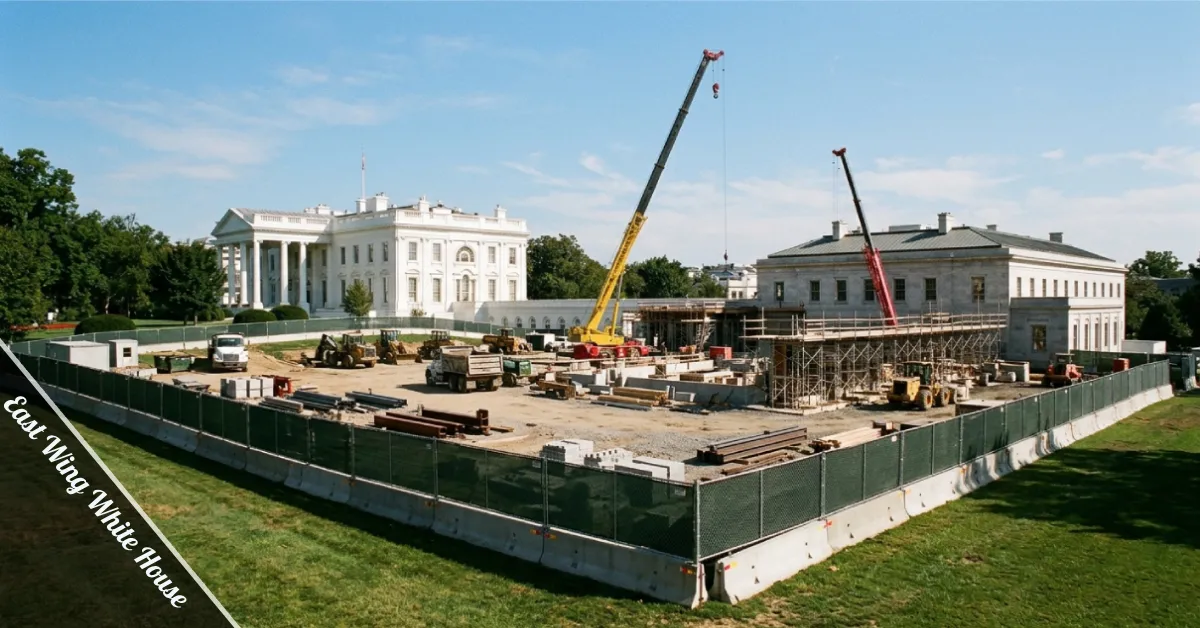
The White House has 132 rooms, 35 bathrooms, and centuries of political history. But one of its most recognisable sections, the East Wing, no longer stands. In late 2025, demolition crews tore it down to clear space for what the Trump administration calls a long-overdue state ballroom. The story behind that decision goes back more than 80 years.
Here is everything you need to know about the East Wing White House, from its wartime origins to the courtroom fight playing out right now.
What Was the East Wing White House?
The East Wing was traditionally the domain of the social aspects of the executive residence, and served as the customary office space for the First Lady for nearly five decades.
The exterior colonnades leading to the East and West Wings were originally added by Thomas Jefferson, but they were open-air spaces without connecting the executive residence to any exterior buildings. Most of the business and social functions of the White House were housed within the executive residence until 1902, when First Lady Edith Roosevelt aimed to move the business of the White House out of the President’s and First Lady’s home.
The two-story East Wing structure was built in 1942 as a clandestine cover for the construction of an underground bunker beneath it, which today is still the Presidential Emergency Operations Centre, designed to be a refuge for the President in case of an attack on the White House.
Beyond the bunker, the wing housed the White House theatre, the visitor entrance, and the calligraphers and social secretaries who managed state events.
How the First Lady’s Office Took Shape There
Among the offices housed in the East Wing was the Office of the First Lady, first professionalised by Eleanor Roosevelt during her husband’s administration. Roosevelt used the East Wing for official functions, as a base of operations for her activism and as a space for interacting with groups representing the American people, from the Girl Scouts to the Women’s Trade Union League.
Betty Ford created the formal Office of the First Lady in the East Wing, which then opened under then-First Lady Rosalynn Carter in 1977.
Carter hired a chief of staff with a rank and salary equal to that of other White House staff, as well as a team of 18 employees covering the press, research, and other special projects.
It was also in the East Wing that Laura Bush launched her literacy efforts, and where Michelle Obama oversaw her “Let’s Move” campaign.
Celebrity real estate watchers may find the concept familiar. Just as famous figures define iconic spaces by the work they do inside them, the East Wing became significant through the people who occupied it. A look at how historic figures shape the spaces they inhabit, from Steven Yeun’s house to the White House itself, shows how strongly identity and purpose are tied to a building.
The East Wing White House by the Numbers
Before its demolition, the East Wing held an important place in the White House layout. Here are the key facts at a glance:
- Built in 1942 under President Franklin D. Roosevelt
- Two stories, with the Presidential Emergency Operations Centre underneath
- Officially home to the Office of the First Lady from 1977 onward
- Contained the visitor entrance used for public White House tours
- Seated roughly 200 guests in the East Room, the largest formal space
- Tours were suspended in September 2025 ahead of demolition
Why Trump Ordered the Demolition
For 150 years, Presidents, administrations, and White House staff had longed for a large event space on the White House complex that could hold substantially more guests than currently allowed.
The White House cannot currently host major events for world leaders without erecting temporary tents for major diplomatic functions. The new ballroom promises to solve this long-standing problem while maintaining the property’s classical architectural heritage.
“Presidents in the modern era have faced challenges hosting major events at the White House because it has been untouched since President Harry Truman,” said Jim McCrery, CEO of McCrery Architects, the project’s lead design firm.
The White House announced the ballroom construction project in late July 2025, and demolition began suddenly on the East Wing in late October, when workers were spotted tearing down the wing of the White House that contained the first lady’s offices.
What the New East Wing Will Look Like
The replacement structure is a significant step up in scale from what it replaces.
The new East Wing will be 89,000 square feet, with two levels, and will be the same height as the White House building itself. The ballroom will have 40-foot ceilings and a 1,000-seat requirement, with the ballroom itself covering 20,000 square feet.
The White House State Ballroom will add approximately 90,000 square feet of ornate, meticulously crafted space, with a seated capacity of 650, more than tripling the East Room’s 200-person limit.
The ballroom will stand apart from the main White House but mirror its architectural theme and heritage. McCrery Architects was selected as lead firm, renowned for classical design and based in Washington, D.C. Clark Construction will lead the construction team, with AECOM overseeing engineering.
Architecturally, the ambition echoes how other high-profile properties balance prestige with practicality. For a look at how prominent figures approach large-scale residential projects, Kiran Patel’s house offers a comparable study in classical scale and design intent.
How the Project Is Being Funded
President Trump and other patriot donors have generously donated the funds for this $250 million project. The figure has since risen considerably.
Trump held a glitzy dinner in October 2025 to thank billionaires and top companies for donating to the new ballroom. Guests included representatives from tech firms like Amazon, Apple, Meta, Google, Microsoft, and Palantir, as well as defence giant Lockheed Martin.
Trump says the project is funded by private donations, although public money is paying for the bunker construction and security upgrades. By early 2026, total estimated costs had reached $400 million.
The Legal Battle Over East Wing Construction
The project has not moved forward without challenge.
The National Trust for Historic Preservation sued Trump and several federal agencies in December 2025, arguing the project has proceeded without required approvals, environmental review, or congressional authorisation. The group says federal law bars construction on federal parkland in Washington without the express authority of Congress.
A federal judge on 31 March 2026 blocked President Trump from moving ahead with any further above-ground work on the ballroom. “The President of the United States is the steward of the White House for future generations of First Families. He is not, however, the owner!” Judge Richard Leon wrote.
Judge Leon’s ruling allowed only below-ground work on a bunker and other national security facilities at the site. Government lawyers argued that the project includes critical security features to guard against a range of possible threats, such as drones, ballistic missiles, and biohazards.
Construction on the proposed ballroom was permitted to continue temporarily after the U.S. Court of Appeals for the District of Columbia Circuit allowed it while the Trump administration challenged the lower court ruling requiring congressional approval.
The legal dispute remains active as of June 2026.
What Critics and Historians Are Saying
When bulldozers began to tear down the East Wing, historians raised alarms that important American history was being buried in the rubble, including chapters about previous first ladies and their roles uplifting women going back nearly a century.
Author Kate Andersen Brower said: “I think there’s a definite diminishment of the first lady’s role. If she’s not going to be working in the White House or having her staff around her, then she’s not going to be in the middle, in the thick of things.”
Professor Katherine A.S. Sibley of Saint Joseph’s University said: “To me, this demolition suggests that the current White House does not think that the first lady does anything of value. They’re not cognizant of the history.”
The White House Historical Association announced that it had supported efforts to digitally preserve the East Wing and Jacqueline Kennedy Garden with comprehensive scanning and photography projects.
Grand residences often hold layers of personal and political meaning that go far beyond their square footage. The way families and public figures leave their mark on the spaces they inhabit is something George Mgdesyan’s house also illustrates, showing how a building’s identity shifts with its occupants over time.
FAQs
What was the East Wing of the White House used for?
The East Wing served as the main visitor entrance, housed the Presidential Emergency Operations Centre underground, and was the official home of the Office of the First Lady from 1977 onward.
When was the East Wing demolished?
Demolition began on 20 October 2025. It was fully cleared by December 2025 to make way for the new State Ballroom.
How big is the new East Wing ballroom?
The planned ballroom covers 20,000 square feet within a 90,000-square-foot two-story structure, with 40-foot ceilings and a capacity of up to 1,000 guests.
Who is paying for the new White House ballroom?
The White House states the ballroom is privately funded, largely through donations from major corporations and the President himself. Public funds are covering the below-ground security and bunker work.
Is the ballroom construction still being contested in court?
Yes. As of mid-2026, the National Trust for Historic Preservation’s lawsuit is ongoing. A federal judge has blocked above-ground construction pending congressional approval, though appeals courts have repeatedly paused that order while the case continues.