

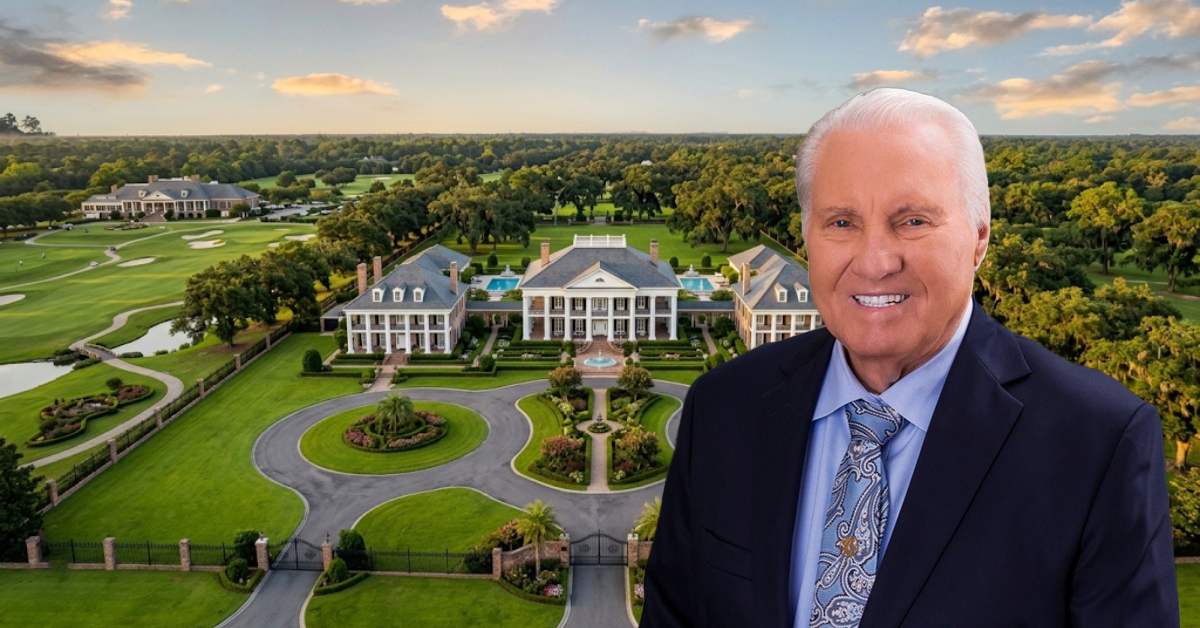
In the mid-1980s, when Jimmy Swaggart’s ministry was pulling in $150 million a year, he wasn’t living like a modest man of the cloth. He was living on a 40-acre compound in one of Baton Rouge’s most exclusive corridors — three custom homes, a $250,000 wrought-iron fence, a guardhouse, and surveillance cameras watching over it all.
Then the scandals hit. Then the money dried up. Then the “For Sale” sign went up.
This is the story of Jimmy Swaggart’s house — what it was, what it was worth, and what became of it.
Who Was Jimmy Swaggart — and Why Does His House Still Get Attention?
Jimmy Lee Swaggart was born in Ferriday, Louisiana, in 1935, into a family that seemed destined for the spotlight. His cousins — yes, actual cousins — were Jerry Lee Lewis and Mickey Gilley, two of the most combustible performers in American musical history. Where they channelled their energy into rock-and-roll, Swaggart went Pentecostal, becoming an ordained minister with the Assemblies of God and building one of the most-watched television ministries in American history.
A Brief Look at His Ministry’s Golden Age
At his peak in the mid-1980s, Swaggart’s weekly telecast reached an estimated 500 million people across 143 countries. His Bible college in Baton Rouge was enrolling over 1,400 students a year. Annual donations to Jimmy Swaggart Ministries topped $150 million. He was, by any measure, one of the most influential religious broadcasters of the 20th century.
That scale of income explains the scale of the estate. When you’re running an organisation that size, a 40-acre compound with three luxury homes isn’t extravagance — it’s the address your peers expect.
His Connection to Jerry Lee Lewis and Mickey Gilley
The Swaggart-Lewis-Gilley triangle is one of Louisiana’s more fascinating footnotes. All three men grew up in the same Ferriday household environment, influenced by the same Pentecostal church. Lewis and Gilley became music legends; Swaggart became the man who publicly condemned rock-and-roll. The irony wasn’t lost on anyone. It’s also the reason that interest in Swaggart — and his home — crosses audiences: rock history fans, religious scholars, and true-crime readers all find a thread to pull.
Where Is Jimmy Swaggart House Located in Baton Rouge?
The Swaggart estate sat on 40 acres adjacent to the Country Club of Louisiana and Country Club Crossing, in the upscale northern end of Baton Rouge. This was not a modest neighborhood. The Country Club of Louisiana is one of the most prestigious gated communities in the state — manicured grounds, golf courses, and the sort of neighbors who notice what kind of fence you put up.
The Neighborhood: Country Club of Louisiana Area
The location placed Swaggart in proximity to Baton Rouge’s established elite, not in a sprawling rural parish on the outskirts of town. The estate was large enough to be its own world — but it was deliberately sited where it could be seen, or at least known about. For a televangelist whose image was carefully constructed, the address mattered.
What Did Jimmy Swaggart’s Estate Actually Look Like Inside?
This is where most articles stop at “a big house.” It wasn’t a house — it was a family compound, and it’s worth understanding the full layout.
The Three Houses on the Property
| Home | Occupant(s) | Square Footage | Key Details |
|---|---|---|---|
| Main Residence | Jimmy & Frances Swaggart | 10,000 sq ft | Primary home; plantation-style, columned façade |
| Son’s Residence | Donnie & Debbie Swaggart | 8,000 sq ft | Full custom home for Swaggart’s son and family |
| Third Home | Formerly Bob Anderson | 4,372 sq ft | Smaller estate home; part of the same 40-acre compound |
Combined, the three homes totaled over 22,000 square feet of residential space across a single 40-acre parcel. To put that in context: 40 acres is roughly 30 football fields. The Swaggart family didn’t just have a big house — they had a private neighborhood.
Architectural Style and Security Features
The main residence set the tone for the whole compound. Classic plantation-style architecture — the kind of design that reads as Southern power, with all the deliberate connotations that carries.
Key architectural and security features included:
- Columned façade on the main residence, the defining visual element of the property
- Two circular driveways, one serving the main house, with landscaped center islands
- A wrought-iron fence encircling the property, valued at $250,000 — more than most homes cost at the time
- A guardhouse at the entrance, with active staffing
- Security cameras covering the grounds
- Manicured lawns and mature landscaping across the full acreage
The security setup was more corporate campus than private home — understandable for a man who received both fan mail and hate mail by the truckload, and who had become a genuine cultural flashpoint by the late 1980s.
How Much Was Jimmy Swaggart’s House Worth?
The assessed value of the Jimmy Swaggart estate came in at approximately $2.8 million — and the actual sale price exceeded that figure. Keep in mind that this assessment reflects the combined value of three custom-built homes, 40 acres of prime Baton Rouge real estate adjacent to one of the state’s most exclusive communities, $250,000 worth of wrought-iron fencing, and a full security infrastructure.
For comparison, the average American home sold for around $100,000 in the early 1990s. The main residence alone — at 10,000 square feet in an upscale Louisiana neighborhood — would have been worth multiples of that median on its own.
The estate’s value was also inseparable from its context. During the ministry’s peak years, the compound was maintained at a level that matched a $150 million annual operation. When that operation contracted, the property became a liability rather than an asset.
Why Did Jimmy Swaggart Sell His Family Estate?
This is the part of the story that turns a real estate profile into something more complicated.
The 1988 Defrocking
In February 1988, Swaggart’s ministry was rocked by the revelation that he had been seeing a prostitute in New Orleans. The Assemblies of God — the denomination that had ordained him — moved to defrock him. Swaggart went on television and delivered what became one of the most-watched confessions in American religious history: “I have sinned against you, my Lord.”
He was placed on a two-year rehabilitation leave by the Assemblies of God. He refused the terms and was subsequently defrocked. He continued preaching independently, but the institutional credibility was gone.
Donations dropped sharply. Bible college enrollment at his Baton Rouge institution — which had peaked at 1,451 students in 1987 — began collapsing. The ministry proposed renaming the college “World Evangelism Bible College and Seminary” as part of a restructuring effort.
The 1991 Indio Scandal and Financial Collapse
On October 11, 1991, Swaggart was pulled over by police in Indio, California. Another woman was in the car. When asked to explain, he reportedly told his congregation: “The Lord told me it’s flat none of your business.” Whatever goodwill he had rebuilt from 1988 largely evaporated.
The financial fallout from the two scandals combined was catastrophic. The ministry laid off hundreds of employees. Enrollment at the Bible college fell from over 1,400 to approximately 370. The $150 million annual contribution figure became a memory. The compound — which had been built during the years of abundance — no longer matched the organization’s financial reality.
A timeline of the collapse:
- 1987: Bible college enrollment peaks at 1,451 students; annual contributions at $150 million
- February 1988: First scandal breaks; Assemblies of God initiates defrocking proceedings
- 1988: Swaggart refuses rehabilitation terms; defrocked; donations fall sharply
- 1988–1991: Ministry restructures; college enrollment begins declining; staff layoffs occur
- October 1991: Second incident in Indio, California; remaining donor support contracts further
- Post-1991: Enrollment drops to approximately 370; estate is eventually listed for sale
What Happened to Jimmy Swaggart’s House After the Sale?
The estate was listed through Brandy Farris of Dixon Realty. The buyer was FDF Property Management, a firm out of Lafayette, Louisiana, represented by Dwayne Duhon of Aptaker Agency Inc.
FDF Property Management had specific plans for the land: they intended to subdivide the 40-acre compound and develop exclusive custom homes on the parcels. The Swaggart family compound — which had been built to house a ministry dynasty — was broken up and turned into a private residential development within one of Baton Rouge’s most sought-after corridors.
The wrought-iron fence, the circular driveways, the columned façade — what happened to the specific structures is less documented than the transaction itself. What is clear is that the property’s next chapter was as private homes for a new generation of Baton Rouge residents, not as a televangelism campus.
A Final Note
What the Swaggart estate ultimately represents is the financial logic of prosperity gospel made literal — a doctrine that equated God’s favor with material wealth, expressed in 40 acres of Baton Rouge real estate and three custom homes behind a quarter-million-dollar fence. When the favor appeared to run out, so did the money, and the property went with it.
That arc — from $150 million in annual contributions to a subdivided lot — is a sharper sermon than anything Swaggart delivered on television.
FAQs
Where did Jimmy Swaggart live?
Jimmy Swaggart lived on a 40-acre compound adjacent to the Country Club of Louisiana in Baton Rouge, Louisiana. The estate also included properties in Metairie, Louisiana, and Indio, California.
How big was Jimmy Swaggart House?
The main residence where Jimmy and Frances Swaggart lived was 10,000 square feet. The compound also included an 8,000-square-foot home for son Donnie Swaggart and a 4,372-square-foot third residence, totaling over 22,000 square feet of living space across three homes.
What happened to Jimmy Swaggart’s mansion?
The estate was sold to FDF Property Management of Lafayette, Louisiana. The buyer’s plan was to subdivide the 40 acres and develop exclusive private homes on the parcels.
Did Jimmy Swaggart sell his house?
Yes. Following the financial collapse of his ministry in the wake of two public scandals — in 1988 and 1991 — the estate was listed through Dixon Realty and sold to FDF Property Management.
How much was Jimmy Swaggart’s estate worth?
The assessed value was approximately $2.8 million, with the actual sale price exceeding that amount. The estate included three custom homes, 40 acres in a prestigious Baton Rouge corridor, a $250,000 wrought-iron fence, and a full security setup.
Is Jimmy Swaggart still alive?
Jimmy Swaggart passed away at age 90. His ministry, Jimmy Swaggart Ministries, continued operating under his family after his death.
Who bought Jimmy Swaggart’s estate?
FDF Property Management of Lafayette, Louisiana, represented by buyer’s agent Dwayne Duhon of Aptaker Agency Inc., purchased the compound. The selling agent was Brandy Farris of Dixon Realty.