

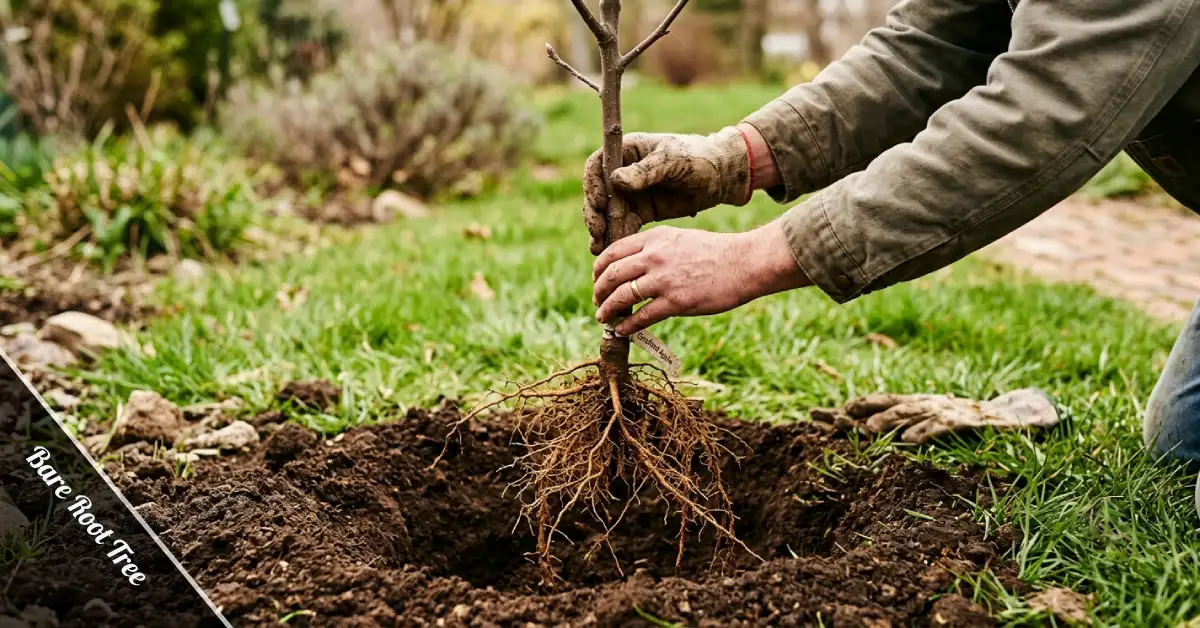
A bare-root tree is a dormant tree sold with no soil around its roots. Nurseries dig these trees from growing fields in late autumn or winter, remove the soil, and ship them while they are still in a resting state. You can buy a wider variety of species at a lower cost than container-grown alternatives. Plant them between December and early March for the best results.
You want to add a fruit tree or shade tree to your garden. You visit a nursery website and see two options: a bare-root tree for $18 or a container-grown version of the same tree for $55. The bare root option looks odd. No soil. No pot. Just roots wrapped in plastic with some moist packing material.
That bare-root tree is very likely the better choice.
Bare-root trees have been a staple of professional orchardists and serious gardeners for decades. They are lighter, cheaper, and when planted correctly, often establish faster than their container-grown counterparts. This guide covers everything you need to know: what bare root trees are, why they work, how to plant them properly, and which species respond best to this method.
What a Bare Root Tree Actually Is
A bare root tree is a tree that has been grown in a field, lifted out of the ground during dormancy, and has the soil removed from its roots before sale. The tree is then stored in a cool, humid environment, packed in moist material such as wood shavings or sawdust, and sold or shipped before spring growth begins.
This process works because dormant trees have very low water and nutrient needs. Their metabolic rate slows considerably in winter, which means the exposed roots can survive the lifting and transit period with minimal stress. Once you plant the tree and spring arrives, the roots grow directly into your native soil without the transition problems that can plague container stock.
“Bare-root trees are lifted from the field after they have entered dormancy, which usually begins after the first frosts in autumn. The dormancy phase is vital for successful lifting, as the tree’s physiological processes slow down, reducing water and nutrient demands.” – Frank P Matthews Nursery, 2025
Most bare-root trees on the market have already spent one to two growing seasons in the field. You are getting a tree with a head start, at a fraction of the cost of a potted equivalent.
Why Bare Root Trees Often Outperform Container Stock
The argument for bare-root trees comes down to root quality and cost. When a tree grows in the ground, its root system spreads naturally. When you transplant it, those roots continue expanding outward into your soil. There is no adjustment period where roots have to unlearn the circular pattern forced on them by a container.
According to UC Agriculture and Natural Resources, “bare-root trees often outperform container trees in the first few years because their roots grow directly into native soil without the circling root problems that plague container stock.”
Circling roots are a real problem with container trees. When a tree spends too long in a pot, its roots spiral around the root ball. If those roots are not teased apart before planting, they can eventually girdle the trunk and kill the tree years later.
Bare-root trees also cost significantly less. Research from Ambitious Harvest (2026) puts the price difference at 30 to 50 per cent less than container-grown equivalents. For anyone planting multiple trees, those savings add up quickly.
Here is a direct comparison of the two approaches:
| Factor | Bare Root | Container Grown |
| Cost | 30-50% cheaper | More expensive |
| Root development | Grows into native soil naturally | Risk of circling/bound roots |
| Transplant timing | Dormant season only (Dec-Mar) | Year-round flexibility |
| Variety selection | Wider range, incl. heritage types | Smaller selection |
| Establishment speed | Often faster once dormancy breaks | Can be quicker initially |
| Shipping weight | Light, easy to handle | Heavy with soil and a pot |
Which Tree Species Work Best Bare Root
Not every tree is well-suited to the bare root method. Species that handle transplant shock easily and have naturally fibrous root systems do best. Others, particularly those with sensitive tap roots, tend to perform better in containers.
Trees That Respond Well to Bare Root Planting
- Apples – one of the most reliably successful bare-root fruit trees
- Pears – establish quickly and produce well when planted dormant
- Peaches and nectarines – benefit from strong native soil root development
- Plums and damsons – handled easily, a wide variety available
- Cherries – both sweet and sour types transplant well
- Mulberries – fast to establish once roots hit native ground
- Ornamental flowering trees – including hawthorns, rowans, and crab apples
- Shade trees – oaks, maples, and ashes shipped bare root at a commercial scale
Trees That Do Better in Containers
Some species are sensitive to root disturbance and tend to struggle when sold without soil. According to LSU AgCenter (2025), citrus, blueberries, pawpaws, pecans, and persimmons perform much better when container-grown.
If you are growing exotic or subtropical fruit trees, bare root may not be the right approach. For example, cherimoya trees require careful container establishment because of their sensitivity to root exposure during transplanting. Choose the method that suits your specific tree species.
When to Buy and Plant a Bare Root Tree
Timing is the single most important factor in bare root success. These trees are only available during their dormant season, which runs from late autumn through early spring. In most of the UK and northern US states, that means November through March. In warmer climates such as California, December through February is the typical window.
“Late winter and early spring planting yields the greatest success with bare-root trees. Order as early as possible to secure the best selection, since stock sells out quickly at popular nurseries.” – BioAdvanced Horticulture
The goal is to get the tree into the ground before it breaks dormancy. Once buds start to swell and leaves begin to appear, the window is closing. A tree that has broken dormancy and still has bare roots will struggle to supply enough water and nutrients to its emerging growth.
If you cannot plant immediately after receiving your tree, keep it stored in a cool, shaded location. Pack the roots in moist wood shavings or potting soil. Do not let the roots dry out, even briefly. A few hours of drying can damage the fine root tips that drive nutrient absorption.
Step-by-Step Bare Root Tree Planting Guide
Follow these steps carefully. Most bare root failures come from skipping the root soak, planting too deeply, or allowing roots to dry out during planting.
- Inspect the roots. Remove any broken, dead, or overly long roots with clean, sharp pruning shears. Healthy roots are firm and light-coloured inside when cut.
- Soak the roots. Place the tree roots in a bucket of water for a minimum of 4 hours and no longer than 24 hours before planting. This rehydrates the roots and reduces transplant stress.
- Choose your site. Confirm sunlight, drainage, and spacing requirements for your specific species. Most fruit trees need at least 6 hours of direct sun per day.
- Dig the hole. Make the hole wide enough that all roots spread outward naturally without bending or bunching. The depth should place the root collar, where roots meet trunk, exactly at ground level.
- Build a central mound. For fruit trees especially, create a small cone of soil at the base of the hole. Drape the roots over this mound so they spread downward and outward rather than sitting flat.
- Backfill with native soil. Do not add fertiliser or compost directly into the planting hole. Use the soil you dug out. Press gently to eliminate air pockets.
- Water thoroughly. Give the tree a deep initial watering immediately after planting and continue weekly for the first 6 to 8 weeks.
- Apply mulch. Spread a 5 to 8 cm layer of organic mulch in a wide circle around the base, keeping it away from direct contact with the trunk.
- Stake if needed. A light stake for the first growing season helps in exposed or windy sites. Remove it after one year so the trunk builds natural strength.
The Arbour Day Foundation advises planting bare-root trees by spreading the roots outward with care and ensuring the root collar sits at or just above ground level. Planting too deeply is one of the most common errors and can lead to stem rot and slow growth over several years.
Common Mistakes That Kill Bare Root Trees
Even when everything else goes right, a few avoidable errors account for most bare root failures. ArborGen planting advisors flag these as the most common problems:
- Letting roots dry out before planting, even for a few hours in the sun or the wind
- Planting too deeply, which suffocates roots and invites fungal disease at the trunk
- Adding fertiliser directly into the planting hole, which burns new roots
- Planting outside the dormant window, when the tree has already broken into active growth
- Forgetting to water in the critical first 6 to 8 weeks after planting
- Using a hole too narrow for root spread, forcing roots to bend or circle
Penn State Extension research notes that even carefully planned bare-root plantings can see 10 to 20 per cent seedling mortality. If a tree does not establish in its first season, replacement planting in the following year is the recommended approach rather than assuming the site is unsuitable.
Bare Root Fruit Trees: Getting the Most From Your Orchard
Fruit trees are where bare-root planting really shows its value. You get access to a far wider variety of cultivars than you would find in containers at most nurseries. Many heritage and regional varieties that commercial operations have stopped stocking are still available bare root.
Stone fruits such as peaches, nectarines, plums, and cherries are particularly well-suited to this method. Their naturally fibrous root systems take quickly to native soil. Trained forms such as espalier and fan-trained trees, which require precise pruning from an early age, are often easier to start with when bought bare root because you can shape them from their first growing season.
Berry crops work on the same principle. Growing Biloxi blueberries in particular benefits from careful site preparation similar to bare root trees: well-drained, acidic soil with good organic matter and attention to dormant planting windows.
The UC Master Gardener Program of Sonoma County recommends bare-root fruit trees as the most cost-effective way to start a home orchard. Their guidance emphasises choosing varieties suited to your local chill hours and soil type, which directly affects fruit set and yield in subsequent years.
Aftercare in the First Growing Season
The first growing season after planting is critical. Your tree has no established root network yet. It is drawing on the energy stored in its trunk and roots from the previous season while new roots grow and begin absorbing water.
Water consistently. A young bare-root tree in its first year needs regular, deep watering rather than frequent shallow applications. Deep watering encourages roots to grow downward in search of moisture, building the deeper network that makes trees drought-tolerant over time.
Hold back on fertiliser for the first 6 to 8 weeks. Let the tree settle into its new environment. After that period, a light application of balanced slow-release fertiliser around the drip line supports healthy growth without overwhelming young roots.
Watch for pests. Newly planted trees with tender growth can attract aphids, caterpillars, and other insects. Check weekly and treat early. Strong root establishment in year one is the foundation of everything that follows.
Frank P Matthews Nursery advises that staking should not remain in place for more than one growing season, as prolonged staking can slow trunk development. After the first year, reduce watering frequency to push roots deeper into the soil profile. The same principle of encouraging root independence applies to many vegetable crops, including sigarilyas (winged bean), where proper root establishment in the planting stage determines long-term productivity.
Where to Buy a Bare Root Tree
Bare-root trees are sold through specialist nurseries, online retailers, and garden centres during the dormant season. Stock at physical retailers tends to be held in bins of moist sawdust. Online nurseries ship with roots packed in moist wood shavings wrapped in plastic.
Order early. Popular varieties of apple, pear, and cherry sell out quickly once the bare root season opens. If you have a specific cultivar in mind, place your order in autumn even if delivery is not until January or February.
When you receive your tree:
- Check that the roots are moist and pliable, not dried out or mushy
- Inspect for any broken branches and trim cleanly with sharp secateurs
- Plan to plant within 24 to 48 hours, or heel the tree in temporarily
- Never leave bare roots exposed to sun, wind, or frost
Reputable online suppliers such as Grow Organic, The Tree Store, and Greenwood Nursery carry a broad range of bare-root fruit, shade, and ornamental trees across USDA zones. The Arbour Day Foundation also ships bare-root stock with planting guides included.
Frequently Asked Questions
How long does a bare-root tree take to establish?
Most bare-root trees show new growth within 4 to 6 weeks of planting if conditions are right. Full root establishment, where the tree no longer needs supplemental watering, typically takes one full growing season. Fruit trees may take 2 to 3 years before producing their first meaningful crop.
Can I plant a bare-root tree in spring?
Yes, but only if the tree is still dormant. Once buds have broken and leaves are visible, the planting window has passed, and you will need to wait for container stock. Late winter planting, when the ground has thawed but spring growth has not started, is generally the sweet spot for most climates.
Dobare-roott trees need staking?
Not always, but it is recommended for exposed or windy sites and for trees with larger canopies. Use a single stake placed to one side of the trunk rather than through the root ball, and attach with a flexible tie. Remove the stake after the first growing season to allow the trunk to develop natural movement strength.
Why does my Bare Root Tree look dead after planting?
This is normal in the first few weeks. The tree is still dormant and directing energy to root growth below ground rather than visible top growth. Scratch the bark lightly with your thumbnail. If the layer underneath is green, the tree is alive. Give it time, keep watering, and wait for spring warmth to trigger visible growth.
Are bare-root trees suitable for beginners?
Yes. Bare-root trees are actually a good starting point for new gardeners because the planting process is straightforward, the cost is low, and the trees are lighter and easier to handle than container stock. The key requirements are getting timing right, keeping roots moist, and not planting too deeply. All three are simple to manage with a little preparation.