

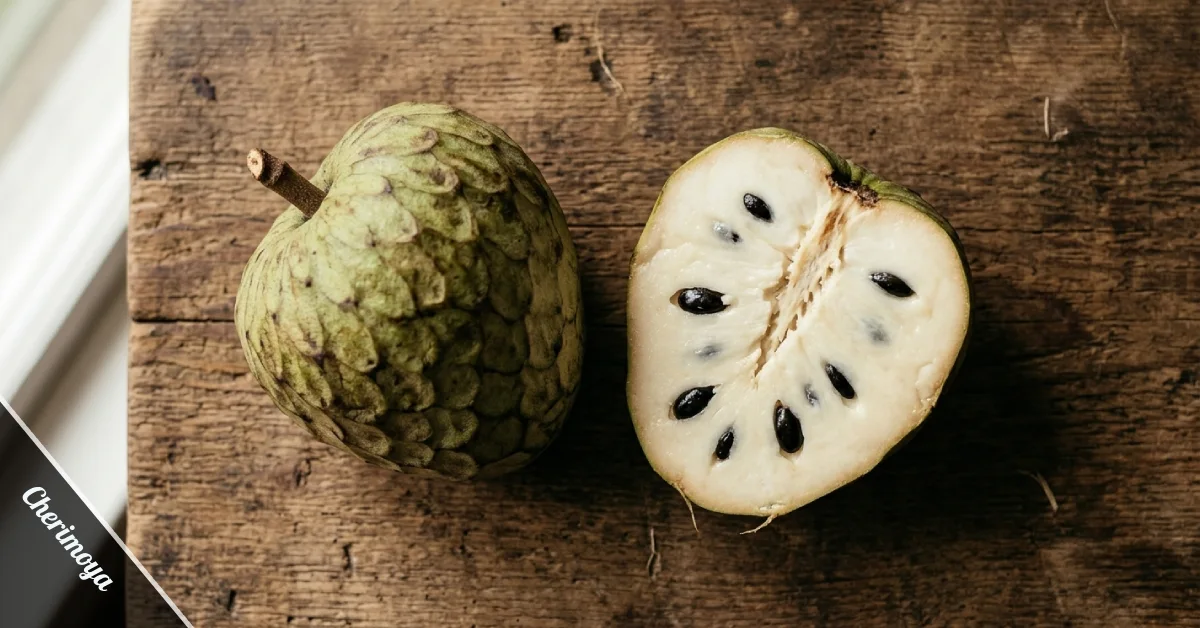
Cherimoya is a subtropical fruit that looks like something you’d find in a fantasy novel—heart-shaped with soft, overlapping scales on the outside. The inside is pearly white, custard-like, and sweet enough that people have been calling it the “ice cream fruit” for over a hundred years. If you’ve spotted one in a speciality produce bin and wondered what the fuss was about, you’re in the right place.
The fruit comes from the Annonaceae family, the same group that includes soursop and sugar apple. It grows on a small evergreen tree originally from the Andes mountains in South America—that cool, high-altitude heritage is exactly why it does well in mild climates instead of hot, humid tropics. Mark Twain tried one in the 1860s and called it “deliciousness itself,” which pretty much nails it.
Here’s what you need to know: the creamy white flesh is what you eat. The green scaly skin and the hard black seeds inside are not for eating. You can eat it straight with a spoon, blend it into smoothies, or freeze it like sorbet. No cooking required.
What Does Cherimoya Taste Like?
The flavour is hard to pin down because it tastes like someone mixed three or four tropical fruits into one. Most people land on pineapple and banana with bright notes of strawberry, and depending on the fruit, you might catch papaya, pear, or even vanilla. The texture is the real star—smooth, melting, and creamy like custard. There’s barely any acid, which is why it tastes more like dessert than fruit.
Ripeness is everything. An unripe cherimoya is firm and tastes watery or slightly bitter. But when it’s ripe and soft to the touch, like a gentle avocado, the whole thing transforms. The sweetness deepens, the creaminess shows up, and every spoonful feels indulgent. I’ve made the mistake of cutting into an unripe one before, thinking it was ready, and it’s genuinely disappointing—the whole fruit tastes flat.
Where the fruit was grown changes the flavour slightly too. California-grown cherimoyas tend to be a bit milder and delicate, while the ones from South America often taste more intensely sweet. If you find one, it’s worth trying to see what you prefer.
Cherimoya vs. Custard Apple and Other Look-Alikes
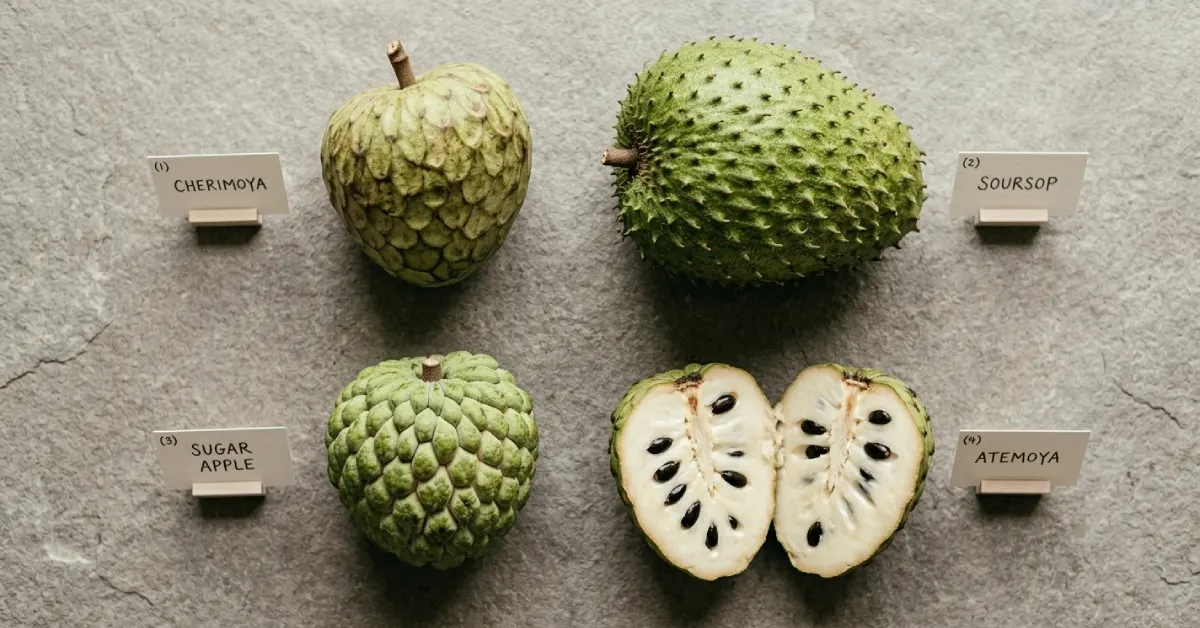
This is where people get confused. “Custard apple” technically names a different fruit (Annona reticulata), but in everyday American and British stores the term gets used for cherimoya all the time. They’re cousins in the same family and look similar, which is part of why the names blur together.
Here’s how to tell them apart:
| Fruit | What It Looks Like | What It Tastes Like |
|---|---|---|
| Cherimoya | Smooth, scaly green, heart-shaped | Creamy, mild, pineapple-banana-strawberry |
| Soursop | Spiny green, larger and oblong | Tangy, fibrous, citrus-pineapple |
| Sugar apple | Bumpy, segmented, smaller and round | Very sweet, grainy, custard-like |
| Atemoya | Slightly bumpy, medium-sized | Sweet-tart, smoother than sugar apple |
If someone hands you a spiny one, that’s a soursop, and it’ll taste sharper. The smooth-scaled, heart-shaped one with the mellow flavour is your cherimoya.
How to Tell When a Cherimoya Is Ripe
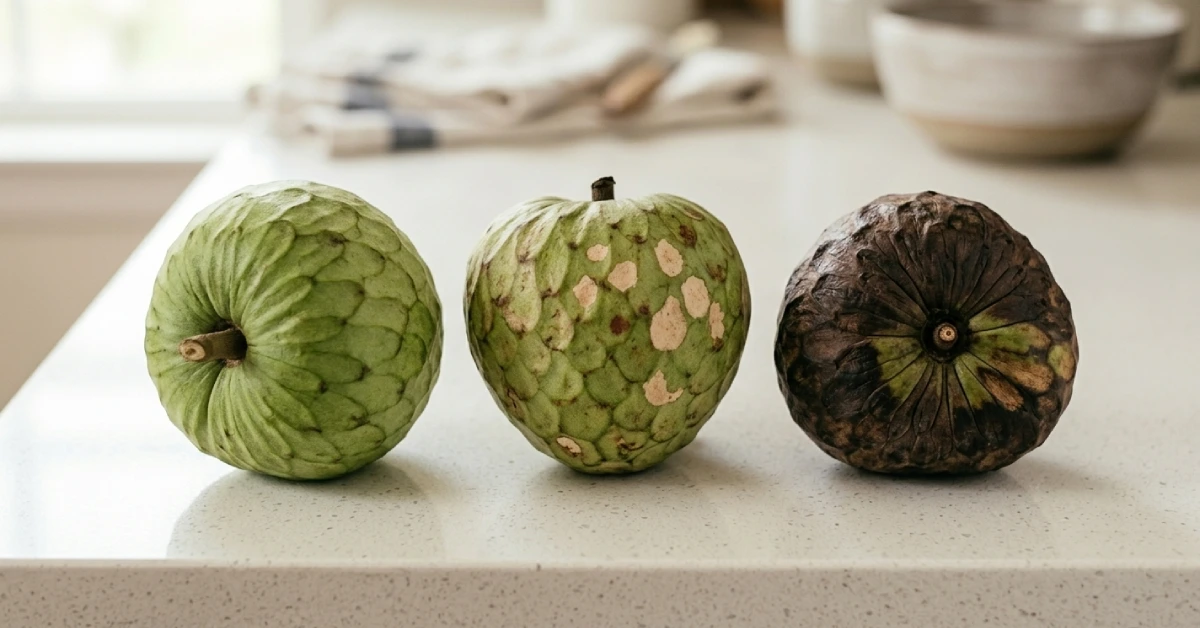
The single most common mistake is waiting for the skin to turn brown. Don’t. Brown skin doesn’t mean the fruit is ready.
Instead, use the squeeze test. Gently press it with your thumb the way you’d test an avocado. If it gives slightly, it’s ripe. If it’s rock-hard, it needs more time. A freshly bought cherimoya typically feels firm with no give at all. By around day three, it starts to yield slightly at the stem end. By day five it presses in gently across the whole fruit—that’s your window. Push past day seven, and you’ll often find it’s gone soft-soft with darkening skin and a flavour that’s starting to ferment.
The skin should be a matte green easing into tan, not dark and bruised all over. That’s a sign it’s overripe inside. You want soft-firm, not mushy.
How to Ripen and Store Cherimoya
Let it ripen on your counter at room temperature, never in the fridge while it’s still firm. Cold below about 55°F damages the fruit before it can ripen properly, and you’ll end up with one that turns dark and never softens the way it should.
Want to speed things up? Put it in a paper bag with a banana or apple. Cherimoya keeps ripening after picking and responds to ethylene gas those other fruits give off. The bag traps that gas and nudges the cherimoya along a day or two faster.
Once it’s ripe, move it to the fridge. A ripe cherimoya will hold for about three days chilled. If you can’t eat it in time, scoop out the seeded flesh and freeze it. Frozen ripe cherimoya tastes like natural sorbet, and it’s genuinely one of the best ways to enjoy it. Over the years I’ve learned the freezer is a safety net for any fruit with a narrow ripeness window, and cherimoya is the poster child for that.
How to Eat a Cherimoya
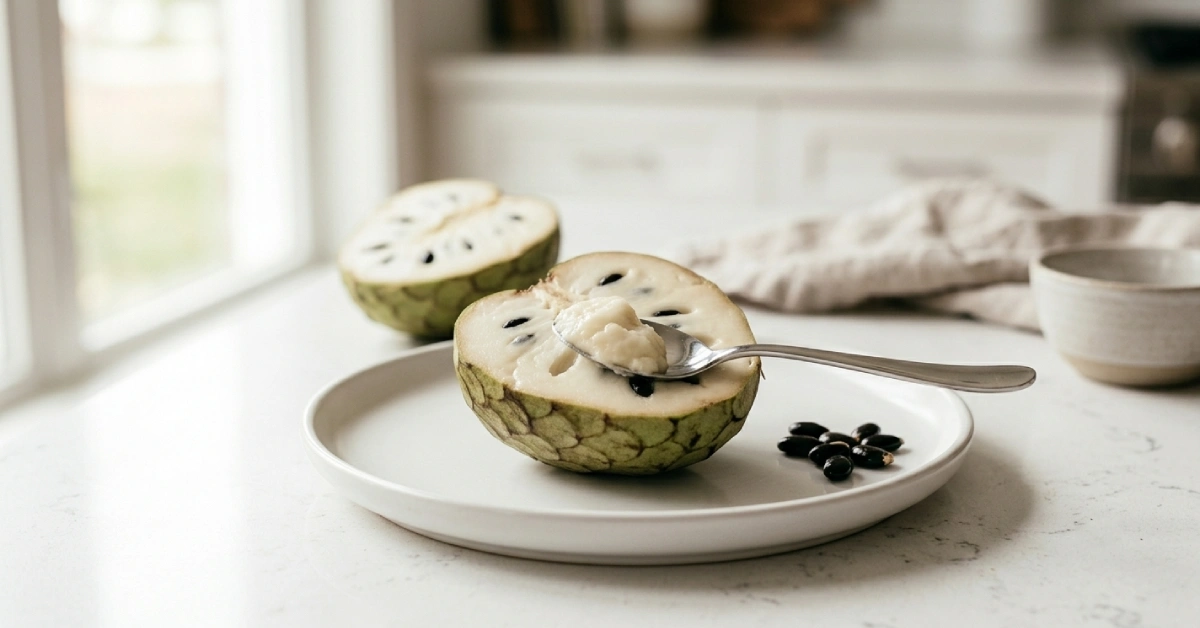
Eating one is simple once you know the steps:
- Chill the ripe fruit in the fridge for an hour or two. Cold flesh tastes better and holds its shape.
- Cut it in half lengthwise with a knife.
- Scoop the soft white flesh out of each half with a spoon, leaving the skin behind.
- Work around the hard black seeds as you eat and set them aside. Don’t bite into them.
- Discard the skin and the seeds. Neither is for eating.
That spoon-straight-from-the-rind approach is how most people enjoy it, and honestly it’s hard to beat. But the flesh is versatile once you separate it from the seeds. It blends into smoothies, layers into a yoghurt parfait, drops into a fruit salad, or churns into sorbet and ice cream. The flavour pairs naturally with citrus, vanilla, dark chocolate, and cardamom. Just remember to pick out every seed before anything goes in a blender—that part isn’t optional.
Cherimoya Nutrition and Health Benefits
Cherimoya is nutrient-dense for a sweet fruit. Raw, it has roughly 75 calories per 100 grams, so a typical medium fruit (around 235 grams of edible flesh) runs near 175 calories. That same serving delivers fibre, potassium, vitamin C, vitamin B6, magnesium, and antioxidants—all wrapped in that custard-sweet flesh.
What does that mean for you day to day? The fibre supports healthy digestion, which is part of why the fruit feels satisfying rather than just sugary. Potassium and magnesium play a role in healthy blood pressure and heart function. Vitamin C and the antioxidant compounds help your immune system. Cherimoya also contains lutein, a compound linked to eye health.
Keep in mind: it’s naturally fairly high in sugar, so it functions more like fruit-as-dessert than an everyday snack. That’s perfectly fine in normal portions. The bigger pattern is that fruits like this—rich in fibre and nutrients alongside sweetness—tend to feel more satisfying than processed sweets, which is a small but real long-term advantage if you’re trying to eat well without feeling deprived.
Is Cherimoya Safe to Eat? Seeds, Skin, and Safety
The flesh of a ripe cherimoya is safe to eat. The seeds and skin are not. The hard black seeds contain compounds called annonaceous acetogenins, and they’re toxic if the seeds are crushed or chewed. Swallowing a whole seed by accident isn’t an emergency because the hard coat passes through intact, but the rule is simple: remove the seeds and never blend them. The skin is inedible and bitter, so toss it.
There’s a bigger-picture caution worth understanding without blowing it out of proportion. Those same acetogenin compounds have been studied in connection with a form of atypical Parkinsonism—but that research centres on heavy consumption of soursop seeds and leaves, not on eating cherimoya flesh in normal amounts. There’s no direct human evidence tying regular cherimoya pulp consumption to harm. The sensible takeaway is moderation: enjoy the flesh freely, skip the seeds entirely, and don’t make seed-containing teas or extracts.
If you have dogs, keep the seeds and skin away from them. A small amount of plain flesh is generally low-risk, but it isn’t something a dog needs, and the seeds are the real hazard.
Where to Buy Cherimoya and When It’s in Season
In the United States, fresh cherimoya season runs roughly November through May for California-grown fruit, with the peak in winter and early spring. Chilean imports fill gaps from May to November, so you can often find it year-round if you look. The best places to check are speciality grocers like Whole Foods, Latin American and Asian markets, Southern California farmers’ markets, and online shippers like Melissa’s Produce or Miami Fruit.
If you’re searching for cherimoya near you and coming up empty at a standard supermarket, a Latin or Asian market is usually your better bet. The fruit has deep roots in those food traditions. Globally, Spain is the largest producer, with protected-origin regions around Granada and Málaga. Chile is the other major source. In the US, California is essentially the only state with commercial-scale production.
That limited supply is the main reason cherimoya is expensive. The trees don’t pollinate well on their own and are often pollinated by hand, which is slow and labour-intensive. The ripe fruit bruises easily and has a short shelf life, so shipping it is tricky and some loss is built into the price. Expect to pay $4–8 per fruit depending on the source and season, with online shippers typically charging more due to packing and overnight shipping costs.
Can You Grow a Cherimoya Tree at Home?
You can, if your climate cooperates. Cherimoya is reliably hardy in USDA zones 10 and 11, and only workable in zone 9b if you have a protected, frost-free microclimate. It’s a subtropical tree, not a lowland tropical one—an important distinction. It loves the cool nights and mild days of coastal Southern California and struggles in humid heat, so Florida is generally a poor fit.
Give it full sun and well-drained soil, ideally slightly acidic to neutral at pH 6.5 to 7.6. A mature tree reaches roughly 15 to 30 feet, though it responds well to pruning if you want to keep it manageable. From a grafted nursery tree, you can expect fruit in about two to four years. From seed it takes longer, and the results are less predictable in fruit quality.
For renters or anyone short on yard space, container growing is possible in a warm zone with a large pot, full sun, and regular feeding. But be realistic—it isn’t a houseplant. It requires real outdoor light and warmth, so a sunny balcony in zone 10b might work while a dim apartment corner won’t. If you’re on the edge of its climate range, a pot you can move to shelter during a cold snap is the safer bet.
Here’s the tricky part: cherimoya trees need hand-pollination. The flowers don’t pollinate themselves easily—each one opens first in a female phase and only later switches to male, so the timing rarely lines up. In the fruit’s native range, specific beetles handle the transfer. Everywhere else, you have to do the work. In the evening, collect pollen from flowers in their male phase using a soft artist’s brush. The next morning, brush that pollen onto the stigmas of flowers in their female phase. Repeat across several evenings during bloom, and your fruit set will jump dramatically. If you have other fruit trees in your garden where hand-pollination is common—like fruit trees described in our guide to successful fruit planting—you’ll already understand the rhythm.
Skip this step and even a healthy, mature tree may give you almost nothing. It sounds fussy until you’ve done it once, and then it just becomes part of the routine.
Should You Try Cherimoya?
If you’ve never had a cherimoya, it’s worth tracking one down in season. Few fruits give you that much creamy sweetness with so little effort: chill it, halve it, scoop it with a spoon, and skip the seeds and skin. It’s nutrient-dense, genuinely satisfying, and unlike anything else in the produce aisle.
The only real learning curve is timing the ripeness and knowing which parts to leave behind. Now you have both. Pick one up firm, give it a few days on the counter, and wait for that gentle avocado-like give. That first cold spoonful tends to win people over on the spot. Once you’ve had a good one, you’ll understand why this fruit has been quietly adored for centuries—and why the people who know it tend to get evangelical about it.
FAQs
How do you pronounce cherimoya?
It’s cheh-ree-MOY-uh, with the emphasis on the “moy.” You’ll also see it spelt chirimoya, especially in Spanish-speaking countries, and that version is pronounced the same way.
Can you eat the skin?
No. The green scaly skin is inedible, bitter, and tough. Cut the fruit open and scoop the soft flesh from inside with a spoon, leaving the skin behind.
Are cherimoya seeds poisonous?
The hard black seeds are toxic if crushed or chewed, so always remove them and never blend them into smoothies or anything else. Accidentally swallowing a whole seed isn’t a crisis since the coat stays intact, but don’t take the risk on purpose.
Is cherimoya the same as custard apple?
Not exactly. “Custard apple” technically names a related fruit (Annona reticulata), but the term is often used loosely for cherimoya in the US and UK. They’re close cousins with similar creamy texture, which is part of why the names blur together.
Can you freeze cherimoya?
Yes, and it’s excellent frozen. Scoop out the seeded flesh from a ripe fruit, freeze it, and eat it like sorbet. Freezing also saves ripe fruit you can’t finish in time—it’s the best rescue move this fruit has.
Why is cherimoya so expensive?
It’s labour-intensive to grow, often hand-pollinated, bruises easily, and has a short shelf life. Limited commercial production, especially in the US, keeps supply low and prices higher than common fruit.
What USDA zone does cherimoya grow in?
It’s reliably hardy in zones 10 and 11, and only in zone 9b with a protected, frost-free microclimate. Young growth is damaged by light frost, so it needs a warm, sheltered spot.
How long until a cherimoya tree fruits?
A grafted tree usually starts bearing in two to four years. Trees grown from seed take longer and won’t reliably match the parent fruit’s quality.
Can you grow it in a pot?
Yes, in a warm climate with a large container, full sun, and regular feeding. It won’t thrive as an indoor plant, so a sunny patio or balcony in a mild zone is the realistic setup.
Can dogs eat cherimoya?
Keep the seeds and skin away from dogs—they contain toxic compounds. A small amount of plain flesh is generally low-risk, but it isn’t something a dog needs, and the seeds are the real danger.
Is it safe during pregnancy?
The ripe flesh is a normal fruit and is generally fine in moderation, but as with any food question during pregnancy, confirm with your own doctor. Always avoid the seeds.