

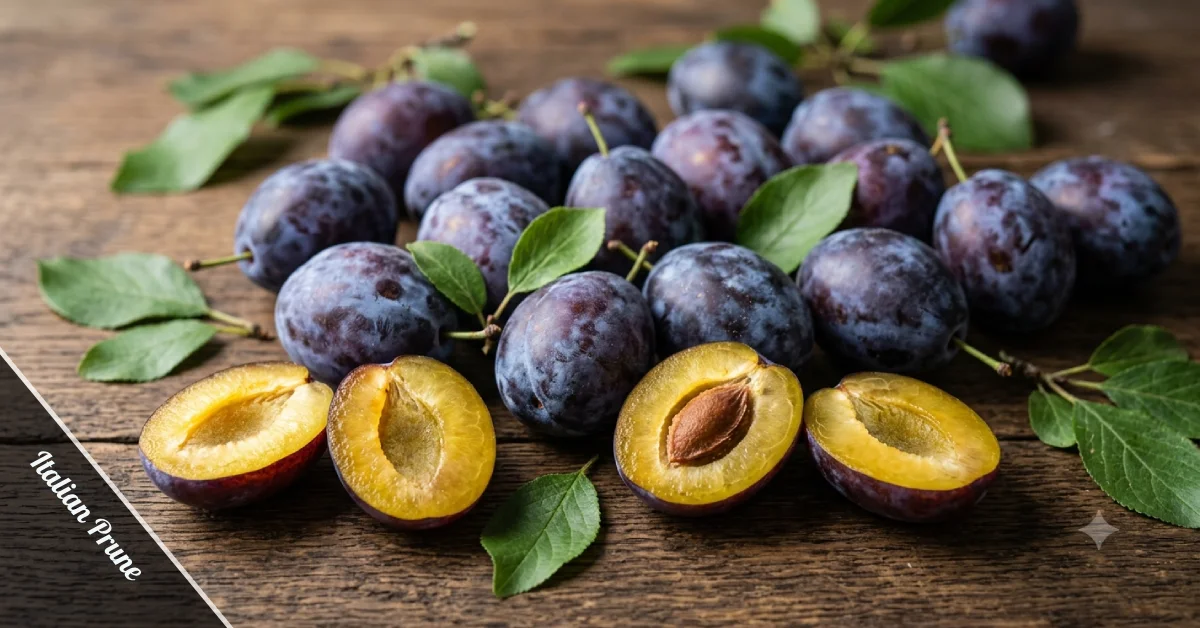
The Italian prune (Prunus domestica) is a small, oval, deep-purple plum prized for its high sugar content, freestone pit, and dense flesh. It ripens from late August through early September, grows in USDA Zones 4 to 9, and is self-fertile.
You can eat it fresh, bake it into cakes and tarts, dry it into prunes, or press it into brandy. It is one of the most productive and easy-care plum trees for home gardens.
What Is an Italian Prune?
The Italian prune is a European plum variety, botanically known as Prunus domestica. It goes by several names: Empress plum, Blue plum, Fellenberg plum, and Italian prune plum. Whatever you call it, the fruit is easy to spot.
It is small to medium in size, with a distinct oval shape and slightly tapered ends. The skin is deep purple to almost black when fully ripe, and it carries a powdery white-blue bloom on the surface. That bloom acts as a natural barrier against bacteria, insects, and moisture loss. It is a sign of freshness; once it fades, the fruit is past its prime.
Beneath the skin, the flesh is golden-yellow to green-yellow with a firm, dense texture. The flesh encases a central light brown pit that is easily removed, making Italian prune plums a true freestone variety.
Seventy per cent of the world’s prune crop comes from this cultivar and its French cousin. California produces ninety-nine per cent of the prunes grown in the United States.
The History Behind Italian Prune Plums
The Italian prune has a long history tied to trade, travel, and agriculture. Experts hypothesise that these plums descended from plums brought from Syria around the 12th century. Those Syrian plums were grafted onto local European plum rootstock, creating several new cultivars.
From there, the variety spread steadily across Europe. The oval plums were a valued dried food source for long journeys, and they reached the United States sometime in the mid-19th century as stone fruit farms began growing in California during the Gold Rush.
Despite the name, Italy is not the biggest fan of this plum. Italian prune plums are a hit in Germany, where they feature prominently in desserts. Forty-one per cent of Germans say the plum is their favourite fruit. The German plum cake, zwetschkenkuchen, is one of the best-known examples of this tradition.
Today, Italian prune plums thrive in arid Mediterranean climates with mild, cool winters and hot, dry, extended summers. They are cultivated in Europe, North America, and Australia.
Italian Prune Flavour and Texture
Raw Italian prune plums taste mild and fruity, with subtle citrus notes. They are not as sweet or juicy as the common red or black plums you find in most grocery stores. The firm skin makes a snap when you bite into it, much like biting into a crusty piece of bread.
Where the Italian prune really shines is in cooking. As the fruits cook, they develop a jammy, creamy consistency and a rich, sugary-sweet flavour. They also transition into a bright pink to fuchsia hue, which makes them visually striking in baked dishes.
Inside, the semi-firm golden-yellow flesh delivers a rich sweetness balanced by a subtle lemony tang, distinctly more complex than most common plums.
This combination of firm texture, concentrated sugar, and low water content is exactly why the Italian prune is the world’s top choice for drying into prunes.
Nutritional Value of Italian Prune Plums
Italian prune plums pack a solid nutritional profile into a small package. They are an excellent source of vitamins A and C, potassium, and dietary fibre, which support immune function, heart health, and digestion. They are naturally low in calories and free from fat.
The dark skin is rich in anthocyanins, a group of flavonoid pigments with antioxidant and anti-inflammatory properties. Research has also investigated the impact of plum consumption on bone health, with some evidence suggesting that prunes may help improve bone density and reduce the risk of osteoporosis.
A quick nutritional breakdown per two medium Italian prune plums:
- Calories: approximately 80
- Carbohydrates: 19g
- Dietary fibre: supports digestive regularity
- Potassium: helps balance fluid levels in the body
- Vitamin C: strengthens immune function
- Vitamin K: aids wound healing
- Vitamin A: supports healthy organ function
- Calcium: protects bones and teeth
According to Healthline, both fresh and dried plums contain fibre and antioxidants that may help reduce constipation and benefit overall health. Dried plums, or prunes, are known for improving several conditions, including constipation and osteoporosis.
One note: dried prunes concentrate sugar and carbohydrates, so portion control matters for those monitoring their sugar intake.
You can learn more about the nutritional benefits of unusual fruits in our cherimoya guide.
When Italian Prune Plums Are in Season
Italian prune plums have a short but reliable season. They are available for a few weeks in the late summer through the early fall.
More specifically, the tree blooms in spring with showy pinkish-white flowers, and the fruit ripens in late summer to early fall, typically August or September.
Early Italian prune plum trees mature around 15 days ahead of standard Italian prune trees, making them a good choice for regions prone to early frost that may damage ripening fruit.
If you grow your own, pay attention to the bloom. The powdery white coating on the skin is your best freshness indicator. Once it fades and the plums soften noticeably, use them quickly, or they will decline fast.
How to Grow an Italian Prune Tree
Growing an Italian prune tree is straightforward, even for beginners. Here is what you need to know before planting.
Hardiness and Climate
The Italian plum is hardy to minus 30 degrees Fahrenheit and grows best in USDA Zones 4 to 9. It tolerates cold winters well once established, but a late spring frost hitting the flower buds can reduce your crop significantly.
The tree prefers a Mediterranean-style climate: cool winters for dormancy and hot, dry summers for fruit development. It performs well in the Pacific Northwest, parts of the Midwest, and much of central and northern Europe.
Sunlight and Soil
Plums prefer at least half a day of full sun and well-drained soil. Waterlogged roots are the quickest way to stress or kill a young tree. If your soil is heavy clay, raise the planting bed slightly or amend with grit and compost before planting.
Tree Size
Italian prune trees can be kept as dwarf trees around 10 to 12 feet through careful pruning, a very manageable size. Semi-dwarf rootstocks will produce trees in a similar range, making harvesting practical without a ladder.
For anyone considering starting with a bare-root tree, see our bare-root tree planting guide for step-by-step advice on establishing young trees correctly.
Pollination
The Italian prune is self-fertile, though it blooms so late that there is poor pollination overlap with other plums. You can grow a single tree and expect fruit. However, planting a second European plum variety within 50 feet, such as Stanley or Green Gage, can improve yields in most years.
Yield and Bearing Age
Italian plum trees typically begin bearing 2 to 3 years after planting and can yield over 50 pounds of fruit per season. Standard trees on vigorous rootstocks may take a year or two longer to produce their first crop.
Pruning
Prune in late winter or early spring, before the tree flowers. Remove dead, diseased, or crossing branches first. Then thin the centre of the canopy to allow air and light to reach the fruit. Keep the tree open and well-shaped rather than tall and dense.
Italian Prune vs. Common Plum: Key Differences
Many people confuse Italian prune plums with the Japanese plums they see in supermarkets. They are quite different fruits.
- Shape: Italian prunes are oval and elongated; common plums are round
- Skin colour: Deep purple-blue on Italian prunes; red, black, or yellow on common varieties
- Flesh: Firm, golden-yellow, and dry on Italian prunes; juicy and soft on most common plums
- Sugar content: Higher in Italian prunes, making them better for drying
- Pit type: Freestone on Italian prunes, meaning the pit comes out cleanly
- Best use: Baking, drying, and cooking for Italian prunes; fresh eating forthe most common plums
The firm, dry flesh of the Italian prune is actually its biggest advantage in the kitchen. It holds its shape when baked and intensifies in sweetness rather than turning watery.
Best Ways to Use Italian Prune Plums
The Italian prune is one of the most versatile stone fruits you can grow or buy.
Fresh Eating
You can eat them straight from the tree, but the experience is different from a standard plum. They are smaller, so you need a handful to make a decent snack. The flavour becomes deeper and far more satisfying once cooked.
Baking
This is where the Italian prune truly excels. Italian prune plums can be baked into pies, crumbles, cakes, dumplings, turnovers, and tarts. They hold their shape well under heat and develop concentrated, rich flavours. The German zwetschkenkuchen plum cake is the most famous example, but they work equally well in a simple crumble or tart shell.
Jams and Compotes
The plums can be simmered into jams, jellies, and compotes, or incorporated into sauces for roasted meats. Their natural sweetness means you need less added sugar than with more acidic fruits.
Drying
Prune trees produce fruit with a much higher sugar content than standard plums, making it preferable for drying with the pit inside without the risk of fermenting. You can dry them in a dehydrator, a low oven, or in a dry climate, simply in the sun.
Drinks and Preserves
Italian prune plums can also be fermented into regional spirits. Slivovitz, the traditional plum brandy common in Central and Eastern Europe, is made from this variety or close relatives.
If you enjoy growing unusual fruits at home, our guide to Biloxi blueberry covers another productive and underused variety worth adding to your garden.
Common Pests and Problems
Italian prune trees are generally tough, but a few issues are worth watching for.
Bacterial Canker
Bacterial canker can occasionally damage trunks or branches. Symptoms include exudations of amber-colored sap. Spraying lime-sulfur or copper in the fall and early spring can help control this disease.
Brown Rot
Brown rot is the most common fungal problem on plum trees. It strikes during wet conditions at harvest time, turning fruit soft and brown rapidly. Good air circulation through pruning is the best prevention.
Aphids and Plum Moth
Aphid colonises new growth in spring. A strong water spray or insecticidal soap handles minor infestations. Plum moth larvae tunnel into fruit. Pheromone traps placed early in the season help monitor and reduce damage.
Overbearing
Italian prune trees can set so much fruit that branches split under the weight. Thin fruit to about two to three inches apart after the natural June drop to protect the tree and improve fruit size.
FAQs
Are Italian prune plums the same as prunes?
Yes and no. The Italian prune plum is the most common fruit used to make dried prunes commercially. Not every plum can be dried successfully; the Italian prune’s low moisture and high sugar content make it uniquely suited for the process. When people say “prune,” they are usually referring to a dried Italian prune.
Can I grow an Italian prune tree in a small garden?
Yes. Italian prune trees can be kept at 10 to 12 feet through careful pruning. Semi-dwarf rootstocks keep them even more compact. They can also be trained flat against a fence or wall using espalier techniques, which works particularly well for smaller spaces.
Do Italian prune trees need a pollinator?
You can plant a single Italian plum and expect fruit because it is self-pollinating. However, planting a second plum tree within 50 feet is an easy way to boost your harvest yield.
When is the best time to pick Italian prunes?
Pick them when the skin is deep purple, the bloom is still present, and the fruit gives slightly when pressed. The tree typically ripens fruit in late August or September. In cooler climates, a light frost actually sweetens the fruit further before harvest.
How long does it take an Italian prune tree to bear fruit?
Italian plum trees typically begin bearing 2 to 3 years after planting. Trees on standard rootstocks may take a year longer. Buying a two-year-old tree from a reputable nursery is a good way to shorten the wait.