

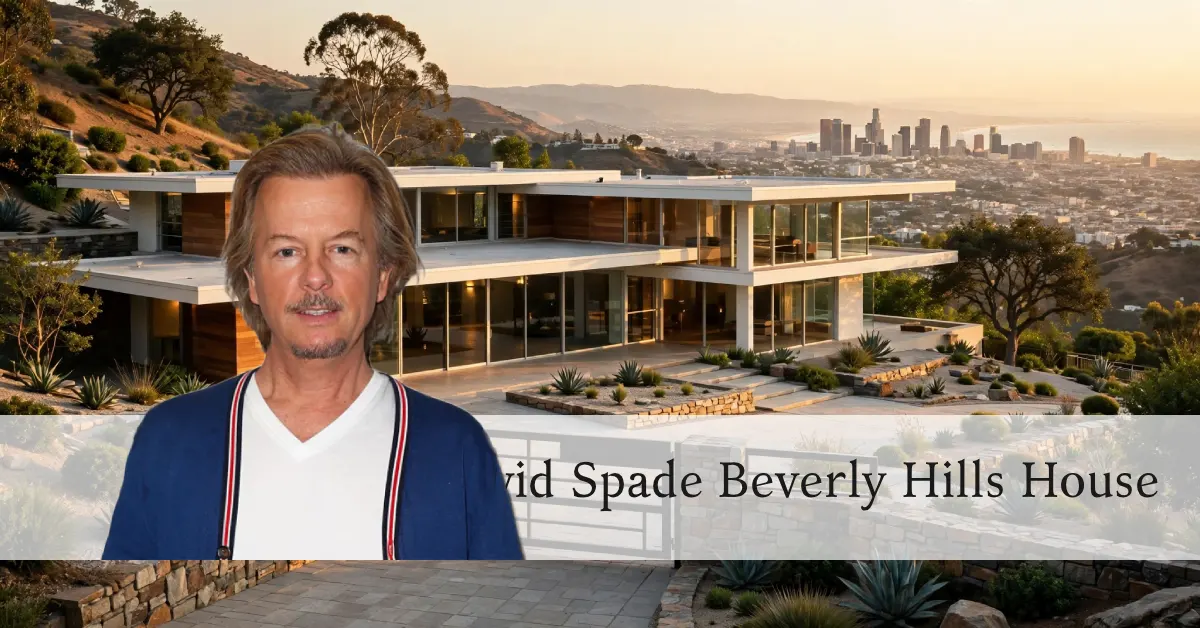
David Spade owned a midcentury house in the Trousdale Estates section of Beverly Hills from 2001 to 2022. Designed by architect Edward Fickett in 1978, the roughly 6,400-square-foot home sat on three-quarters of an acre. Spade bought it for about $4 million and sold it for $19.5 million after two decades of renovations.
David Spade owned a midcentury house in the Trousdale Estates section of Beverly Hills from 2001 to 2022. Designed by architect Edward Fickett in 1978, the roughly 6,400-square-foot home sat on three-quarters of an acre. Spade bought it for about $4 million and sold it for $19.5 million after two decades of renovations.
What Is the David Spade Beverly Hills House
For more than twenty years, David Spade lived in one house. That kind of loyalty is rare among celebrities who tend to trade up every few years, so when Spade finally sold his longtime home in early 2022, real estate watchers took notice.
The David Spade Beverly Hills house sits in the Beverly Crest area, inside the celebrity-favoured Trousdale Estates neighbourhood. It is a clean-lined midcentury property that Spade bought in his mid-thirties and slowly reshaped into a personal retreat, using profits from his film and television work to fund a string of renovations over the years.
Spade is known for roles in Tommy Boy, Joe Dirt, Grown Ups, and the sitcoms Just Shoot Me! and Rules of Engagement. More recently, ly he has hosted the late-night talk show Lights Out With David Spade and co-hosted the podcast Fly on the Wall with Dana Carvey. Through all of it, this Trousdale property stayed his home base in Los Angeles, which is part of why the sale drew so much attention from real estate outlets when it finally happened.
This article breaks down where the house sits, what it looks like inside, how much Spade paid for it, and what happened after he moved on. You will also find quick answers to common questions readers ask about the property’s location and value.
Where the House Sits in Trousdale Estates
The property is located on Wallace Ridge, tucked behind a gate on the southern face of the hills above Los Angeles. From that elevated spot, the home looks out over the city and, on a clear day, all the way to the Pacific Ocean.
Trousdale Estates has long attracted actors, musicians, and industry executives who want privacy along with proximity to the rest of Beverly Hills. Homes in the neighbourhood historically belonged to figures ranging from Elvis Presley to Frank Sinatra, and current residents have included Elton John and Ringo Starr. Spade’s street placed him among that same circle of quiet, high-value real estate.
The lot itself covers about three-quarters of an acre, generous by Beverly Hills standards, and gave Spade room for a tennis court and pool alongside the main house. Trousdale sits at one of the higher points in Beverly Hills, bordered by thecelebrity-favouredd Bird Streets, and the neighbourhood has drawn architects like Paul R. Williams, Wallace Neff, and A. Quincy Jones over the decades. That kind of design pedigree is a big part of why homes in the area hold their value so well.
Being surrounded by that level of neighbourhood history also shapes how quickly homes move once they hit the market. Buyers in Trousdale tend to already know the streets, the views, and the architects, so a well-priced listing rarely lingers. If you enjoy learning how other entertainers settle into their neighbourhoods, the Caroline Kennedy house offers a similar look at how location shapes a property’s story.
Inside the Edward Fickett-Designed Midcentury Home
The house was built in 1978 by Edward Fickett, an architect credited with designing tens of thousands of homes across Southern California during the postwar decades. Fickett also earned a reputation for pioneering cantilevered tennis courts, and Spade’s property carried one of those signature courts.
At roughly 6,400 square feet, the home held four bedrooms along with a primary suite that included its own loft and private terrace. Interior details included a sitting room with a bar, a double-sided fireplace, and a kitchen built around a central island and breakfast bar.
The great room stood out for its nearly 20-foot ceilings and an indoor tree that grew alongside the staircase, a detail several outlets highlighted as one of the home’s most memorable features. Steel beams cut through glass walls in a split-level layout, with stairs leading down from the dining area into the living room. Outside, vanishing glass walls opened the main living space onto a pool deck and dining terrace with skyline views.
Fickett’s other work across Southern California leaned heavily on tract housing, so a custom hillside commission like this one stood apart from most of his portfolio. He is sometimes called the King of the Tennis Court because he is credited as one of the first architects to design cantilevered tennis courts, a signature that shows up again in this property’s own court perched on the hillside. That kind of architectural detail is one reason listing agents lean on an architect’s name when marketing a home in this price range. It gives buyers a story beyond square footage, and it tends to hold up well when a house resells years later.
Beyond the structural details, Spade’s team focused renovations on the parts of the home that got the most daily use. Reports describe an updated kitchen with an island and breakfast bar, a sitting room built around a bar setup for entertaining, and a primary suite positioned to take advantage of the loft and terrace layout. None of the updates changed the home’s original footprint, which kept the Fickett design intact while still giving the interior a more current feel.
David Spade Beverly Hills House Price History
Spade first saw the home from the air in the late 1990s and tried to buy it, but that early deal fell through. Three years later, in 2001, he got a second chance and paid the full asking price of around $4 million.
Over the next two decades, Spade funnelled earnings from his career into a series of updates. He has described the renovations as funded partly by his film work and partly by his television paychecks, joking that money from projects like Joe Dirt and Just Shoot Me went straight back into the house.
By January 2022, Spade decided it was time for a change. He listed the home for just under $20 million through Stuart Vetterick of Hilton & Hyland. The listing moved quickly. Within about a week, Spade had an offer, and the sale closed the following month at $19.5 million, roughly $15.5 million more than his original purchase price.
Public records show the buyer’s identity was not disclosed at the time, and the deal was represented on the buyer’s side by Branden and Rayni Williams of The Beverly Hills Estates.
Here is a quick timeline of the price history:
- 2001: Spade purchases the home for approximately $4 million
- January 2022: Spade lists the home for just under $20 million
- February 2022: The sale closes at $19.5 million
- November 2022: The new owner relists the property for $32.5 million
That timeline shows a return of roughly $15.5 million on Spade’s original purchase, not counting the cost of two decades of renovations. Even accounting for those upgrades, the sale reflected how much Trousdale Estates’ value climbed between 2001 and 2022, a period when Beverly Hills luxury pricing rose sharply across most neighbourhoods.
Why the Home Sold So Fast
Several factors lined up to move this sale along quickly. Beverly Hills inventory was tight in early 2022, and homes with a clear architectural pedigree in a neighbourhood like Trousdale tend to draw fast attention from buyers who already know the area well.
The home also benefited from Fickett’s design reputation and decades of documented upkeep, which reduced the uncertainty that often slows down high-end sales. Listing agent Stuart Vetterick noted that limited supply across nearly every price bracket in the Los Angeles luxury market was pushing buyer demand higher at the time, a pattern that held for much of that sales cycle.
Timing mattered too. Early 2022 sat near the peak of a multi-year run in luxury home pricing across Los Angeles, with buyers competing hard for move-in ready properties that came with a clear architectural story. A home that had already been maintained and updated for two decades removed a lot of the guesswork that usually slows down high-end deals, since buyers did not need to budget for a full renovation before moving in.
For readers curious about how quickly other celebrity properties have changed hands, the Jon Pardi house article covers a different kind of fast-moving real estate story in the entertainment world.
The Home’s Life After David Spade
Spade did not go far after selling. Later that same year, he had already purchased a larger home nearby in the Hollywood Hills for close to $13.85 million, roughly double the square footage of his old Trousdale property.
His former Trousdale house did not stay quiet for long either. By November 2022, the new owner relisted the property for $32.5 million, about 66 per cent above what Spade had sold it for just months earlier. That relisting priced in the home’s architectural pedigree, its view corridor, and continued demand for move-in ready homes in the neighbourhood.
Key features that carried over from Spade’s ownership into the relisting included:
- A cantilevered tennis court designed in Fickett’s signature style
- An infinity-edge pool with skyline views
- A 20-foot great room with an indoor tree along the staircase
- A private primary suite with a loft and terrace
- Glass walls opening the main level to outdoor living space
If you like tracking how a single property’s value shifts across owners, the Quinn Tallulah Lewis house walks through a comparable case of a well-documented home changing hands.
It is worth noting that the $32.5 million figure was an asking price under the new owner, not a confirmed second sale amount for Spade himself. Still, the jump shows how much confidence the market had in the property even a few months after Spade’s own sale closed, and it says a lot about how architect-driven homes in Trousdale tend to hold or gain value once they change hands.
What Made This House Stand Out From Other Trousdale Listings
A few things separated this property from other homes that come through Trousdale Estates each year.
- A documented architect: Fickett’s name carries weight with buyers who track midcentury design, unlike many Trousdale homes that have been rebuilt from the ground up
- A rare cantilevered tennis court: few hillside lots in the neighbourhood have the grading needed to support one
- Long single ownership: two decades under one owner meant consistent upkeep rather than a string of quick flips
- A private, gated approach: the Wallace Ridge address kept the home away from the busier through streets in the flats below
Combined, these details gave the listing agents a clear story to tell buyers, which is part of why the sale closed so quickly once it hit the market.
Final Thoughts
The David Spade Beverly Hills house tells a fairly simple story once you strip away the celebrity name. A buyer found a well-located lot with strong architectural bones, held onto it for two decades, invested steadily in upkeep, and sold into a tight market at the right moment. The numbers, from the original $4 million purchase to the $19.5 million sale and the later $32.5 million relisting, track closely with how Trousdale Estates values have moved over the same period.
For fans of celebrity real estate, the house also serves as a reminder that long-term ownership in a strong neighbourhood tends to pay off, even without a major renovation splash right before selling.
FAQs
How much did David Spade pay for his Beverly Hills house?
Spade paid roughly $4 million for the property in 2001, according to public records cited by Hilton & Hyland and the Wall Street Journal.
How much did David Spade sell his Beverly Hills house for?
He sold the home for $19.5 million in February 2022, about a month after listing it for just under $20 million.
Where is David Spade’s former Beverly Hills house located?
The property sits on Wallace Ridge in the Trousdale Estates section of Beverly Crest, within Beverly Hills.
Who designed David Spade’s Beverly Hills house?
The home was designed by architect Edward Fickett and built in 1978.
Did David Spade’s old house sell again after he moved out?
The new owner relisted the property in November 2022 for $32.5 million, about 66 Percent above the price Spade sold it for earlier that year.