

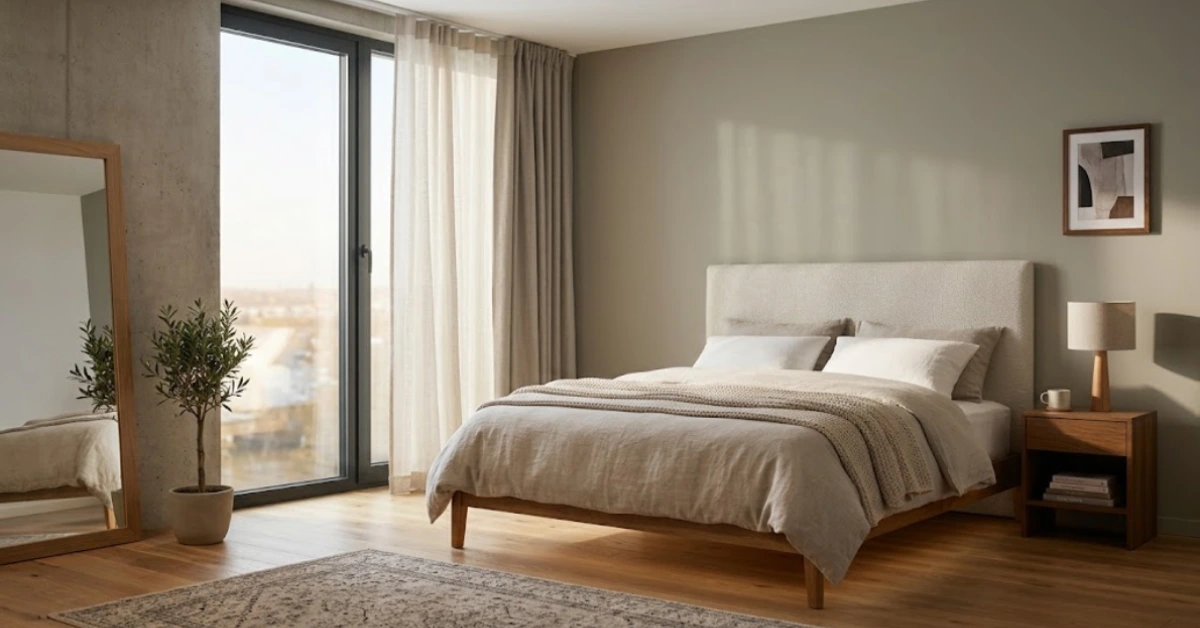
The best curtains for a bedroom block light, fit the window well, and suit your style. Choose blackout lining or layered sheers for sleep, lined linen, cotton, or velvet for comfort, and panels that are 1.5 to 2 times your window width. Hang the rod 4 to 6 inches above the frame.
Do you wake before your alarm because sunlight fills the room? The right curtains bedroom owners choose can fix that. The Sleep Foundation says the first step in setting up a bedroom for sleep is to make it as dark as possible. Curtains are the simplest way to do that, and they also add privacy, insulation, and style.
Many buyers pick a colour first and think about fit later. That order causes problems, such as light gaps at the sides, panels that look thin, or fabric that blocks too little light. This guide helps you get function, size, and style right together.
You will learn which curtain types suit sleep, how to measure your window, which fabrics work best, and which mistakes to avoid. You will also find five designer ideas from 2026 that you can adapt at home.
Why Bedroom Curtains Matter for Sleep
Light is the main reason to treat curtains as a sleep tool. The Sleep Foundation reports that blackout curtains block most outside light, and it also advises reducing technology in the bedroom. Its guides on light and sleep, updated in 2026, name a dark room as the first step.
Research supports the link between bedroom light and sleep. A 2024 study in the journal Sleep analysed data from 47,765 women. Those who slept with a TV on were about 1.6 times as likely to have a poor overall sleep score as women who slept with no light in the room.
That study measured indoor light, not curtains. It still shows why controlling light in your bedroom is worth the effort. Curtains handle the light that comes from outside, and your habits handle the rest.
Curtains also affect privacy, warmth, and noise. Heavy, lined fabric softens outside sound a little, although it will not soundproof a room. Decide your top priority before you shop, because it changes which curtain type you should buy.
Curtains Bedroom Ideas for Every Style
Designers now treat bedroom curtains as part of the room’s design. Interior designer Alyssa Owens told Livingetc in June 2026 that drapery works as “soft architecture rather than simply window dressings.” Here are five ideas from 2026 coverage that you can adapt.
- Layered sheers and blackout panels: A sheer panel hangs closest to the glass, and a heavier lined panel hangs on a second rod. You get soft daylight in the morning and full darkness at night.
- Wall-to-wall curtains: Designer Jessica Davis of Nest Studio says one continuous run of fabric looks cleaner than a separate treatment on each window. She suggests a ripple-fold pleat and a track fixed close to the ceiling.
- Curtains behind the bed: Livingetc reports designers hanging drapery behind the headboard, sometimes with framed art set against it. Designers Megan Pflug and Moses Nadel hung curtains at headboard height as a DIY headboard.
- Bed hangings: Designer Christopher Alexander uses sheer fabric around a bed to reduce the scale of a very large room.
- Short hems for casual rooms: Designer Heather Peterson recommends dividing the space between the window bottom and the floor into thirds and ending the hem in the top third. She prefers cotton, linen, or chintz with some body, because very soft fabric can look saggy.
Pick one idea and keep the rest of the room calm. A bold pattern works best when the walls and bedding stay quiet. Designer David Ries suggests nature-inspired motifs, such as botanicals or soft geometric shapes, for bedrooms.
Blackout, Sheer, or Layered Curtains?
The three main types do different jobs. Blackout curtains use a dense layer that stops light. Room-darkening curtains let a little more light through. Sheers soften daylight, but an AOL designer round-up from July 2026 notes that they give little privacy and block little natural light.
Match the type to your room, not to a trend. Use this list to decide:
- Choose blackout if morning sun, streetlights, or shift work interrupts your sleep.
- Choose room-darkening if you like some daylight and only need to reduce glare.
- Choose sheers alone only when privacy and early light are not concerns.
- Choose layered panels if you want privacy, soft daylight, and full darkness in one setup.
A single flat panel still leaks light at the edges. Curtain hardware retailer Freshine recommends a wraparound rod, also called a return rod, that curves back to the wall and seals the side gap. The U.S. Department of Energy gives similar advice for insulation: overlap the panels in the centre and seal them at the sides.
Best Fabrics for Bedroom Curtains
Fabric changes how much light, warmth, and sound the curtain controls. It also changes how the room feels when you lie in bed. These five options cover most bedrooms.
- Linen and linen blends: Ries says linen blends, cottons, and textured weaves diffuse light softly, while very shiny fabrics can feel too formal for a room meant for rest. Add a lining if you need darkness.
- Cotton: Cotton is easy to wash and takes a blackout lining well. It suits casual and traditional rooms.
- Velvet: Velvet is heavy, so it blocks light and draughts well. Freshine advises a 1.25 to 1.5 inch rod for heavy velvet to prevent sagging.
- Polyester blackout fabric: This is the budget choice for total darkness. Check the care label, because some coated fabrics cannot be machine washed.
- Sheer voile or chiffon: Use it for a daytime layer. Owens chose a lightweight chiffon sheer to diffuse light and soften the edges of a bedroom.
If you plan a dark, rich room, our moody bedroom ideas explain how velvet, linen, and warm lighting work with deep wall colours.
How to Measure and Hang Bedroom Curtains
Correct sizing matters more than price. Follow these steps in order.
- Set the rod position. Mount the rod or track 4 to 6 inches above the window frame. Designer Victoria Meadows, quoted by AOL, says this makes the bedroom feel taller. Let the rod extend past the frame on each side so the panels rest off the glass when open.
- Choose fullness. The Shade Store says panels should be 1.5 to 2 times the window width for a full look. For example, a window 64 inches wide needs 96 to 128 inches of fabric in total. Use the higher end for heavy blackout panels.
- Choose the length. The Shade Store lists sill length, floor length that just clears the floor, and puddle length with 3 to 6 inches of extra fabric. For curtains you open daily, a hem that clears the floor is the easiest to live with.
- Measure both sides. Floors are often uneven, so measure the drop on the left and right and use the shorter number.
- Check the edges. Close the panels and look for gaps at the top, sides, and centre. Adjust the rod depth or add a return rod if light shows.
Choose Colours That Work With Your Room
The safest choice is a colour close to your wall shade, because it keeps the room calm and unbroken. Deeper colours add drama in rooms that get good daylight. Test a fabric swatch against your wall in morning and evening light before you order.
Colour also affects heat. The U.S. Department of Energy says studies show medium-coloured draperies with white plastic backing can reduce heat gain by 33 percent. That makes a medium tone with a light lining a practical choice for a bedroom that gets afternoon sun.
For a nature-led look, Freshine points to muted olive, clay, and grey-green, and it links that palette to Valspar’s 2026 Colour of the Year, Warm Eucalyptus.
For a lighter scheme, our Japandi bedroom guide shows how linen or cotton curtains in neutral shades work with sheers by day and heavier panels at night.
Do Bedroom Curtains Save Energy?
They can, but the results depend on fabric, colour, and fit. The U.S. Department of Energy says most conventional draperies can reduce heat loss from a warm room by up to 10 Percent when drawn in cold weather. It says the amount varies too much by type of fabric for a single figure to apply to every home.
Fit matters as much as the fabric. The department gives these tips for better results:
- Hang curtains as close to the window as possible.
- Let them fall to the sill or the floor.
- Seal the sides and overlap the panels in the centre.
- Hang two layers together, because two layers create a tighter air space.
- Close them at night in winter, and close them on sunny windows during summer days.
These steps cost little, and they also improve the light control you want for sleep. A well-fitted blackout curtain does both jobs.
Rods, Lighting, and Small Details
Hardware carries the weight of your fabric, so choose it with the curtain in mind. Freshine says a 1-inch rod suits most standard windows. Very wide windows over 100 inches, or heavy velvet, need a 1.25 to 1.5 inch rod to stop sagging. The retailer also says curtain rings with hooks slide more easily than rod pockets, and that wood rods suit rooms where quiet matters, such as bedrooms.
Lighting changes how curtains look at night. Choose warm bulbs in bedside lamps so the fabric keeps its true colour and the room stays restful.
If you add strip lights or lamps near the window, read our LED lights bedroom guide first. It explains warm bulbs at 2700K or lower and why you should keep power supplies away from bedding and curtains.
Common Curtain Mistakes to Avoid
Most disappointing curtain jobs come from a short list of errors. Check your plan against this list before you buy.
- Buying panels the exact width of the window. They look flat and stretched when closed.
- Hanging the rod at the top of the frame. This makes the window and the ceiling look lower.
- Skipping the lining when you need darkness. A thin fabric lets light through even when it is closed.
- Leaving side gaps. Light and draughts enter at the edges, so use a return rod or wider panels.
- Choosing an in-between hem. A hem should land clearly at the sill, just below the trim, or at the floor.
- Using a light rod for heavy fabric. Lined velvet needs a thicker, stronger rod.
FAQs
What colour curtains are best for a bedroom?
Choose a colour close to your wall shade, or a soft muted tone such as sage, clay, or warm neutral. If your room gets strong sun, a medium colour with a light lining helps reduce heat gain.
Should bedroom curtains touch the floor?
They can end just above the floor, at the floor, or with 3 to 6 inches of extra fabric for a puddle look, according to The Shade Store. For curtains you open every day, a hem that clears the floor is the easiest to use and keep clean.
How wide should bedroom curtains be?
Aim for 1.5 to 2 times the width of your window. A window 64 inches wide needs 96 to 128 inches of total fabric.
Are blackout curtains good for sleep?
Yes. The Sleep Foundation says blackout curtains block most external light, which supports a darker room. They work best with a cool room, limited technology, and a steady bedtime.
Can I use sheer curtains alone in a bedroom?
You can, but sheers give little privacy and block little light, so they suit rooms that are not overlooked and do not face early sun. Most bedrooms work better with sheers layered under a lined panel.