

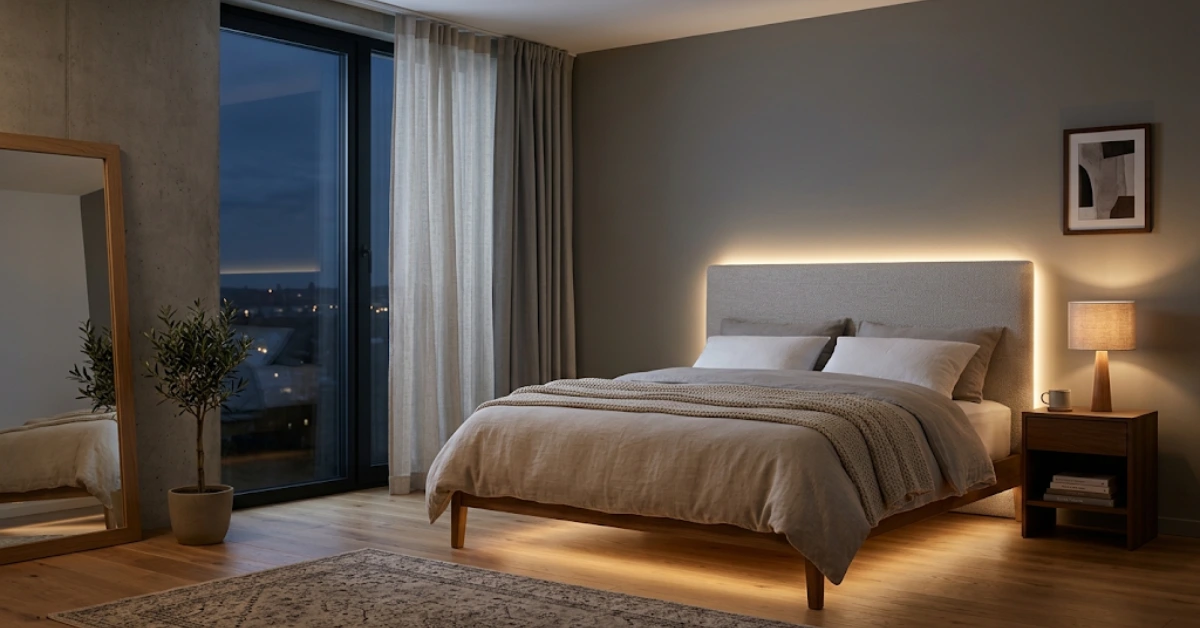
The best LED lights for a bedroom use warm white light at 2700K or lower, sit on a dimmer, and avoid bright cool tones at night. Place strips behind the headboard or under the bed frame, use bedside lamps for reading, and choose certified power supplies for safe overnight use.
Have you ever switched on a bright white bulb at 10 p.m. and felt wide awake ten minutes later? The colour of your evening light affects how easily you fall asleep. That makes your LED lights bedroom setup worth planning with care.
LED lighting comes as strips, bulbs, lamps, string lights, and panels. Each type changes how a room looks and feels. This guide explains which colors suit sleep, where to place each type, how to keep strips safe, and how to match colour lights to your style.
Why LED Lights Suit Your Bedroom
The U.S. Department of Energy states that LEDs use 75% less energy and last up to 25 to 50 times longer than incandescent bulbs. Those savings matter in a bedroom where lights stay on for reading, dressing, and winding down. A longer bulb life also means fewer trips up a ladder to change a ceiling bulb.
UK homes can save too. The Energy Saving Trust estimates that replacing the remaining halogen spotlights in a home with LEDs could save £45 a year in Great Britain and cut CO2 emissions by 35kg. Bedrooms with ceiling spotlights are a good place to start.
LEDs also give you more control. You can pick a colour temperature, dim the output, and set schedules from your phone. Govee, for example, sorts its bedroom range by scenes such as Morning Glow, Wind Down, and Night Reading. That approach makes sense because you use your bedroom differently at 7 a.m. than you do at 10 p.m.
Best LED Colour for Sleep
Light colour is measured in kelvin (K). Lower numbers give warm, yellow light. Higher numbers give cool, blue-white light. Blue-rich light signals daytime to your brain and can reduce melatonin, the hormone that helps you feel sleepy.
A 2026 study in Scientific Reports tested tunable LED lamps and found estimated melatonin suppression fell from 10% at 5700K to 0.1% at 2100K. The same research compared lamp types and found cool white LEDs suppressed melatonin far more than warm white LEDs, at a median of 12.3% versus 3.6%, while traditional incandescent lamps came in at 1.5%.
The Sleep Foundation notes that a dark bedroom is best for sleep, and that warm colors such as red, orange, and yellow are the better choice if you need light in colour-changing or at night.
Use this simple guide when you choose bulbs and strips:
- Evening and bedtime: warm white at 2700K or lower, dimmed.
- Reading: warm white, bright enough to read without eye strain and without glare.
- Morning: a brighter, slightly cooler setting if you like to wake up alert.
- Night trips to the bathroom: a dim amber or red night light.
Brightness Matters as Much as Colour
Colour is only one factor. A 2025randomisedd crossover study in Behavioural Sleep Medicine tested adjustable LED lighting during the two hours before bed, and one setup moved from 5000K at 160 lux down to 3000K at 30 lux. The design mirrors what you can do at home: lower the colour temperature and lower the brightness together as bedtime gets closer.
Put your lamps on dimmers or use smart bulbs with a bedtime scene. Set the scene to start about two hours before you sleep. Then the change happens on its own, and you do not need to remember it.
LED Lights Bedroom Ideas by Type
Most bedrooms work best with two or three layers of light. One layer gives general light, one gives task light for reading, and one adds a soft accent glow. Govee’s bedroom range shows how wide the choice is, with table lamps, floor lamps, strip lights, ceiling lights, neon rope lights, and light panels. Here is how the main types compare:
- LED strip lights: Best for indirect glow behind a headboard, under a bed frame, or along a shelf.
- Bedside lamps with LED bulbs: Best for reading. Choose warm white bulbs and a dimmer.
- String lights: Best for a headboard wall or a window. They give a low, even glow.
- Smart bulbs: Best for changing colour or temperature and brightness by schedule.
- Ceiling lights and panels: Best as the main light. Pick a dimmable model so it does not feel harsh at night.
- Night lights: Best for hallways and bathrooms. Choose amber or red and keep the output low.
Start with the main light and the two bedside lamps. Add strips or string lights last. Accent lighting works best when added to good general lighting. It cannot replace general lighting.
Smart Controls, Timers, and Scenes
Smart LED lights let you change colour, brightness, and timing without leaving bed. A morning scene can raise the colour slowly before your alarm. A bedtime scene can move to warm white and lower the output. A night reading scene can keep only the bedside lamp on. Govee groups its bedroom lights around these same moments, and other brands offer similar scene tools.
Keep the setup simple. Two or three scenes are enough, and you should name them by time of day so anyone in the home can use them. Check that the app lets you set a schedule and that the lights keep it after a power cut. If you share the room, keep a physical switch or dimmer as well, so you can adjust the lights without a phone.
Where to Place LED Lights in a Bedroom
Placement decides whether a light feels soft or harsh. Aim for light that bounces off a wall or ceiling before it reaches your eyes.
Behind the headboard, a strip lights the wall and gives a gentle glow. You see the light on the wall and not the bare LEDs. Mount the strip a few centimetres from the wall so the light spreads.
Under the bed frame, a strip lights the floor. This works well for night walks because it shows the path without lighting your face. Keep strips away from mattress fabric and bedding.
On shelves and above wardrobes, a strip adds depth. Use a diffuser channel if you can see individual dots of light. Around a mirror or wardrobe, use a neutral warm white so clothes and skin tones look natural.
Beside the bed, place lamps at shoulder height when you sit up. That position lights your book and avoids glare on the page. Keep the bulb hidden by the shade. If you share the bed, choose lamps with a narrow beam so one person can read while the other sleeps.
Match LED Lights to Your Bedroom Style
Lighting should match the room’s mood. Dark walls and rich fabrics look best with low, warm light at several heights. If you like that look, our moody bedroom ideas show how colour and texture work together. Use dimmed lamps and a soft strip behind the headboard, and avoid bright overhead light.
Light woods, plain fabrics, and simple shapes suit a calmer style. In a room like that, you want light that looks clean and quiet. Warm white paper shades and a hidden strip under a floating bed keep the space simple. The Japandi bedroom style is a good example of this approach.
A colourful or playful room can use colour-changing lights during the day. Switch to warm white in the evening so the room still feels ready for sleep.
Safe Setup Tips for LED Strips
LED strips run on low voltage, but the power supply and wiring still need care. FlexFire LEDs lists fire risk factors such as strips that overheat next to flammable materials, strips that are overpowered or paired with an incompatible power supply, and products from unreliable suppliers. It advises buying parts with a recognised safety certification such as ETL, CE, or UL Listed. It also recommends testing the setup before you peel the tape and stick the strip down.
The UK-based guide from Simple Lighting adds a useful rule: add a 20% safety margin to the total wattage of your strip. Its example is a 5 metre strip at 9.6 watts per metre, which needs 48 watts, so you should choose a 60 watt supply.
Follow these steps:
- Check that the strip voltage matches the power supply voltage.
- Multiply the strip length by the watts per metre, then add 20%.
- Buy strips and power supplies with a safety mark used in your country.
- Test the strip on the floor before you install it.
- Keep the power supply in a ventilated spot, away from bedding and curtains.
- Use a timer or smart plug so the strip switches off after you fall asleep.
LED Lights for Kids’ Bedrooms
Children need extra care with evening light. A study in Physiological Reports compared children and adults under 3000K and 6200K lighting at night. Children had greater melatonin suppression than adults at both settings, and the higher colour temperature had a stronger effect in children than the lower one. The study is older than three years, but it remains a clear reason to keep children’s lighting warm and dim.
For a child’s room, use a warm white ceiling light on a dimmer and a small amber night light. Save colour-changing modes for playtime in the afternoon. If you are planning a full room, this colour-changing room guide covers layout and storage ideas that work with these lighting choices.
Common Mistakes With Bedroom LEDs
Most problems come from a few habits:
- Using a cool white bulb in a bedside lamp. Choose a warm white bulb instead.
- Leaving smart bulbs on one scene all evening. Set a bedtime scene that gets warmer and dimmer.
- Placing strips where the bare LEDs face your eyes. Point them at a wall.
- Buying the cheapest kit without a safety mark. Check the marking on the strip and the power supply.
- Using only one bright ceiling light. Add lamps so you can turn the ceiling light off in the evening.
Small changes fix most of these. Swap the bulb, add a dimmer, or move a strip. You do not need to replace everything at once.
FAQs
Are LED lights bad for sleep?
LED lights are not bad for sleep by default. Colour and brightness decide the effect. Cool white light in the evening suppresses more melatonin than warm white light, so choose warm tones and dim them before bed.
Can I leave LED strip lights on all night?
The Sleep Foundation says a dark bedroom is best. If you want a light on, use a dim amber or red setting or a timer. For safety, use a certified power supply with 20% spare capacity and keep it in a ventilated place.
What colour LED is best for a bedroom?
Warm white at 2700K or lower suits most bedrooms. Amber and red work well for night lights. Avoid blue and cool white in the evening.
How many LED lights does a bedroom need?
Most bedrooms work well with one main ceiling light, one lamp on each side of the bed, and one optional accent strip. Put every light on a dimmer if you can.