

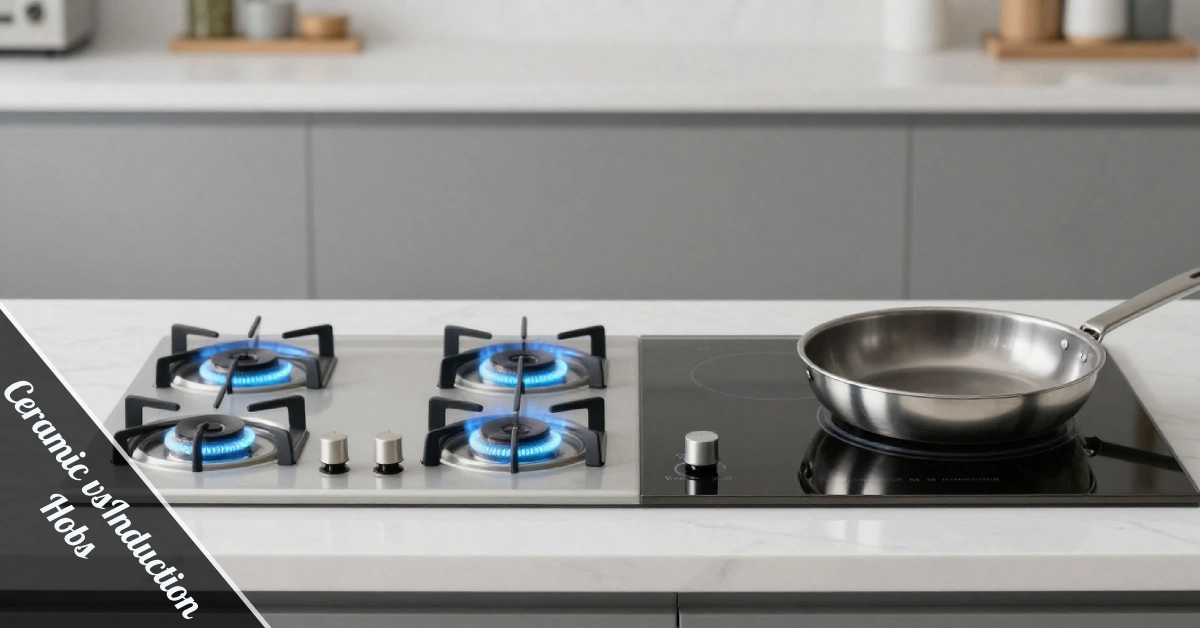
Upgrading your hob sounds simple — until you’re standing in a showroom staring at two nearly identical glass surfaces. But ceramic vs induction hobs is a genuine fork in the road. Pick wrong, and you’ll feel it every time you cook — and every month on your energy bill.
One heats the glass surface beneath the pan. The other heats the pan itself directly. That single difference changes your cooking speed, your safety, your monthly costs, and more.
No fluff here. Just the honest breakdown you need to make a smart, confident kitchen decision.
How Do Ceramic and Induction Hobs Actually Work?
A ceramic hob uses electric heating elements fitted under a smooth glass surface. Switch it on, the ring heats up, and that warmth transfers through the glass into your pan. It’s straightforward tech that’s been around for decades.
An induction hob works completely differently. Copper coils beneath the glass generate a magnetic field. When you place a compatible pan on top, the pan itself becomes the heat source. The glass surface stays cool the entire time.
According to Maurizio Servergnini, Managing Director at Bertazzoni UK, induction “enables faster cooking times and maximum energy efficiency,” while ceramic is slower and loses more heat into the surrounding kitchen air.
The practical consequence is this: with ceramic, you’re heating the glass, the air around the ring, and eventually the pan. With induction, you skip all of that and go straight to the source. Less energy wasted, faster results, and better overall control of your cooking temperature.
The Real Benefits — Honestly Compared
Why Induction Hobs Win on Performance
Kitchen expert and CEO of Kitchen Door Hub, Steve Larkins, lays out exactly why induction keeps dominating the debate among serious home cooks:
- Speed: Energy transfers directly into the pan — no warmth wasted heating glass or surrounding air
- Safety: The hob cuts off the moment you lift the pan off the surface
- Cleaner cooking: Spills don’t burn on because the surface itself never gets dangerously hot
- Cooler kitchen: Far less waste heat escapes into your room while you cook
Why Ceramic Hobs Still Hold Their Ground
Ceramic isn’t just the cheap option — it brings some real, practical advantages to your kitchen.
- Universal cookware: Any pan works — copper, aluminium, glass — no replacements needed
- Even heat spread: The ring distributes warmth consistently with no annoying hot spots
- Residual heat warning: A red indicator light tells you the surface is still warm after use
- Dead easy to clean: Flat glass surface — a damp cloth after it cools, and you’re done
Ceramic vs Induction Hobs — Full Feature Comparison
Ceramic vs induction hobs compared feature by featur,e so nothing important gets glossed over or missed:
| Feature | Ceramic Hob | Induction Hob |
| How it heats | Warms the glass surface | Heats the pan directly |
| Cooking speed | Moderate | Fast |
| Energy efficiency | Lower | Higher |
| Monthly running cost | Higher | Lower |
| Upfront price | Cheaper (£150–£400) | Pricier (£300–£900+) |
| Cookware needed | Any type of pan | Ferrous metals only |
| Surface after use | Stays hot — burn risk | Stays cool — much safer |
| Child safety | Risk of contact burns | Far safer |
| Installation | Standard — DIY friendly | Needs a specialist |
| Cleaning ease | Easy once fully cooled | Wipe instantly mid-cook |
The Real Cost Story: Buying Price vs Running Costs
Most people get stuck on the sticker price when they’re comparing ceramic vs induction hobs. Ceramic is cheaper upfront — no question about that. But the running costs tell a very different story once you start factoring in how much energy gets wasted every single session.
Because ceramic hobs heat the entire glass ring and stay hot for a long time after use, a chunk of that energy just bleeds out into the room, doing nothing useful.
Induction transfers almost all its energy directly into the food. Less waste equals a lower electricity bill every month. Over a full year in a busy kitchen, those savings stack up fast and can seriously offset the higher purchase price.
Renting short-term? Ceramic makes financial sense today. Staying put for years? Induction pays for itself. It really is that straightforward.
Think of it this way: ceramic is the smart buy when you’re not planning to stay. Induction is the smart investment when you are. Your timeline should drive the decision just as much as your budget does.
Cost at a Glance
| Cost Factor | Ceramic Hob | Induction Hob |
| Upfront cost | £150 – £400 | £300 – £900+ |
| Monthly energy use | Higher | Lower |
| Installation cost | Minimal | Professional required |
| New cookware needed? | No | Possibly yes |
| Long-term value | Lower | Higher |
Cookware Compatibility and Installation — Know Before You Buy
Induction hobs have one catch that catches buyers off guard. They only work with ferrous metal cookware — stainless steel, cast iron, and enamelled steel. Aluminium, copper, and ceramic pans won’t work without an induction adapter plate built into the base.
Ceramic hobs work with every type of pan without exception. No replacements, no adapter plates, no extra spending before you even start cooking.
Installation matters too. Plugging an induction hob into a standard 13-amp socket risks blowing the fuse. You’ll need a specialist to wire it in correctly — budget for that on top of the unit price.
Ceramic hobs, by contrast, are generally plug-and-play. Most homeowners can handle the swap themselves without calling in a professional or paying extra installation fees.
Safety Considerations — Kids, Burns, and Pacemakers
Safety is one of the sharpest dividing lines in the ceramic vs induction hobs debate. Ceramic surfaces stay dangerously hot long after you’ve switched off — a serious burn risk if you’ve got young children running around the kitchen while you cook or clear up.
Induction surfaces stay cool throughout. The only heat comes from the pan itself, not the glass.
There’s one important safety note for induction: the electromagnetic field it generates can interfere with pacemakers and insulin pumps. This is a genuine medical consideration worth taking seriously before you buy.
The British Heart Foundation advises keeping at least 60cm distance from an induction hob if you have a fitted pacemaker. When unsure, check your device instructions first.
For households without these medical considerations, induction is objectively the safer daily-use choice. Fewer accidental burns, no lingering hot surfaces, and automatic shut-off when the pan is removed — it’s a more forgiving hob all round.
Cooking Performance: Temperature Control and Responsiveness
This is where professional kitchens made their decision — and where the gap between ceramic vs induction hobs is most obvious. Induction responds almost instantly. Lower the setting and the pan cools within seconds. Ceramic lags noticeably, which makes precise temperature control genuinely difficult.
Want to take a rolling boil down to a gentle simmer on a ceramic hob? You may need to physically move the pot to a cooler ring to stop it from overcooking. That’s not great for flow in a busy kitchen.
Premium induction models take it further with a zoneless design — place your pan anywhere on the surface and only the coils directly underneath it activate. Maximum flexibility, zero wasted space on the hob.
For everyday cooking, both hobs are perfectly fine. But for real control, ceramic vs induction hobs has one clear winner: induction.
Which One Is Right for Your Kitchen?
The honest answer is that it depends on four things: your budget today, how long you plan to stay in the property, what cookware you already own, and whether anyone at home has a pacemaker.
Choose ceramic if you’re renting, working with a tight budget, or you’ve built up a full collection of non-ferrous pans you don’t want to replace.
Choose induction if you cook regularly, care about energy efficiency, have young children at home, or want to cut your long-term running costs.
Either way, you’re upgrading. Both are massive steps up from a worn-out old solid plate hob.
The key is being honest with yourself about how you actually cook. Daily meal prep with precise heat control? Go induction. Occasional cooking with no intention of changing your pan collection? Ceramic is your friend.
Final Verdict
Ceramic hobs are affordable, compatible with all cookware, and genuinely easy to live with day to day. Induction hobs are faster, safer, more energy efficient, and cheaper over time — but they cost more to buy and need professional installation.
If you can stretch the budget, induction is the smarter long-game investment. The ceramic vs induction hobs decision really comes down to this: pay less now or save more later.
Match the choice to your lifestyle, your budget, and your kitchen reality — not just the showroom sheen. Your call.
And if you’re still unsure after reading all of this? Talk to an appliance specialist before you commit. They’ll ask you the right questions and point you toward exactly the right fit.