

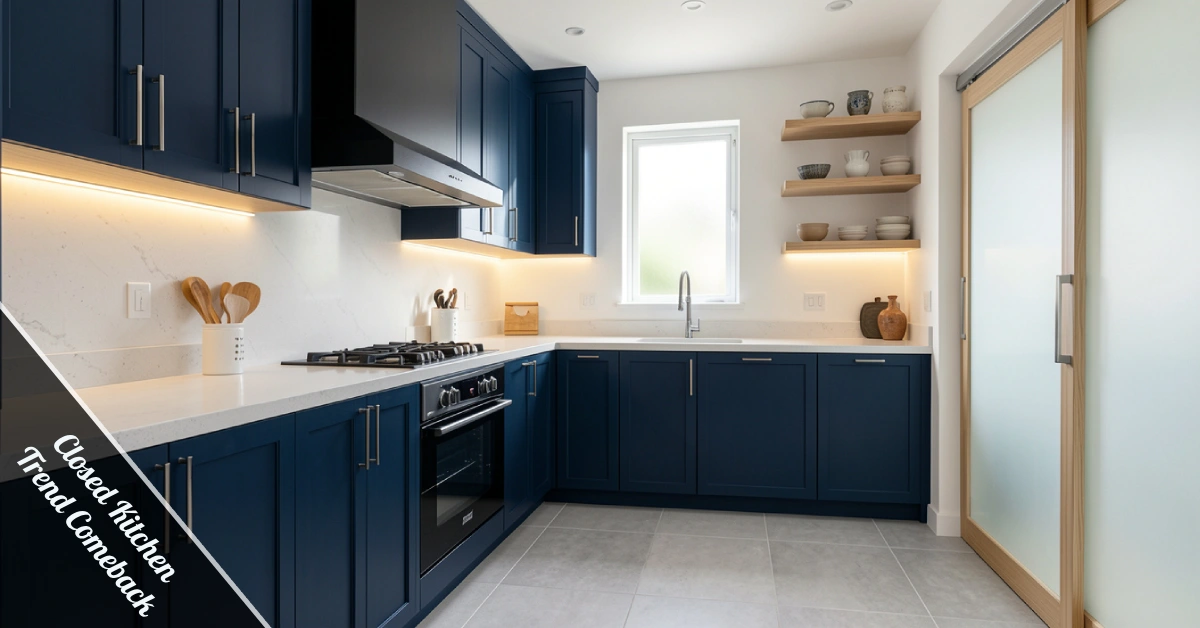
Open kitchens ruled for years. Knocking down walls was the move—the bigger, the breezier, the better. But something’s shifting. The closed kitchen trend comeback is one of 2025’s most talked-about design pivots, and honestly? It makes total sense.
Remote work changed everything. Your home is now your office, your gym, and your refuge. The last thing you want is blender noise killing your 9 AM Zoom call while curry smells drift into the living room.
This isn’t your grandma’s boxy, dark kitchen either. Modern closed kitchens are bright, bold, and seriously stylish. Think glass pocket doors, deep navy cabinets, and layouts built around how you actually cook. We’re breaking down why this trend is back, what it looks like today, and whether it’s the right call for your home.
What Is a Closed Kitchen? (Quick and Simple)
A closed kitchen is exactly what it sounds like—a cooking space enclosed by walls, doors, or partitions. It sits separate from your living and dining areas.
Unlike open-plan layouts where the kitchen bleeds into the lounge, a closed kitchen gives every room a job. Cook in the kitchen. Relax in the living room. Revolutionary? Maybe not. But effective? Absolutely.
The key difference isn’t isolation—it’s control. Modern versions use glass panels, sliding doors, or partial walls to stay connected without being fully exposed. You get privacy without the cave vibes.
Closed Kitchen vs Open Kitchen: The Real Comparison
Still on the fence? Here’s the honest breakdown between the two layouts—no fluff, just facts.
| Feature | Closed Kitchen | Open Kitchen |
| Privacy | High – fully enclosed space | Low – always on display |
| Noise Control | Contained – quieter living areas | Noise travels freely throughout |
| Odor Control | Strong – smells stay inside | Weak – spreads across the home |
| Storage Space | More walls = more cabinets | Limited wall space available |
| Visual Clutter | Mess stays completely hidden | Always visible to guests |
| Social Interaction | Controlled, quieter setting | High – fully open to guests |
| Flexibility | Doors and partitions help | Fixed open layout only |
The winner depends on your lifestyle. If you host dinner parties every weekend, open might be your vibe. But if you’re cooking daily, working from home, or just value a clean-looking living space, closed is a serious cheat code.
Why the Closed Kitchen Trend Comeback Is Happening Right Now
Timing matters. The closed kitchen trend comeback didn’t appear out of nowhere—three big lifestyle shifts are driving it hard in 2025.
First: remote work. When your home is also your office, acoustic control isn’t a luxury—it’s a necessity. Open kitchens broadcast every clinking dish, every sizzling pan straight into your workspace.
Second: smell control. Strong aromas from cooking—garlic, fish, spices—spread instantly in open layouts. In a closed kitchen, those smells stay contained and don’t compete with your living room ambiance.
Third: visual stress. Studies show clutter affects mental clarity. In open kitchens, even a pile of dishes becomes a focal point. Closing off the kitchen removes that constant low-level visual noise from your line of sight.
People aren’t just chasing aesthetics anymore. They want their homes to function better for real, modern life. A separate kitchen delivers exactly that.
Key Benefits of a Closed Concept Kitchen
Let’s get specific. Here’s what you actually gain by switching to a closed concept kitchen layout.
Noise and Smell Stay Where They Belong
Appliances are loud. Exhaust fans, dishwashers, blenders—in an open kitchen, these become everyone’s problem. Walls fix that instantly, keeping the chaos contained.
Cooking smells are trickier. Some are amazing, some aren’t. A closed kitchen lets you control what drifts out and when. Your guests smell the finished dish, not the entire cooking process.
More Wall Space = More Storage
Open kitchens sacrifice cabinet space for sightlines. Closed kitchens give you four full walls to work with. That means more upper cabinets, pantry options, and vertical storage—especially valuable in smaller homes.
Cleaner, Calmer Living Spaces
When the kitchen is out of sight, it’s out of mind. Countertop clutter, dirty pots, prep mess—none of it affects how your living room looks or feels. That separation is genuinely stress-reducing.
Focused Cooking Workflow
Everything designed for cooking lives in one dedicated space. No compromising layout to maintain sightlines. Your kitchen works harder because it’s built purely around cooking efficiency and storage.
Modern Closed Kitchen Design Ideas That Actually Look Good
The closed kitchen trend comeback isn’t about going backwards—it’s about going smarter. Modern designs are anything but outdated.
Bold colors are having a moment. Since the kitchen is its own room, you can go deep without worrying about clashing with your living area. Navy blue, forest green, charcoal, even matte black—these create a rich, intentional atmosphere that open kitchens can rarely pull off.
Materials are doing heavy lifting, too. Natural wood grain, honed stone countertops, and handmade-look tiles add texture and warmth. The kitchen becomes a destination, not just a utility zone.
Glass partitions and steel-frame doors are the modern closed kitchen’s secret weapon. They maintain the visual separation while letting light flow freely between spaces. You get privacy and brightness—without sacrificing either.
Closed Kitchen Design with Door: Best Options for Every Home
The right door transforms a closed kitchen from boxy to beautifully functional. Here are your best picks.
Pocket doors disappear into the wall when open—zero footprint, maximum flexibility. Sliding barn doors are a style statement that works in both modern and rustic homes. Glass-panel doors keep things light and connected while still maintaining that crucial separation.
Hinged doors are classic and reliable. For smaller kitchens, a half-door or café-style swing is a clever design move—it contains odors and noise while keeping the space above waist height visually open.
The real advantage of any door? Control. Open it when you want the connection. Close it when the cooking gets serious. That flexibility is something a fixed open plan can never offer you.
Best Closed Kitchen Floor Plans for Modern Homes
Layout is everything. Getting the floor plan right means the space feels spacious, not suffocating.
Galley kitchens are the efficiency king for narrow spaces—two parallel walls, everything within arm’s reach. L-shaped layouts offer more flexibility and work well in medium-sized homes with a corner to work with.
U-shaped kitchens are the powerhouse option—maximum counter space, maximum storage, ideal for serious cooks. The workflow triangle (sink, stove, fridge) fits naturally into a U-shape without any awkward reaching.
Regardless of which layout you choose, prioritize spacing. Counter-to-counter clearance of at least 42 inches keeps things comfortable for one cook; 48 inches if two people share the kitchen regularly.
Broken-Plan and Hybrid Kitchens: The Best of Both Worlds
Not ready to fully commit to a closed kitchen? The broken-plan approach is your answer—and it’s one of the smartest design moves happening right now.
A broken-plan kitchen uses partial walls, peninsulas, or glass partitions to create zones without full enclosure. You get noise and smell buffering without losing the connected, social feel of an open layout.
Steel-frame glass partitions are especially popular. They’re architectural, modern, and let light flood through while still creating a clear separation between spaces. It’s the visual language of lofts and contemporary homes.
This hybrid approach works perfectly for homeowners who entertain often but also need a functional cooking space that doesn’t expose every mess. You define the boundary; you control the interaction.
The Dirty Kitchen Concept: What It Is and Why It’s Genius
Here’s a concept gaining serious traction in high-end home design: the dirty kitchen, also called a prep kitchen or back kitchen.
The idea is simple. Your main kitchen stays pristine—it’s for serving, socializing, and looking good. A secondary space handles the heavy work: deep frying, marinating, messy prep, and cleanup. Two kitchens, two purposes, zero compromise.
It sounds luxury-only, but smaller homes can adapt the concept with a utility corner, a scullery nook, or even a well-designed pantry with a prep sink. The principle scales down beautifully with smart planning.
How to Make a Closed Kitchen Feel Bright and Spacious
The biggest fear people have about closed kitchens? That they’ll feel dark and cramped. Here’s how you beat that completely.
Ventilation first. A strong range hood is non-negotiable—it removes heat, smoke, and moisture fast. Good airflow makes the space feel fresh and comfortable, not sealed off.
Layer your lighting. Task lighting under cabinets for prep work, ambient overhead lighting for general use, and a statement pendant over an island if you have one. Layered light makes any space feel bigger and more inviting.
Keep countertops clear. Vertical storage pulls clutter off surfaces and draws the eye upward, making the room feel taller. Light-colored upper cabinets also help reflect light around the room.
Common Mistakes to Avoid When Planning a Closed Kitchen
Even a great layout can go wrong. Watch out for these common missteps before you commit.
Skipping ventilation planning is the biggest one. Retrofitting a range hood or exhaust system after the fact is expensive and disruptive. Plan it from day one, spec a powerful CFM rating for your cooking style.
Overcrowding the space is another trap. More cabinets sound good in theory, but cramped walkways kill the cooking experience. Quality and function over quantity—always.
Poor lighting placement makes kitchens feel like basements. Don’t rely on a single ceiling fixture. Map out task zones first, then light each one deliberately for both function and atmosphere.
Finally, ignoring workflow will frustrate you daily. The triangle between your fridge, sink, and stove should flow naturally. A beautiful kitchen that’s inefficient to cook in is a miss, not a win.
Is the Closed Kitchen Trend Comeback Right for Your Home?
The closed kitchen trend comeback isn’t a universal answer—but it is a genuinely strong one for the right household.
It’s ideal for: frequent cooks, remote workers, families with young kids, anyone who values a clean-looking living space, and homes where the kitchen is used hard every single day.
It’s less ideal for people who love hosting open dinner parties where guests mingle around the kitchen island, or anyone whose home is too compact to dedicate a fully enclosed zone to cooking.
The honest take? Most homeowners benefit from at least a semi-closed or broken-plan approach. Full open layouts were always more of an aesthetic trend than a practical one. Your kitchen should serve how you actually live—not how a 2010 design magazine said you should.
The Bottom Line
Open kitchens had their moment. A long one, honestly. But the closed kitchen trend comeback signals something more meaningful than just a style cycle—it’s a genuine shift in what homeowners actually need from their spaces.
Privacy, noise control, smell containment, efficient storage, and visual calm are all things a well-designed closed kitchen delivers without compromise. And with modern tools like glass partitions, sliding doors, bold color palettes, and smart layouts, there’s nothing dated about it.
Whether you go fully closed, embrace a broken-plan hybrid, or just add a statement door, the goal is the same: a kitchen that works for your life. That’s always the right trend to follow.
FAQs
Why is the closed kitchen trend making a comeback?
Remote work, noise sensitivity, and the need for cleaner living spaces are the main drivers. People want their homes to function better—not just look bigger.
Is a closed kitchen better than an open kitchen?
It depends on your lifestyle. Closed kitchens win on privacy, noise control, and storage. Open kitchens win on social flow. Hybrid layouts often deliver the best of both for most modern homes.
Do closed kitchens make a home feel smaller?
Not with the right design. Glass doors, smart lighting, light-colored upper cabinets, and vertical storage keep closed kitchens feeling spacious and open without sacrificing their functional benefits.
What does a modern closed kitchen look like?
Bold colors, quality materials, layered lighting, smart storage, and flexible door options. Modern closed kitchens are designed to be beautiful rooms—not just utilitarian cooking boxes.
What is a dirty kitchen in modern homes?
A secondary prep kitchen used for heavy cooking and cleanup. It keeps your main kitchen presentable while handling the actual mess. Increasingly popular in larger homes and adaptable to smaller spaces with creative planning.