

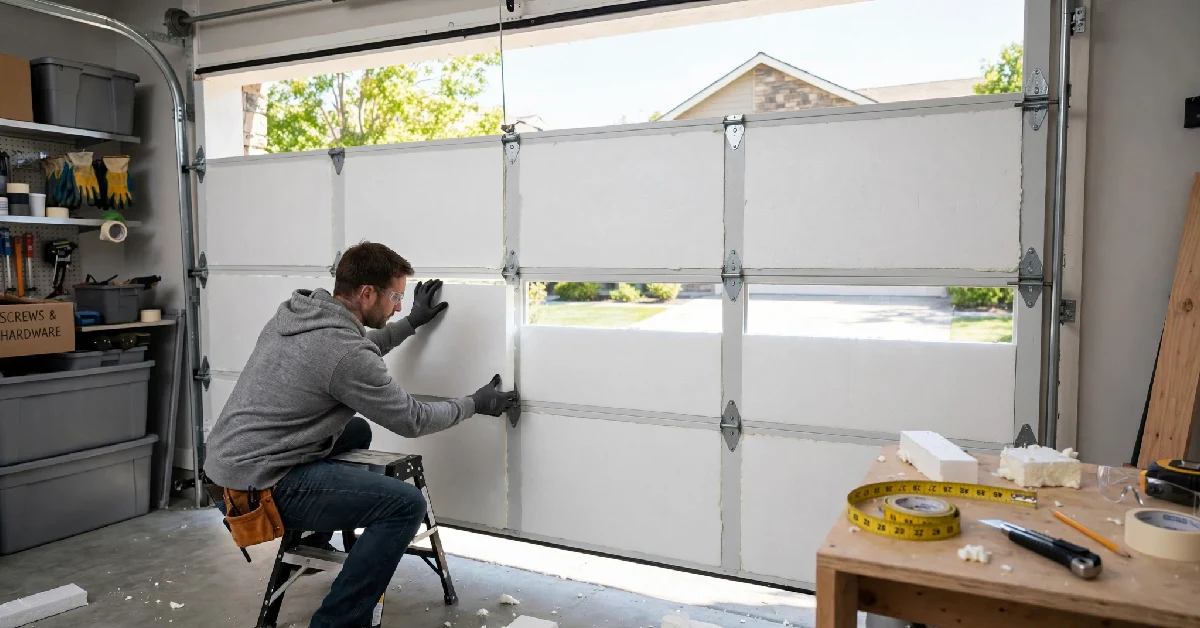
Garage door insulation reduces heat transfer through your door by adding foam panels or pre-installed insulating material between door layers. It lowers energy costs by up to 15%, reduces noise, and protects stored items from temperature swings. R-value measures insulation strength; most homes with attached garages benefit from a minimum R-10 rating.
Why Your Garage Door Is Leaking Energy
Your garage door is the largest opening on your home’s exterior. Without insulation, it acts like a hole in a wall, letting heat pour out in winter and bake in during summer.
If your garage is attached to your house, that temperature gap directly affects your living spaces. Rooms above or beside the garage feel drafty in January and stuffy in August. Your heating and cooling system works harder to compensate.
According to the U.S. Department of Energy, insulating an attached garage can reduce home energy costs by up to 15%. That adds up fast, especially in climates with extreme summers or winters.
Even a detached garage benefits. If you use it as a workshop, gym, or storage area for vehicles or equipment, temperature extremes damage gear and make the space nearly unusable for months at a time.
What Garage Door Insulation Actually Does
Garage door insulation slows the transfer of heat between the inside and outside of your garage. It acts as a thermal barrier, keeping the cold out in winter and the heat out in summer.
Beyond temperature control, insulation provides two other clear benefits. First, it dampens sound. The added material absorbs noise from street traffic, equipment, and activity inside the garage. Second, it adds structural strength to the door. Insulated doors are denser and more resistant to dents and everyday wear.
As noted by Clopay, a leading garage door manufacturer: “insulated doors help regulate temperature, improve durability, and even reduce outside noise,” making them a practical upgrade for almost any home.
Understanding R-Value for Garage Door Insulation
R-value is the standard measure of thermal resistance. The higher the R-value, the better the material resists heat flow. For garage doors, R-values typically range from 0 (no insulation) to over 20 (high-end polyurethane construction).
Here is a simple breakdown:
- R-0 to R-6: No insulation or minimal coverage. Fine for detached garages in mild climates.
- R-7 to R-12: Decent thermal resistance. A good baseline for most attached garages.
- R-13 to R-20+: Superior performance for extreme climates, spaces above garages, or garages used as living areas.
For attached garages, most experts recommend a minimum of R-10. If you heat or cool the garage, or have a room directly above it, aim for R-16 or higher.
One important note: R-value measures the insulation material alone. The U-factor, a newer industry measurement, gauges heat transfer across the entire door assembly, including tracks, hardware, and seals. According to the Door and Access Systems Manufacturers Association (DASMA), these two measurements use different methods and are not directly interchangeable. A lower U-factor means better overall performance.
The Two Main Types of Garage Door Insulation
Polystyrene (EPS/XPS)
Polystyrene is the most common material used in DIY kits and lower-cost pre-insulated doors. It comes in rigid foam panels that fit into the door’s sections. It is lightweight, affordable, and easy to cut and install.
Standard polystyrene kits deliver an R-value between 4 and 6.5, depending on thickness. EPS (expanded polystyrene) is the most widely sold variety. Its R-value is stable over time because the only gas inside the foam cells is air, so it does not degrade the way some other foam types do.
The main drawback is density. Polystyrene panels are placed between door rails, not bonded to the structure, so they do not add much strength to the door itself.
Polyurethane
Polyurethane is the premium option. It is injected as a liquid foam that expands to fill every gap inside the door cavity. Brands such as Clopay offer proprietary systems like Intellicore®, where the injected foam expands to fill every crevice, yielding R-values that can exceed R-18 for thicker doors. This creates a dense, bonded layer that boosts both thermal resistance and structural rigidity.
Polyurethane doors reach R-values from R-10 up to R-18 or higher, depending on door thickness. A 2-inch-thick polyurethane door can reach R-18, which exceeds the insulation value of most exterior walls.
The tradeoff is cost. Polyurethane-insulated doors cost more upfront. For most homeowners in cold climates or with active garages, the long-term energy savings and added door durability make it worth the investment.
Garage Door Insulation Kits: What You Get
If you already own an uninsulated door and do not want to replace it, a DIY kit is a practical and affordable option.
DIY garage door insulation kits typically cost between $50 and $200. Most kits include eight polystyrene foam panels sized for a standard 9-foot single-door panel layout. A double-car garage requires two kits.
Popular kit options include:
- Insulfoam / Cellofoam EPS kits: Panels measuring roughly 1.25 inches thick with an R-value of around 4.8. Sold at Lowe’s and Home Depot. No formaldehyde or ozone-depleting chemicals.
- Radiant foil barrier kits: Reflective foil material that blocks radiant heat—such as the Reach Barrier 3009 kit. These have low R-values on their own but work well in hot climates when combined with a small air gap.
- Fibreglass batt kits: Cut-to-fit rolls secured inside door sections with adhesive or pins.
Most polystyrene kits can be installed in under two hours with basic tools: a measuring tape, a straight edge, a utility knife, and a step stool.
Important: Adding insulation increases door weight. After installation, check your door’s spring tension and balance. If the door feels heavy or the opener strains, the torsion springs may need professional adjustment or replacement. An unbalanced door stresses the opener motor and can cause premature failure.
How to Install a Garage Door Insulation Kit
Here is a step-by-step overview for a standard polystyrene panel kit:
- Measure each panel section. Garage doors have multiple horizontal sections. Measure the height and width of each one separately, as they may vary.
- Cut the foam panels. Use a straight edge and a utility knife to score and snap the panels to size. Add roughly 1/2 inch extra on each side so panels fit snugly without gaps.
- Install the panels. Slide or press panels into the door’s back channel or use adhesive pins included in the kit. Start from the bottom section and work upward.
- Seal edge gaps. Apply low-expansion spray foam sparingly around the edges of each panel. Unlike standard expanding foam, the low-expansion formula will not warp the door’s metal frame.
- Check the door balance. Disconnect the opener, lift the door manually to waist height, and let go. It should stay put. If it drops or rises, adjust the spring tension or call a garage door technician.
- Add weatherstripping and seals. Insulation panels alone do not seal the door edges. Replace worn weatherstripping around the door frame and inspect the bottom rubber seal. For uneven floors, a floor-mounted threshold seal creates an extra barrier against drafts, water, and debris.
For an internal link suggestion, see our guide on [weatherstripping a garage door] for a full seal walkthrough.
Choosing the Right R-Value for Your Situation
Not every home needs the highest available R-value. The right choice depends on three factors: climate, garage use, and door location.
Detached garage, mild climate, storage only: An R-4 to R-6 kit is sufficient. It costs little, installs quickly, and takes the edge off temperature extremes.
Attached garage, moderate climate: Aim for R-8 to R-12. A polystyrene pre-insulated door or a quality kit with thicker panels fits this range well.
Attached garage, cold climate, rooms above: Go for R-16 or higher. This typically means a polyurethane-injected door from a manufacturer. It costs more upfront but delivers meaningful energy savings and comfort year-round.
Workshop or home gym in any climate: Treat the garage like a living space. R-16 to R-20 is appropriate, especially when combined with insulated walls and ceiling.
For a second internal link suggestion, see our article on [how to insulate a garage ceiling] to address all heat loss points at once.
DIY Kit vs. Pre-Insulated Door: Which Makes More Sense
The honest answer depends on your budget and your existing door’s condition.
A DIY polystyrene kit costs $50 to $200 and takes an afternoon to install. It will raise the R-value of an uninsulated door from zero to roughly R-4 to R-6. That is a meaningful improvement, but it will not match the performance of a factory-insulated door.
A new pre-insulated garage door costs $750 to $2,500 or more installed, depending on size, material, and R-value. The advantage is that polyurethane is injected under pressure during manufacturing, filling every corner of the door cavity. The result is a stronger, better-sealed, higher-performing door that also looks newer and can improve curb appeal.
If your door is older than 15 years, dented, or showing rust, replacing it is probably the smarter financial decision. A new insulated door pays back faster when you are not also dealing with air leaks through worn panels and broken seals.
If your door is in good condition and you just want to reduce energy loss, a quality kit is a cost-effective fix.
Garage Door Insulation Costs at a Glance
| Option | Estimated Cost | R-Value Range |
|---|---|---|
| DIY polystyrene kit (1 door) | $50 to $100 | R-4 to R-6.5 |
| DIY radiant barrier kit | $50 to $150 | Low (reflective only) |
| Pre-insulated steel door (polystyrene) | $800 to $1,500 installed | R-6 to R-12 |
| Pre-insulated steel door (polyurethane) | $1,200 to $2,500+ installed | R-12 to R-18+ |
Cost estimates sourced from HomeGuide (2026) and reflect U.S. national averages.
FAQs
Does garage door insulation actually lower energy bills?
Yes. The U.S. Department of Energy estimates up to a 15% reduction in energy costs for homes with attached garages when the garage door is properly insulated. Savings vary by climate, home size, and how well the rest of the garage is sealed and insulated.
What is the best insulation material for a garage door?
Polyurethane foam offers the highest R-value and the best structural performance. For DIY kits, polystyrene (EPS) panels are the most practical. They are affordable, easy to cut, and perform well for basic insulation needs.
Can I insulate any garage door?
Most steel and aluminium doors with recessed panels can accept a polystyrene kit. Flush doors without rear channels may need adhesive pins. Wood doors generally do not accept standard foam kits and often require professional assessment.
Will adding insulation void my garage door warranty?
It may. Check your door manufacturer’s warranty terms before installing a retrofit kit. Some manufacturers specify that adding aftermarket materials affects structural warranties.
How do I know if my insulation is working?
Feel the interior surface of the door on a hot or cold day. A well-insulated door will not feel as extreme as the outdoor temperature. You can also measure with a surface thermometer before and after installation to compare.