

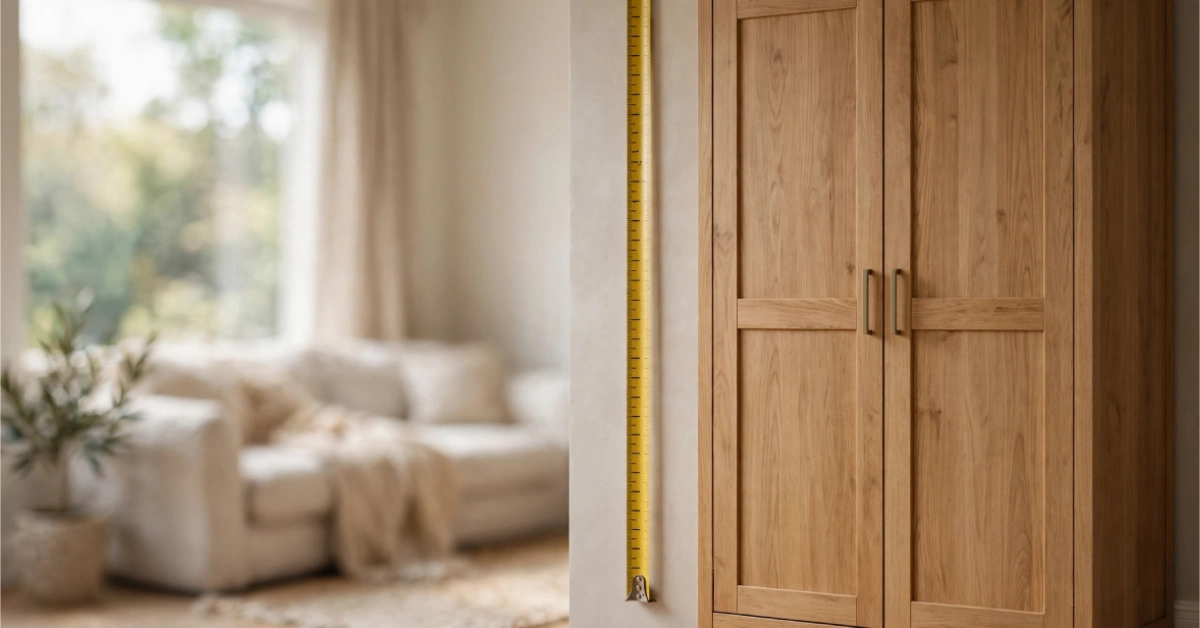
75 inches equals 6.25 feet, or 6 feet and 3 inches. To convert, divide 75 by 12, since one foot holds 12 inches. The result, 6.25, means 6 whole feet plus a leftover 0.25 feet, which works out to exactly 3 inches. This height sits close to a standard UK internal door.
Someone hands you a measurement of 75 inches and asks what that means in feet. Maybe it is a curtain drop, a bed frame, a doorway or a piece of furniture you are trying to fit into a room. You do not want a rough guess. You want the exact number, and you want to know what it actually looks like in real life.
This guide gives you the precise conversion, the formula behind it, and a set of home-based comparisons so the number means something beyond a decimal point.
75 Inches in Feet: The Full Conversion
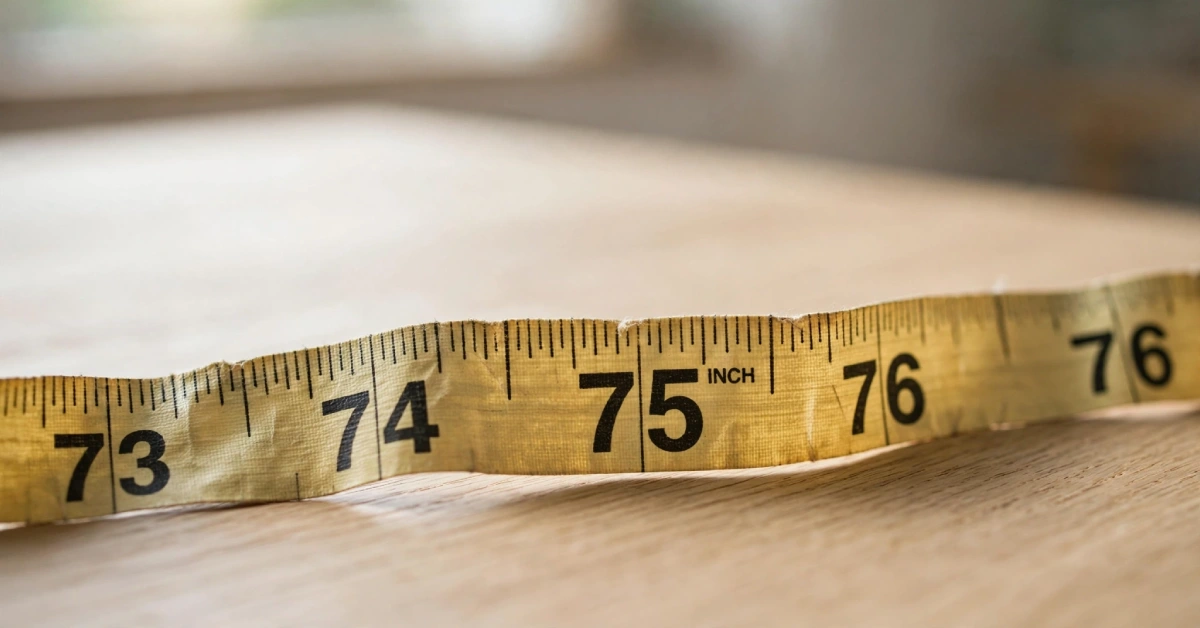
There are 12 inches in every foot. That single fact is the entire basis of the conversion.
To turn 75 inches into feet, you divide by 12:
75 ÷ 12 = 6.25 feet
So 75 inches is 6.25 feet. Not 6 feet, not 7 feet, but 6 and a quarter feet exactly. If you round it for a quick mental check, 6.25 rounds to roughly 6.3 feet, but the precise figure is 6.25.
How to Convert Inches to Feet, Step by Step
The formula never changes, no matter what number you start with. Here is the process broken down:
- Take your measurement in inches (in this case, 75).
- Divide it by 12, the number of inches in one foot.
- The whole number in your answer is the number of feet.
- The decimal part, multiplied by 12, gives you the remaining inches.
Applied to 75 inches, that looks like this:
- Step 1: 75 ÷ 12 = 6.25
- Step 2: The whole number, 6, is your feet count.
- Step 3: 0.25 × 12 = 3, your remaining inches.
- Step 4: Final answer, 6 feet 3 inches, or 6.25 feet.
Once you have run this a few times, you can do it in your head for most everyday measurements.
75 Inches in Feet and Inches Together
This is where a lot of confusion creeps in. People see “6.25 feet” and assume that means 6 feet 25 inches, which is wrong, since 25 inches is more than 2 additional feet on its own.
Remember that 6.25 is a decimal, not a feet-and-inches figure. The 0.25 represents a quarter of a foot, and a quarter of 12 inches is 3 inches. So the correct, plain-English version is 6 feet 3 inches. That is the figure you would use on a tape measure, a spec sheet or a set of furniture dimensions.
If you keep seeing decimal feet on product listings and want the feet-and-inches version, always multiply the decimal part by 12, not by 100.
How 75 Inches Compares to Average Height
Six feet three inches is well above typical adult height, which helps put the number into perspective.
According to CDC data collected between August 2021 and August 2023, the average adult man in the United States measures 68.9 inches tall, close to 5 feet 9 inches, while the average adult woman measures 63.5 inches, close to 5 feet 3.5 inches. At 75 inches, a person or an object would stand roughly 6 inches taller than the average man and around a foot taller than the average woman.
For a UK reference point, adult male height figures sit in a similar range, generally between 5 feet 8 inches and 5 feet 10 inches depending on age group. So if you are picturing 75 inches as a person, think of someone noticeably tall, well into the upper range for adult height, rather than an average build.
Where 75 Inches Shows Up Around the Home

Because this is such a specific figure, it helps to know where it naturally appears in everyday household items and layouts.
Doors and Doorways
Standard UK internal doors measure 78 inches tall (1981mm), just 3 inches taller than 75 inches. If you are measuring a doorway, a piece of furniture at 75 inches will generally clear a standard UK door frame, though you should always account for door furniture, hinges and any angle needed to manoeuvre it through.
Beds and Mattresses
A standard UK double mattress runs 75 inches long (190cm), which is exactly the figure in question. This is also why taller sleepers, generally anyone above 5 feet 11 inches, are often advised to size up to a king, since a king mattress runs a little longer at 78.75 inches (200cm).
Sofas and Seating
Larger three-seater sofas commonly fall in the 75 to 84 inch range for total width, so this figure is a useful benchmark when you are working out whether a sofa will fit along a particular wall. If you are furnishing a compact living room and want ideas for scaling seating and surfaces to the space, our guide to choosing a coffee table for a small British living room covers proportion and clearance in more detail.
Ceiling Heights and Room Planning
Most UK homes have ceiling heights well above 75 inches, typically between 94 and 96 inches (around 2.4m), so this measurement is rarely a ceiling constraint on its own. It becomes more relevant when you are stacking furniture, hanging tall units or planning shelving that needs headroom clearance above it.
If you are working through a full room layout and want a broader sense of how different measurements interact in a compact footprint, our breakdown of what fits comfortably in a 250 sq foot room is a useful next read.
Curtains, Blinds and Window Drops
Full-length curtains for standard UK windows often hang somewhere between 54 and 90 inches, depending on the drop from pole to floor. A 75 inch drop is a common in-between length, tall enough for a floor-to-window setup in a room with average ceiling height, but shorter than the full-length curtains you would need in a room with taller-than-average windows. Measuring the exact drop before ordering matters here, since even a 3- or 4-inch mismatch will show once the curtains are hung.
Wardrobes and Tall Storage
Freestanding double wardrobes commonly range from 72 to 79 inches in height, which places 75 inches close to the middle of that range. If you are comparing wardrobe listings and see a mix of centimetre and inch measurements, converting everything to the same unit first- feet and inches or a single decimal figure- makes side-by-side comparison far easier and avoids costly ordering mistakes.
Why Getting the Conversion Right Matters
A small rounding error in a home project rarely stays small. If you round 75 inches down to “about 6 feet” when ordering a mattress, a wardrobe or a set of curtains, you lose the 3 inches that made the number 6.25 feet in the first place. That gap is enough to leave a mattress too short for a tall sleeper, a wardrobe that will not clear a stairwell turn, or curtains that hover awkwardly above the floor instead of grazing it.
This is why tradespeople and furniture retailers work in exact figures rather than rounded ones. A carpenter fitting a door frame, a removals company assessing whether a sofa will fit through a stairwell, or a curtain fitter measuring a bay window all rely on the same principle: convert once, convert accurately, and keep the full decimal or the full inches, not a rounded guess.
Practical Tips for Measuring at Home
A few habits make inch-to-feet conversions far less error-prone when you are working on an actual home project rather than a maths problem on paper.
- Always measure twice before you convert, since an error in the original inch measurement carries through every later calculation.
- Keep both the inch figure and the converted feet-and-inches figure written down together, so you can double-check either one later without remeasuring.
- When comparing product listings from different retailers, convert every measurement to the same format first, since some list decimal feet, some list feet and inches, and some list only centimetres.
- For anything load-bearing or structural, such as fitting a door or building shelving, add a small buffer, generally half an inch to an inch, to account for skirting boards, hinges or uneven walls.
Common Mistakes When Converting Inches to Feet
A few errors come up again and again with this type of conversion. Watch for these:
- Treating the decimal as inches. 6.25 feet is not 6 feet 25 inches. Multiply the decimal by 12, not by 100.
- Rounding too early. Rounding 6.25 to “about 6 feet” loses 3 inches, which matters for anything that needs to fit through a doorway or against a wall.
- Mixing up feet and yards. A yard is 36 inches, so don’t confuse a 75-inch measurement with roughly 2 yards, which is actually 72 inches.
- Forgetting that furniture listings sometimes include packaging or frame dimensions rather than the usable measurement, so always check what the number actually refers to before you rely on it.
Quick Reference: Nearby Inch to Feet Conversions

If you are comparing a few similar measurements, this table saves you running the formula each time.
| Inches | Feet (decimal) | Feet and Inches |
|---|---|---|
| 70 in | 5.83 ft | 5 ft 10 in |
| 72 in | 6.00 ft | 6 ft 0 in |
| 74 in | 6.17 ft | 6 ft 2 in |
| 75 in | 6.25 ft | 6 ft 3 in |
| 76 in | 6.33 ft | 6 ft 4 in |
| 78 in | 6.50 ft | 6 ft 6 in |
| 80 in | 6.67 ft | 6 ft 8 in |
Final Thoughts
75 inches converts to 6.25 feet, or 6 feet and 3 inches, using the simple rule that 12 inches make one foot. Once you understand that the decimal portion represents a fraction of a foot rather than a count of inches, you can apply the same method to any measurement you come across, whether it is a doorway, a bed, a sofa or a shelf.
If you are planning a room around a specific piece of furniture, keeping a running note of key measurements like this one makes future shopping and layout decisions far quicker. For more ways to think through scale and proportion in your space, take a look at our latest interior design trends for ideas on making the most of every inch you have.
FAQs
How many feet is 75 inches?
75 inches equals 6.25 feet, which is the same as 6 feet and 3 inches.
Is 75 inches taller than average height?
Yes. At 75 inches (6 feet 3 inches), a person would stand roughly 6 inches taller than the average US adult man and around a foot taller than the average US adult woman, based on recent CDC data.
What is 75 inches in feet and inches, not decimal feet?
75 inches is 6 feet 3 inches. The decimal version, 6.25 feet, means the same thing, since 0.25 of a foot equals 3 inches.
Does 75 inches fit through a standard UK door?
Generally yes. Standard UK internal doors measure 78 inches tall, 3 inches more than 75 inches, though you should always allow extra clearance for angling larger items through a doorway.
What household items are close to 75 inches?
A standard UK double mattress measures 75 inches long. Larger three-seater sofas and tall wardrobes also frequently fall near this length or height.
Why is 75 inches not a round number of feet?
Because 75 does not divide evenly by 12. Only multiples of 12, such as 72 or 84 inches, convert to a whole number of feet. Since 75 sits between two of those multiples, it converts to a mixed figure: 6 feet and 3 inches.
How do I convert 75 inches to centimetres as well?
75 inches equals approximately 190.5cm, since 1 inch equals 2.54cm. This is useful if you are comparing a UK product listed in inches against one listed in metric measurements more commonly used across Europe.