

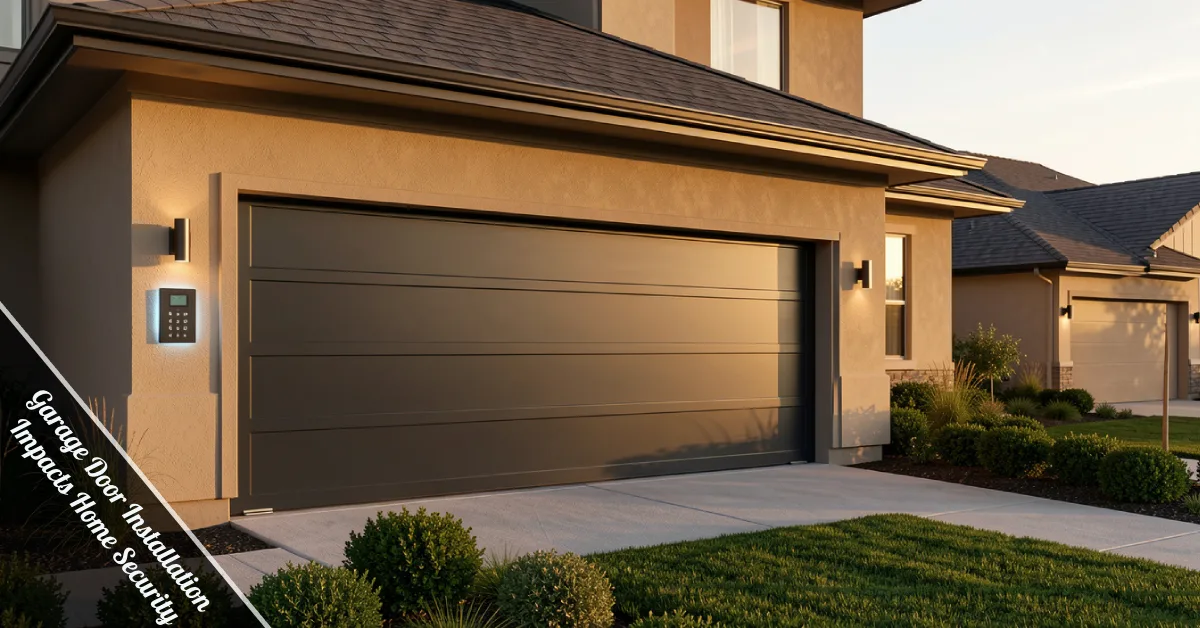
Most homeowners obsess over smart locks and alarm systems. But your garage door? That big, beautiful slab of metal or composite is your home’s most overlooked security checkpoint.
Think about it — it’s the largest moving part of your home’s exterior. It sees daily use, connects directly to your living space, and yes, it’s one of the first things a potential intruder scopes out.
Here’s the deal: how garage door installation impacts home security is way more nuanced than most people realize.
This guide breaks it all down — materials, locks, smart tech, property value — so you can make a genuinely smart upgrade decision.
Your Garage Door Is a Barrier — Treat It Like One
Old garage doors — especially the thin-wood or single-layer-metal ones from the early 2000s — were basically a polite suggestion. They bent, warped, and creaked their way into retirement. Modern doors are built with reinforced steel, aluminum, or insulated composite panels. Different beast entirely.
When garage door installation impacts home security at the structural level, it starts with material selection. Multi-layered panels resist bending, warping, and straight-up brute force attempts from would-be intruders.
But materials alone won’t cut it. Professional installation ensures every panel, track, and anchor point is properly aligned. Misaligned hardware is basically a cheat code for intruders — gaps, weak points, easy prying opportunities.
Bottom line: strong door + correct install = a perimeter that earns its keep.
Advanced Locking Systems: Where Installation Makes or Breaks Security
A deadbolt is only as good as its alignment. Improper installation makes even the beefiest lock laughably easy to bypass.
Modern garage doors can integrate automatic multi-point locks, reinforced manual deadbolts, and electronic locking systems that talk directly to your home security app. That’s serious protection — when installed correctly.
Sloppy installation leaves locking components misaligned with the door frame. Result? The lock doesn’t engage fully, and the door can be compromised with minimal effort.
Electronic locks take it further — they pair with smartphone apps and home security systems, sending alerts if someone tries unauthorized access. This is the kind of setup that makes your property a hard target for opportunistic break-ins.
Old Door vs. New Installation — Security Feature Comparison
| Feature | Old Door | New Installation |
| Material Strength | Thin wood / basic metal | Reinforced steel or composite |
| Locking System | Basic manual lock | Multi-point automatic deadbolt |
| Opener Security | Fixed code (hackable) | Rolling code technology |
| Smart Integration | None | Remote monitoring + alerts |
| Safety Sensors | Rarely present | Auto-close + obstacle detection |
| Energy Insulation | Poor | Insulated panels, temperature-regulated |
Smart Garage Door Systems: Security You Can Monitor From Anywhere
Remote monitoring isn’t a luxury anymore. For busy households, it’s basically essential.
Smart garage door systems connect to your Wi-Fi and let you check door status, get activity alerts, and open or close the door remotely. On vacation? You’ll still know exactly what’s going on at home.
The real cheat code here is rolling code technology. Every time you use your remote, the access code changes automatically. Old fixed-code systems could be intercepted and cloned — rolling codes make that attack basically impossible. That’s a massive security upgrade in one feature.
Proper installation ensures sensors, cameras, and communication modules are calibrated correctly. A poorly installed smart system that fails to send real-time alerts is worse than no smart system at all.
Safety Sensors and Auto-Close Features
Safety sensors do double duty. They prevent accidents — protecting kids, pets, and your bumper — while also keeping the door from being propped open unintentionally.
Auto-close features are the unsung heroes of garage security. An accidentally open door is an open invitation — literally.
Correct installation calibrates these sensors precisely. Misaligned sensors either fail to detect obstacles or trigger false stops, reducing both safety performance and the door’s overall security reliability.
Environmental Stress and Why Installation Quality Matters Long-Term
Extreme heat, humidity, and harsh winters don’t care about your warranty. They stress every component of your garage door — panels, tracks, rollers, and springs. An improperly installed door warps, shifts, and misaligns under these conditions far faster than a correctly installed one.
Insulated doors handle environmental stress better, maintaining structural integrity season after season. That’s not just a comfort upgrade — insulation keeps the door rigid and harder to manipulate, which directly contributes to how garage door installation impacts home security over time.
A door that holds its shape under stress is a door that holds its security.
Curb Appeal as a Security Signal — Yes, Really
Here’s something the security world doesn’t talk about enough: the appearance of your garage door sends a signal. A well-maintained, modern door says, “This home is looked after.” Opportunistic intruders notice that.
Worn-out, dented, or clearly outdated garage doors communicate neglect. And neglect communicates opportunity to the wrong people. A fresh garage door installation — even without the advanced security features — visually upgrades your property’s defensive posture. Throw in reinforced panels and smart locks, and you’ve got a full package.
Property Value: The ROI You Didn’t Expect From a Garage Door
Buyers notice garage doors. A fresh, modern door signals the home has been maintained — and reduces buyer anxiety about hidden repair costs.
Exterior improvements consistently rank among the highest-ROI upgrades in real estate. A new garage door installation is visible, tangible, and immediately signals quality. For potential buyers, that’s a reduced mental list of “things I’ll need to fix.”
Insulated doors add another layer of value — better energy efficiency, quieter operation, and temperature-regulated attached garages appeal to modern buyers.
Think of it this way: the installation isn’t just about today’s security. It’s a long-term investment in your home’s appeal, performance, and market position.
Signs Your Current Door Is Quietly Lowering Your Home’s Security
Not sure if your garage door needs replacing? Check this table. If you’re nodding at more than two of these warning signs, it’s time to have a serious conversation about a new installation.
| Warning Sign | What It Means |
| Visible dents or rust | Structural weakness, easy to force open |
| Loud/inconsistent operation | Misalignment reduces security performance |
| No auto-close feature | Door left open = open invitation to intruders |
| Outdated fixed-code opener | Vulnerable to code-grabbing attacks |
| Poor insulation / cold gaps | Energy loss and potential structural weakness |
What a Professional Garage Door Installation Actually Looks Like
No guesswork. A professional installation starts with a precise measurement of your opening — because a door that doesn’t fit perfectly creates exactly the kind of gaps that compromise security.
Technicians install panels, tracks, springs, and all hardware as a complete, integrated system. Then the door gets balanced and tested — because even a premium door becomes a security liability if spring tension is off or hardware isn’t torqued correctly.
Final inspection confirms every component operates smoothly and meets current safety standards. No shortcuts.
The whole process typically wraps up in a single day — a quick turnaround for an upgrade that delivers years of reliable protection.
The Bottom Line
Your garage door isn’t just a convenience feature. It’s a security asset, a curb appeal statement, and a property value contributor — all rolled into one large, highly visible part of your home’s exterior.
Understanding how garage door installation impacts home security helps you stop treating it as a maintenance chore and start treating it as a strategic upgrade.
From reinforced materials and rolling code technology to smart home integration and professional calibration, every element of a proper installation works together to protect what matters most.
If your current door is showing its age, or you’ve never given it a second thought, now’s the time. Talk to a professional and see what a modern installation can do for your home.