

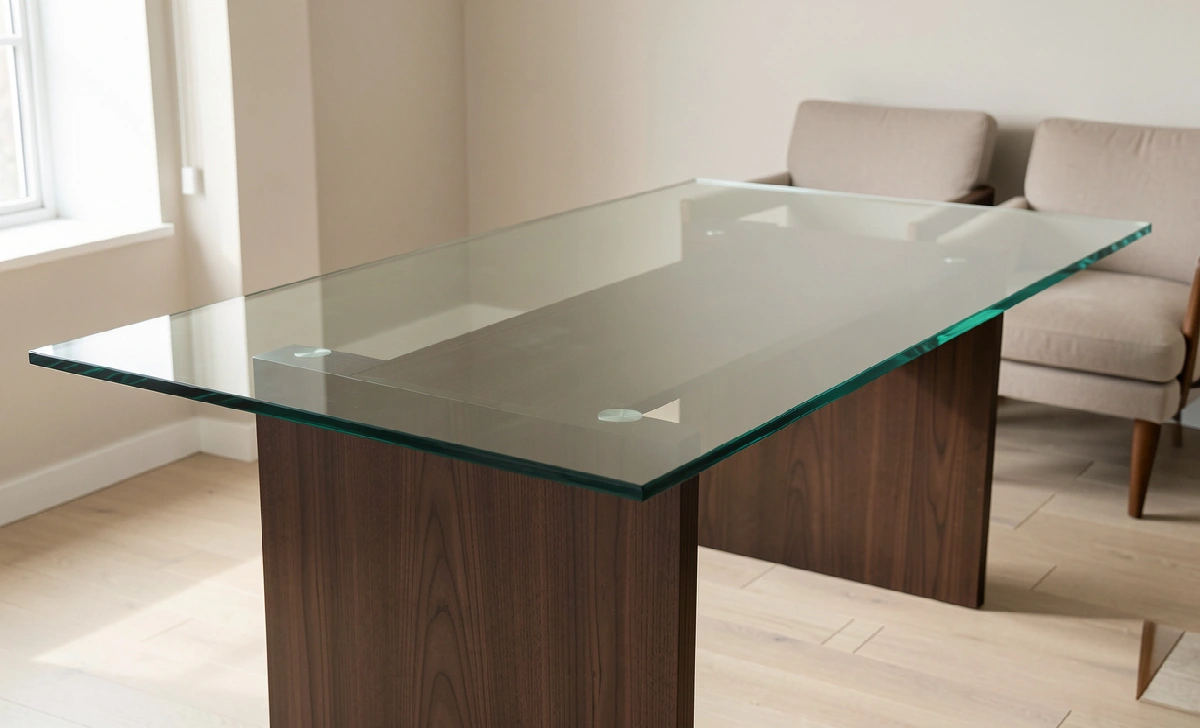
A glass Table for Glass on any furniture base, from wood to metal, to protect the surface or serve as the full tabletop. To pick the right one, match the glass thickness to your table’s use: 1/4″ for protective covers, 3/8″ for coffee tables, and 1/2″ for dining tables. Always choose tempered glass for safety. Your edge finish, glass type, and shape all affect how the table looks and performs.
Picking a glass top sounds simple until you realize how many decisions sit between you and the finished table. Thickness, glass type, edge profile, shape, tint — each one changes how the table looks, how long it lasts, and how safe it is. Get any of these wrong, and you end up with a top that cracks under pressure, shows constant fingerprints, or just looks off. This guide walks you through every decision so you order the right piece the first time.
Why Glass Works Better Than Wood for Table Tops
Wood scratches. It warps with humidity, stains from spills, and shows wear within a few years. Glass, by contrast, cleans in seconds, stays flat, and lets your table base remain visible, which matters if you spent money on a decorative pedestal or an interesting frame.
Glass tops are highly customizable — you can order them cut to size with various finishes, edges, and thicknesses. That level of control over the final product is something you rarely get with wood or stone.
Glass also adds a visual lightness to a room. A solid wood table can dominate a small dining area. A glass top over the same base keeps the room feeling open.
What Glass Thickness Should You Use for a Table
This is the decision most buyers get wrong. People assume thicker is always better, but the right thickness depends on how the glass sits on the base and what the table gets used for.
For a stand-alone glass top where the glass is the entire table surface, use a thicker gauge — 3/8″ or 1/2″. For a glass protector placed over an existing wooden surface, 1/4″ is usually sufficient.
Here is a breakdown by table type:
- Side and accent tables: 1/4″ works well. These tables carry light loads and have full edge support.
- Coffee tables: Go with 1/4″ if your coffee table is small (under 36 inches) and has good edge support. Bump up to 3/8″ if your table is larger, has a more open base, or has kids who treat every surface like a jungle gym.
- Dining tables: The recommended thickness range for a dining tabletop is 1/4″ to 1/2″. For large spans or pedestal bases, 1/2″ prevents flex and adds structural integrity.
How your glass sits on the base matters more than people realize. If you have a frame that supports all four edges of the glass, you can go thinner. If your glass is on a center pedestal or just a few contact points, you need thicker glass to bridge those gaps without sagging.
Tempered vs. Annealed Glass for Table Tops
Annealed glass is standard, untreated glass. It breaks into long, sharp shards, which is a real hazard on a dining or coffee table. Tempered glass is heat-treated and, as a result, up to five times stronger than regular glass. If it breaks, it shatters into small, blunt, pebble-like pieces rather than sharp shards.
For any table that gets daily use, always order tempered glass. The price difference between tempered and annealed is minor. The safety difference is not.
The one exception: if your glass sits inside a metal frame and the frame holds it fully on all sides, annealed glass can work in very low-traffic situations. But for anything exposed, tempered is the standard.
Glass Types and Tints to Consider
The color of your glass affects how the table reads in a room. Clear glass is the most common option, offering excellent value. Low-iron (ultra-clear) glass is treated to remove the greenish tint, offering maximum clarity — ideal when the glass is meant to be nearly invisible or when covering a light-colored or decorative base. Tinted glass is available in shades like bronze or gray, adding warmth or dramatic depth. Frosted glass provides a translucent look that hides smudges and fingerprints better than clear glass.
Clear glass is the right default for most buyers. If your base is dark-colored or heavily detailed, low-iron glass keeps the clarity without a green cast at the edges. Bronze or gray tints work well outdoors or in rooms where you want the table to feel more substantial.
Edge Finishes: The Detail Most People Overlook
The edge profile changes how the table looks from the side and how safe it feels to walk past. Beveled edges offer elegance, flat polished edges give a clean, modern look, and pencil polished edges provide safety with a smooth, rounded finish.
Here is how each edge type performs in real use:
Flat polish cuts a clean, straight edge with a slight chamfer at the corners. It works with any table style and is the most popular choice for modern furniture.
Pencil polish rounds the edge into a soft curve. It is safer in homes with children and works well on circular or oval tops where the edge is often at hip height.
Beveled edge slopes at a 45-degree angle from the surface down to the edge. Beveled edges cost $2 to $5 more per linear foot but create a prismatic effect that adds elegance to dining and coffee tables.
If you want to minimize cost and keep a contemporary look, flat polish is the practical pick. If the table is the focal point of a room, a beveled edge makes a visible difference.
Table Shape and What It Means for Your Glass
Shape affects both how stress distributes across the glass and how the table fits your space.
Rectangular tables put the most stress on glass, especially at corners and long spans. Oval and round glass tops distribute stress evenly, so they can sometimes use slightly thinner glass. Square tables fall in the middle.
Round tops also solve a practical problem: they eliminate sharp corners, which matters in tight spaces or rooms with high foot traffic. Round glass tops provide symmetry, increase flow in tight spaces, and eliminate sharp edges, making them a favorite for families, restaurants, and design-forward homeowners alike.
If you have a rectangular dining table in a narrow room, an oval replacement top gives you the same seating capacity with less risk of someone bumping a corner.
How to Measure for a Glass Table Top
Measure wrong, and the glass will not fit — or it will overhang so much it looks unfinished. Follow these steps before you place an order:
- Measure the length and width (or diameter for round tops) of the base or existing top.
- Decide whether you want the glass to sit flush with the base or extend slightly beyond it. A 1/2″ overhang on each side gives a cleaner look.
- For pedestal or open-frame bases, measure the full span the glass needs to bridge.
- Note the weight of the glass thickness you want, especially for furniture that is not rated for heavy loads. A 1/2″ tempered glass top on a large dining table is significantly heavier than a 1/4″ top.
Most online glass suppliers cut to 1/8″ tolerance, so the measurements you provide need to be accurate. Use a steel tape measure, not a cloth one.
Caring for a Glass Table Top
Glass requires less maintenance than wood, but it does require the right maintenance. Always start by gently wiping away surface dust with a soft, lint-free microfiber cloth. Use an ammonia-free glass cleaner or a simple mixture of white vinegar and water. Spray the cleaner directly onto your cloth, not the glass, to prevent excess liquid from seeping onto the table base beneath.
Inspect your glass for chips or cracks every few months, especially at the edges. A small chip can turn into a crack, and a crack in tempered glass means eventual complete shattering. Catch problems early, and you might get the edge re-polished before it becomes a bigger issue.
Avoid ammonia-based products like many standard window cleaners. They degrade coatings on treated glass over time.
FAQs
Can I put a glass top on any table base?
Yes, as long as the base is stable and level. A wobbly base transfers stress to the glass edges and accelerates cracking. Fix any instability in the base before adding a glass top.
Do I need rubber bumpers under the glass?
Yes. Small silicone or rubber bumpers sit between the glass and the base, preventing sliding and absorbing minor vibrations. They cost almost nothing and extend the life of the glass.
Is 1/4″ glass strong enough for a dining table?
Only if the glass sits inside a full perimeter frame that supports every edge. For open bases or pedestal styles, 1/4″ is too thin for dining use. Use 3/8″ or 1/2″.
What is the difference between low-iron and standard clear glass?
Standard clear glass has a slight green tint at the edges, which becomes more noticeable in thicker sheets. Low-iron glass removes that tint, giving you near-colorless clarity. It costs more but is worth it when covering a white or light-colored base.
Can I order a custom shape?
Yes. Most glass suppliers cut to any shape — rectangle, oval, round, or fully custom. Custom shapes cost more and usually have longer lead times than standard cuts.


