

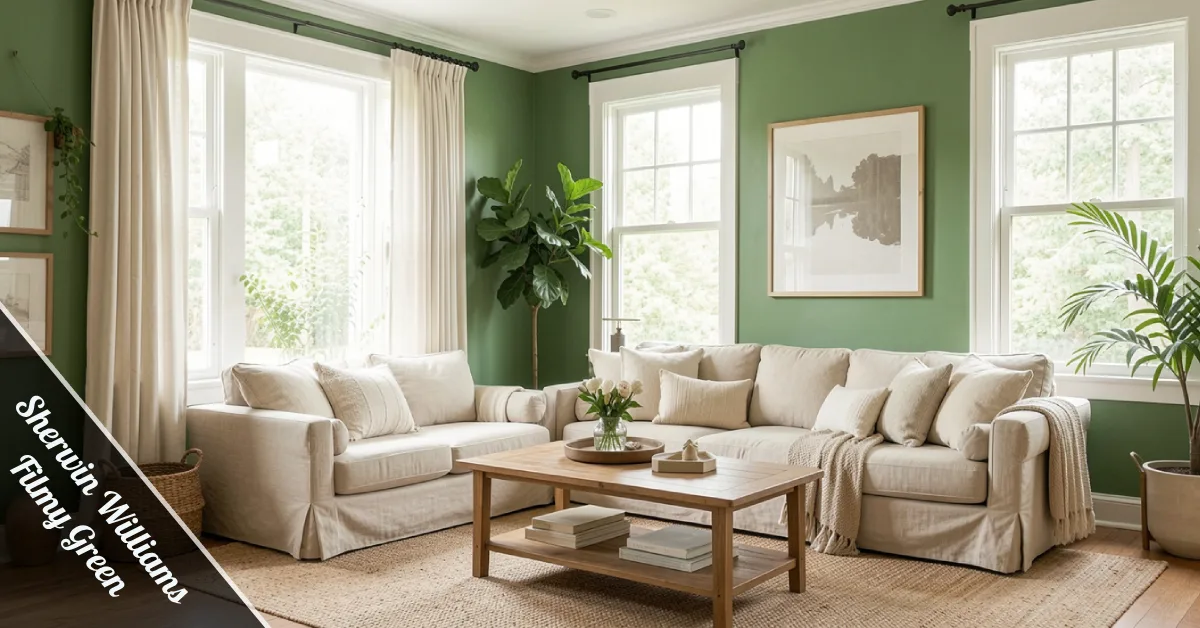
Here’s the thing about green paint. Most people want it until they see it on the wall. Suddenly, that soft sage looks like a hospital waiting room, and that deep emerald feels like a mood swing you didn’t sign up for. You’re not alone if you’ve been burned before.
Enter Sherwin Williams Filmy Green. It’s the color equivalent of that friend who always knows the coolest wine bar but still shows up to your backyard BBQ with a six-pack. Approachable but never basic. Soft but never boring. This green-gray hybrid does something rare: it actually looks better in real life than it does on the tiny swatch card.
Let’s break down why this shade keeps showing up on mood boards, bathroom renos, and kitchen cabinets—and whether it’s the right move for your space.
What Makes Filmy Green Different From Every Other Green Out There
Most greens pick a lane. They’re either aggressively earthy or timidly pastel. Filmy Green refuses to choose, and that’s exactly why it works.
The formula here is sneaky smart. Sherwin Williams Filmy Green carries a cool undertone with hints of both gray and blue. The gray keeps it grounded—no loud, grassy vibes screaming for attention. The blue whispers tranquility without turning your living room into a spa waiting area. Together, they create a muted green that feels calm without fading into the background.
This isn’t the green your grandma had in her sunroom. This is the green that makes people say, “Wait, what color is that?” It’s subtle enough for walls but interesting enough to anchor a whole room.
The Numbers Nerds Care About (And You Should Too)
Let’s talk about LRV, but I’ll keep it painless. LRV stands for Light Reflectance Value, and it basically tells you how much light a color bounces back into the room. Higher number = brighter, airier vibe.
Filmy Green sits at 64.48% LRV. For context, that’s firmly in the “light but not white” territory. It reflects enough light to keep small spaces from feeling cramped, but it’s still rich enough to hold its own in larger rooms with tons of natural light.
What this means for you: the color won’t disappear when the sun hits it, and it won’t turn into a moody cave when the clouds roll in. It adapts, which is exactly what you want from a neutral-adjacent green.
Where to Use Sherwin Williams Filmy Green (Without Overthinking It)
Living Rooms That Actually Feel Lived-In
If your living room gets decent natural light, this color is basically a cheat code. Sherwin Williams Filmy Green on the walls creates that effortless look where nothing feels too matchy-matchy, but everything just works.
The soft, earthy tone makes the space feel intentional but not staged. It plays well with both modern furniture and thrifted finds. Pair it with white trim, and the whole room opens up. Throw in some natural wood tones—think oak coffee table, linen sofa—and suddenly your space looks like it cost twice what you actually spent.
Bedrooms That Won’t Keep You Up at Night
Bedrooms are tricky. Too dark, and mornings feel like a chore. Too bright, and you’re wide awake at 2 a.m. staring at the ceiling.
Filmy Green hits that sweet spot. The cool undertone brings a refreshing energy without feeling sterile. It’s calming without screaming “relaxation zone” in that forced, hotel-spa kind of way.
Pair it with soft beiges, warm whites, and natural materials like wood and linen. The result is a bedroom that feels like a retreat but still looks like someone actually lives there—not a catalog spread.
Kitchen Cabinets That Don’t Scream for Attention
Here’s where things get fun. Kitchen cabinets are a commitment, but this green makes the risk worth it.
If you’re painting cabinets, leave the walls white. The contrast creates a focal point that draws the eye without overwhelming the space. Sherwin Williams Filmy Green cabinets work especially well with metal elements—brass pulls, matte black handles, even polished nickel. It’s the kind of kitchen that makes guests hover around the island because they don’t want to leave.
For smaller kitchens, consider using it on lower cabinets only and keeping the uppers white. Same impact, less commitment.
Bathrooms That Feel Like a Mini Escape
Bathrooms are where this color really shines. The green-gray tone feels clean but not clinical—exactly what you want in a space that’s often stuck with builder-grade beige or stark white.
Use it moderately. An accent wall behind the vanity keeps things fresh without making the room feel smaller. White on the remaining walls gives you that crisp, airy vibe while the green does the heavy lifting visually.
Exteriors That Actually Have Personality
Most houses on the block are either white, gray, or beige. Yours doesn’t have to be.
On the exterior, Sherwin Williams Filmy Green reads as a soft, sophisticated neutral with actual character. It’s light enough that it doesn’t fade into the landscape, and the gray undertone keeps it from looking like a cottage from a children’s book.
Pair it with crisp white trim and natural wood accents for a facade that feels modern but timeless. It’s the kind of curb appeal that makes neighbors stop and ask what color you used.
What Colors Actually Work With Filmy Green
This green is social. It gets along with almost everyone.
White: Pure White by Sherwin Williams is the obvious choice, and for good reason. It’s clean without being harsh, which lets the green do its thing without competition.
Beige and Greige: Edgecomb Gray and Pale Oak bring warmth that balances the cool undertone of Filmy Green. It’s the kind of pairing that looks effortless because it just makes sense.
Navy Blue: If you want contrast with some depth, navy is your move. The cool tones play off each other, creating a sophisticated palette that works in living rooms and bedrooms alike.
Dark Greens: For a monochromatic moment, layer Filmy Green with deeper greens in the same family. The variation adds dimension without introducing a new color family.
Yellow: A juicy, bright yellow keeps things from feeling too serious. Think throw pillows, art, or a single accent piece.
| Color Pairing | Best Use | Vibe |
|---|---|---|
| Pure White (SW 7005) | Trim, ceilings, cabinets | Clean, timeless |
| Edgecomb Gray (HC-173) | Adjacent walls, accent pieces | Warm, balanced |
| Naval (SW 6244) | Accent wall, furniture | Bold, sophisticated |
| Darker green (any) | Textiles, accessories | Layered, rich |
How Lighting Changes Everything (Read This Before You Paint)
Here’s where people mess up. They pick a color, slap it on every wall, and wonder why it looks different than the swatch.
Lighting is the variable you can’t skip.
In north-facing rooms, Filmy Green leans harder into its gray undertone. The blue notes get quieter, and the whole space feels more neutral. This is actually a good thing—it prevents the color from looking too cool or washed out.
In south-facing rooms, the warmth from the sun brings out the green more. The color feels brighter, fresher, and more present. If you want the green to pop, put it where the sun hits.
Artificial light matters too. Warm bulbs (2700K–3000K) bring out the gray and make the color feel cozier. Cool bulbs make the blue undertones more noticeable. Test your lighting before you commit.
Filmy Green vs. Other Popular Greens
Let’s be honest: you’ve probably looked at other greens. Here’s how this one stacks up.
Against Sea Salt (SW 6204): Sea Salt is more blue-green and lighter overall. Filmy Green has more body—it feels like a color, not just a tint. If Sea Salt is the background singer, Filmy Green is the headliner.
Against Clary Sage (SW 6178): Clary Sage leans warmer and more earthy. Filmy Green stays cooler and more versatile. One feels rustic, the other feels refined.
Against Oyster Bay (SW 6206): Oyster Bay is darker and more moody. Filmy Green is the easier-to-live-with cousin—less drama, more everyday wearability.
Application Tips That Actually Help
Painting isn’t complicated, but skipping steps is how you end up with streaks and regret.
Start with tape. Don’t skip this unless you enjoy touching up trim later. Use a 2-inch angled brush to cut in the edges—it’s easier to handle than a wider brush and gives you more control.
Paint the edges of the room first. This creates a clean border so you can roll without playing bumper cars with the ceiling. When you load your brush, don’t wipe off the excess. If it drips, tap it off gently inside the can.
Tap the brush against the wall, fan it out, and pull. Smooth, consistent strokes. One wall at a time—finish before moving on so the wet edge stays workable.
Roll into the border, but keep the roller off the ceiling. Let it dry fully, and you’ll get consistent color across every wall.
Conclusion
Sherwin Williams Filmy Green works because it doesn’t try too hard. It’s light enough for small spaces, rich enough for big ones. Cool enough to feel fresh, neutral enough to feel timeless.
It pairs with whites, beiges, blues, and even itself. It handles natural light like a champ and doesn’t get weird under bulbs. It looks just as good on kitchen cabinets as it does on bedroom walls.
If you’ve been hunting for a green that feels current without being trendy—one that won’t make you second-guess yourself six months later—this is the one.