

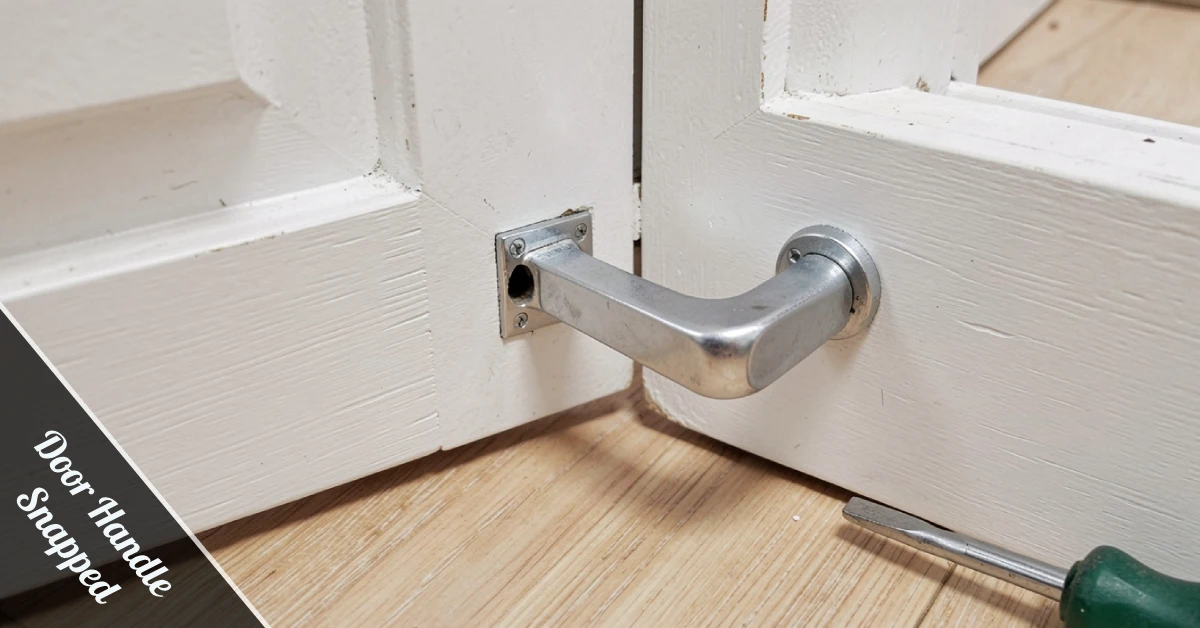
You grab the handle. It moves. Then it doesn’t. Or worse — it snaps clean off in your hand.
Yeah, that’s a terrible moment. Whether you’re locked out, trapped in, or just staring at a hanging handle wondering where your Saturday went, you’re not alone. A door handle snapped situation is one of the most common household panic moments, and most of the time, it’s completely fixable without calling anyone or spending big money.
This guide walks you through every scenario, from quick escape tricks to full replacements. No fluff. Just what actually works.
Why Do Door Handles Snap in the First Place?
Most handles are made from cast zinc or aluminum — cheap, light, and not built to last forever. Over time, daily use wears them down from the inside out.
The spindle is usually the first thing to go. That square metal bar connecting both sides of your handle takes the full force every time someone presses down. When it wears or cracks, the handle moves, but the latch doesn’t. Feels broken, even if the handle itself is still attached.
Springs fail quietly, too. Your handle starts drooping. Doesn’t spring back. That’s the spring inside giving up. It’s a slow decline before the eventual snap.
Loose screws are sneaky. The handle wobbles, the screws pull out of softwood, and one day the whole plate shifts under pressure. It feels like a snap, but it’s actually just the fixings letting go. Either way, you’ve got a problem to solve.
What to Do When a Door Handle Snapped — Fast Reference
Before diving into each fix, here’s your quick-read guide based on your exact situation:
| Situation | What’s Likely Wrong | First Move |
|---|---|---|
| The handle snapped from inside | The spindle or inner mechanism failed | Find the square spindle hole, turn with a flathead screwdriver |
| The handle snapped from the outside | The outer handle is broken, and the inner may still work | Ask someone inside to open, or use a screwdriver on the spindle |
| The door won’t open at all | Latch is still engaged | Spindle trick or flexible card on simple interior latches |
| Handle droops and won’t spring back | Spring has failed | Remove and inspect — likely needs full replacement |
| uPVC or front door handle snapped | Multi-point lock involved | Don’t force it — call a locksmith |
| The car door handle snapped off | Outer linkage or clips broken | Try from inside first, then remove the door panel |
Door Handle Snapped from Inside
If you’re stuck in a room, stay calm. Panic doesn’t open doors.
First, look for the square spindle hole where the handle was attached. If it’s visible, slide a flathead screwdriver into the slot and turn it in the direction the handle would normally move. This pulls the latch back, and the door opens.
If the spindle is still in the door but just loose, grip it gently with pliers and rotate it. Don’t crank it hard — you’ll jam the latch worse. Slow and steady works here.
For interior doors without a key lock, a flexible plastic card can work on simple spring latches. Slide it into the gap between the door and the frame near the latch, angle it against the slanted face of the latch, and push. Works best on interior bedroom or cupboard doors — not on deadbolts, obviously.
Got a bathroom or bedroom privacy lock? Check the outside handle for a small pinhole. A straightened paperclip or thin screwdriver tip pushed into that hole releases the lock. Most privacy sets have this feature built in.
Door Handle Snapped from Outside
First question: Is someone inside who can just open it? Often, the inside handle still works fine when only the outer one has failed.
If nobody’s home and you’re standing outside staring at a half-broken handle, look for the exposed spindle slot where the handle sat. A flathead screwdriver turned slowly in the correct direction may retract the latch. This works more often than people expect.
One thing to get clear on: a broken handle doesn’t mean the door is locked. The handle only controls the latch. If the door is also locked with a key, turning the spindle won’t help — you need the key. Don’t confuse the two problems.
For uPVC front doors, patio doors, or any door with a multi-point locking system, do not force the mechanism. These have internal gearboxes, and breaking them costs far more to fix than a locksmith call. Step back, phone a professional.
When the Door Handle Is Broken, and You Can’t Open the Door
This is the high-stress one. The latch is still holding the door shut, and you have no working handle on either side.
On a standard interior wooden door, look at the gap at the edge. Try the card method on the latch face. If the latch is spring-loaded and the door isn’t locked, this can work fast. While sliding the card, push or pull the door slightly to reduce pressure on the latch — it moves more freely with a little give in the frame.
Avoid slamming or kicking the door. You’ll crack the frame, split the architrave, or pull the hinges loose. Those repairs cost a lot more than a new handle. Keep your cool and work the latch patiently.
If the latch is completely seized inside the door, you’ll likely need a locksmith for a clean entry. It’s not a defeat — it’s the smart call when forcing entry would cause serious damage.
Tools You’ll Need for the Fix
You don’t need a toolbox full of gear. Most handle repairs need just four things.
A Phillips head screwdriver removes the handle plate screws. A flathead screwdriver helps turn the spindle slot and pry off cover plates. Pliers give you grip on a loose or broken spindle. A replacement handle set — with matching spindle, latch, and screws — covers the rest.
For wooden doors where screws have pulled out and left soft, stripped holes, matchsticks or wooden toothpicks dipped in wood glue pushed into the hole give the screw something solid to grip again. Simple and it works.
When buying a replacement handle, take the broken one with you. Match the screw hole spacing, spindle size, backplate shape, and latch type. A handle that looks similar but doesn’t match these measurements won’t fit correctly.
How to Remove and Replace the Broken Handle
Wedge the door open before you start. Seriously — don’t let the broken latch close on you mid-repair. A doorstop, a folded towel, anything works.
Look for screws on the handle plate. Some handles have decorative covers hiding the screws underneath. Pry those off gently with a flathead before you go digging for screws that aren’t there.
Unscrew both plates and pull the handles apart. The spindle may slide out with one side or stay inside the latch housing. Pull it out, check it for rounding, bending, or cracking, and replace it if it’s worn. A worn spindle is often why the handle stopped working in the first place, even before the snap.
Check the latch on the door edge while you’re in there. If it feels gritty, stiff, or moves unevenly, replace it alongside the handle. Fitting a new handle onto a worn latch just delays the next failure.
Insert the new latch first with the slanted face pointing the right way — toward the door frame, so the door can close. Slide the new spindle through. Fit both handle plates, tighten screws evenly, and test the handle several times while the door is open before you close it.
Car Door Handle Snapped Off — Different Problem, Same Calm Approach
Car handles connect to rods, cables, and clips inside the door panel — not just a spindle and latch. When the outer handle snaps, the internal mechanism may still be intact.
Try opening the car from the inside first. If that works, you can drive the car and deal with the handle repair without being stranded. Don’t yank on loose, broken parts — you can damage the internal linkage, which then makes the repair more expensive.
Replacing a car door handle at home is possible on many models, but it usually requires removing the inner door panel, which involves clips, trim pieces, and sometimes wiring. If the door won’t open from either side, an auto locksmith or body shop is the right call.
Mistakes That Make It Worse
Don’t glue a snapped metal handle back together. Cast zinc doesn’t bond reliably under daily pressure. It’ll snap again, probably faster.
Replacing only the outer handle without checking the spindle and latch is the other big one. If the mechanism was worn before the snap, fitting a fresh handle onto old internals just restarts the countdown.
And don’t close the door until you’ve tested the new handle at least three or four times while it’s open. One slow test run saves you from immediately repeating the problem.
When to Call a Locksmith
If someone is physically trapped, if it’s a main entrance with the lock engaged, or if the door is uPVC or has multi-point locking, call a professional without hesitation.
For cars, if neither door handle works, an auto locksmith is faster and safer than trying to pry a door open.
Locksmith fees vary, but they’re almost always cheaper than repairing a broken frame, damaged locking gearbox, or replacement door.
FAQs
Why did my door handle snap suddenly?
Internal parts wear gradually. The snap is usually the final failure of a spindle, spring, or cast metal handle that’s been weakening for months.
Can I glue a snapped handle back together?
Not safely. Glue won’t hold cast metal under daily use. Replace it.
Can I fix a broken door handle myself?
Yes, on most interior doors with basic tools. External doors and uPVC systems are best left to a professional.
What if my car door handle snapped off?
Try the inside handle first. Then assess whether the door panel needs removing — or call an auto locksmith.