

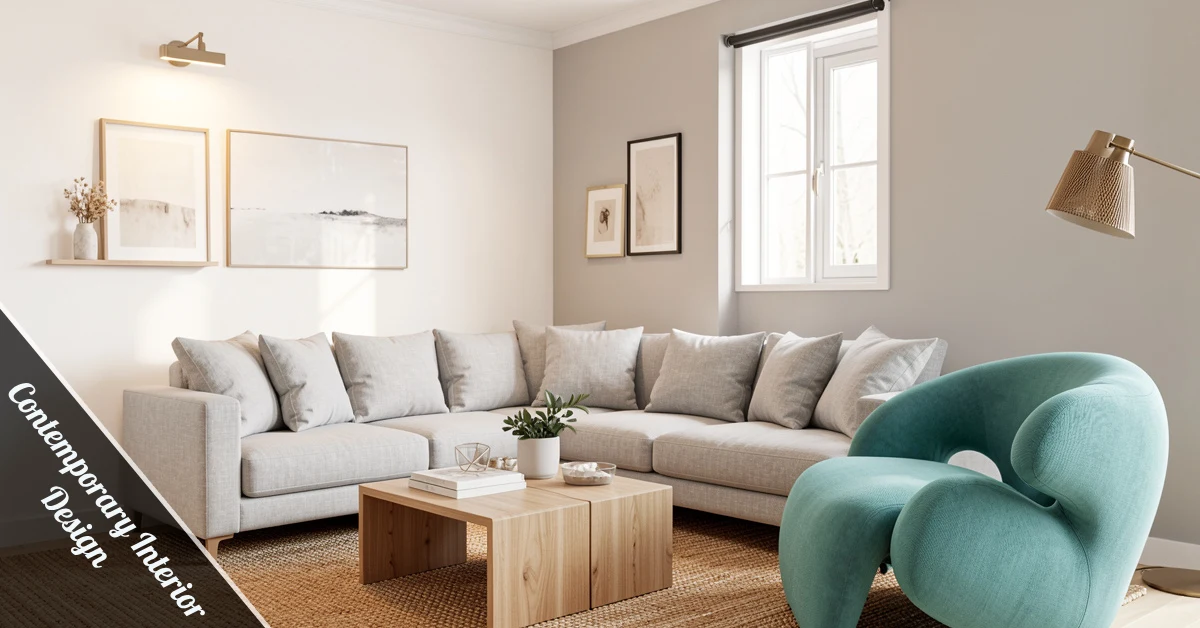
Most people confuse “contemporary” with “modern.” They’re not the same thing. Contemporary interior design is always evolving, always current, and always adapting to what’s happening right now. It’s the one style that never goes out of fashion because it literally moves with the times. Whether you’re renting a city apartment or renovating your family home, this guide gives you everything you need to understand, plan, and pull off a contemporary space with confidence.
What Contemporary Interior Design Actually Means
It’s not a fixed style. Think of it as a living, breathing design philosophy that absorbs current trends and makes them work in real homes. Unlike mid-century modern, which is tied to a specific era, contemporary interior design reflects whatever is happening in design culture today.
Interior designer Erin Sander of Erin Sander Design describes it best: “What distinguishes it so much is that it is an ever-evolving design style, versus some of the ones in history where they have a very set time period.” That flexibility is exactly why so many homeowners love it.
You’ll spot it by its clean lines, open layouts, and a color palette that leans neutral but never boring. It doesn’t lock you into one look. It gives you a framework and lets you fill it with your personality.
The style pulls freely from modern, traditional, and Art Deco influences. That mix is what keeps it feeling fresh. No two contemporary homes look the same, which is part of the appeal.
Contemporary vs. Modern Design: The Real Difference
This is the question everyone gets wrong. Modern design refers to the mid-20th-century aesthetic: think wood-heavy furniture, earthy tones, and strong minimalism. It’s a historical style with fixed rules.
Contemporary interior design, on the other hand, belongs to right now. It welcomes curved furniture, bold patterns, mixed textures, and even smart home technology. It borrows from modern design but isn’t limited by it.
Here’s a quick comparison so you don’t mix them up again:
| Feature | Modern Design | Contemporary Design |
|---|---|---|
| Time Period | Mid-20th century | Always current |
| Color Palette | Earthy, warm tones | Neutral with bold accents |
| Furniture | Angular, wood-focused | Curved, mixed materials |
| Flexibility | Fixed rules | Evolving, adaptable |
| Technology | Not a factor | Smart home features welcome |
The bottom line: modern is a moment in history. Contemporary is the moment you’re living in right now.
The Color Palette That Defines the Look
Color is where contemporary spaces do their quiet magic. The base is almost always neutral. Whites, grays, beiges, and taupes set the tone. These aren’t boring choices. They’re the canvas that lets everything else pop.
On top of that neutral base, you add color intentionally. A deep teal sofa. A terracotta accent wall. A charcoal velvet armchair. These bold, saturated tones give the space personality without making it feel chaotic or overwhelming.
Monochromatic schemes work really well in contemporary interiors. A room done entirely in warm whites with varying textures feels incredibly sophisticated. Add a single bold piece, and it becomes unforgettable.
Cool tones tend to dominate, but raw wood and rustic accents provide warmth and balance. Sheer curtains in soft beige, a warm wooden floor, a stone countertop. These details keep the space from feeling too cold or clinical.
Furniture and Materials That Fit Contemporary Interior Design
The furniture in a contemporary space does two things at once: it works hard and looks good. Clean silhouettes with minimal ornamentation are the starting point. Then come the materials, and this is where things get interesting.
Glass, metal, wood, and fabric coexist comfortably in one room. A glass coffee table next to a velvet sofa. Stainless steel appliances in a kitchen with warm timber shelving. Reflective surfaces alongside soft textiles. These combinations create visual depth without clutter.
Statement pieces earn their place in contemporary interiors. One sculptural floor lamp, one oversized piece of art, one bold-patterned rug. These are the moments that give a room its identity. Choose carefully, and you won’t need much else.
Furniture that functions as sculpture is a key feature of the style. Think of a curvy armchair with an unexpected shape or a dining table with a striking geometric base. The piece doesn’t just serve a purpose. It contributes to the visual story of the room.
How Light and Space Work in Contemporary Homes
Open floor plans and big windows are practically non-negotiable in the contemporary playbook. Natural light isn’t just a nice bonus. It’s a design element that changes how every color and texture reads in a space.
Keep window treatments minimal. Sheer curtains or simple blinds let light pour in without blocking the view. Heavy drapes close a room off and weigh it down. The contemporary approach is always toward openness and airiness.
In terms of layout, contemporary spaces avoid visual clutter at all costs. Furniture is arranged to encourage flow, not to fill every corner. Negative space is treated as an asset, not an accident.
Layered lighting ties everything together. Combine pendant lights with floor lamps and accent lighting to build depth. A well-lit contemporary room feels alive at every hour of the day, not just when the sun is doing the work.
Ways to Personalize Without Losing the Style
Here’s the thing about contemporary design: it’s flexible enough to hold your personality without falling apart. You don’t have to choose between a stylish space and one that feels like you.
Bring in artisanal pieces from local designers. A hand-thrown ceramic vase. A woven wall hanging. A custom piece of art from someone in your city. These touches add soul to a space that might otherwise feel too polished.
Plants are a cheat code in contemporary interiors. Potted plants or even a vertical garden soften the clean edges of the design and add organic warmth. A large fiddle leaf fig in a concrete pot? That’s the whole vibe right there.
Texture is your best tool for personalization. A chunky knit throw on a sleek sofa. A raw linen cushion against smooth leather. A jute rug on a glossy floor. Contrast creates interest, and interest is what makes a room memorable.
Why Contemporary Interior Design Works for Almost Any Home
This style adapts. That’s its superpower. It works in a studio apartment as well as it does in a five-bedroom suburban house. It scales to your space and your budget without losing its character.
It prioritizes comfort alongside aesthetics. Contemporary spaces are designed to be lived in. They’re inviting and practical, not just pretty to look at. That balance between form and function is what keeps the style relevant year after year.
Sustainability is increasingly part of the picture too. Many contemporary interiors now incorporate eco-friendly materials, energy-efficient lighting, and responsibly sourced furniture. Looking good and being responsible aren’t mutually exclusive here.
The versatility of the style means it works across generations and demographics. Whether you’re 25 and styling your first apartment or 55 and renovating a family home, contemporary design gives you enough structure to work with and enough freedom to make it yours.
Conclusion
Contemporary interior design doesn’t ask you to follow a rigid rulebook. It asks you to stay curious, stay current, and make intentional choices about the space you live in. Start with one room. Pick a neutral base, add one bold statement piece, and layer in textures that feel right to you. The style will take shape from there. And if it evolves? That’s not a mistake. That’s exactly how contemporary design is supposed to work.