

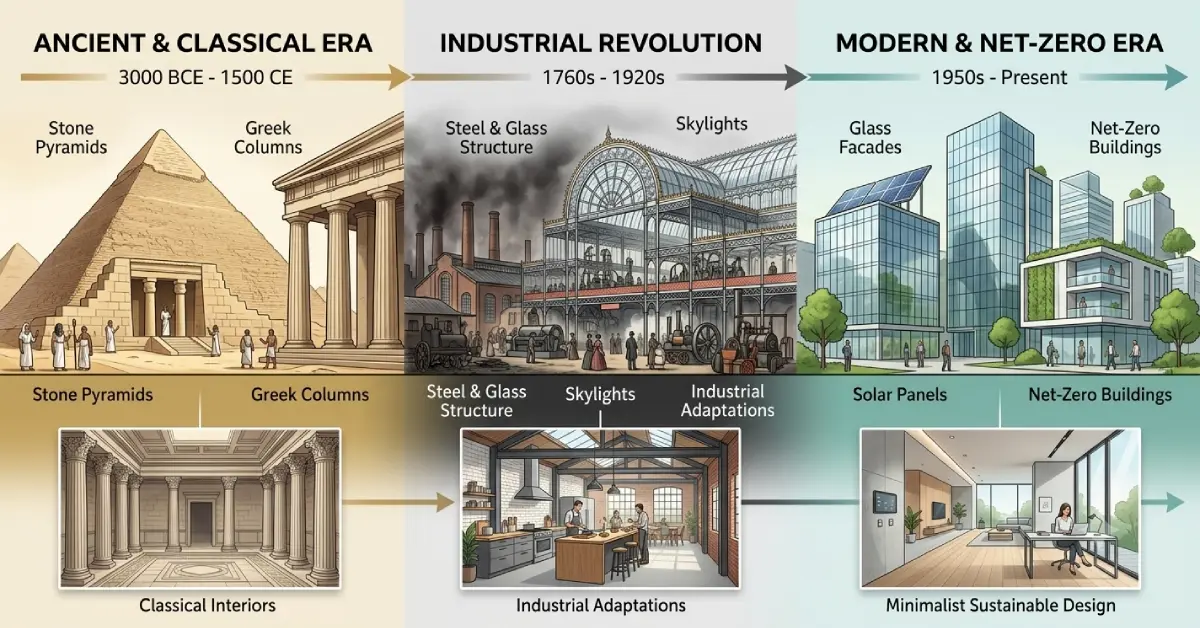
Architecture has changed over time from stone and symmetry to glass, steel, and smart technology. Each major period, from ancient Greece to today’s net-zero buildings, was driven by new materials, changing beliefs, and shifting social needs.
Understanding this history helps you make better, more confident decisions about your own home or interior space.
What “How Architecture Has Changed Over Time” Actually Means
If you have searched for information on how architecture has changed over time, you are looking for something specific: a clear, connected timeline that explains why buildings look the way they do, and how those changes ripple directly into interior design.
That is exactly what this guide covers.
Architecture is not just the outside of a building. Every shift in how people built walls, chose windows, or arranged rooms has always reflected something deeper: new technology, cultural priorities, or plain necessity. You cannot understand how a room should feel without knowing what period it came from and why.
This guide takes you through the key turning points, from ancient stone temples to 2025’s net-zero towers, and shows you what each era still contributes to the spaces you live and work in today.
Ancient Architecture: When Buildings Meant Power
The story starts in Mesopotamia, Egypt, Greece, and Rome.
Every major structure from this period was built to announce power and permanence. The Pyramids of Giza used limestone and granite blocks weighing up to 80 tons. The goal was not comfort. It was longevity and authority.
Greek architects introduced mathematical precision. The Parthenon, completed in 432 BCE, applied a near-perfect ratio of 4:9 across almost every dimension, from column spacing to facade width. Nothing was accidental. Geometry was the language of beauty.
Roman builders took those principles further with the arch and the barrel vault. These structural advances let them span wide spaces without collapse. The Pantheon’s concrete dome, 142 feet wide, held for over 2,000 years because the geometry was exact.
Inside these buildings, the rules were just as deliberate. Symmetry organised every room. Stone and marble communicated status. Carved decorative friezes moved directly from temple exteriors into domestic interiors. That instinct toward symmetry and focal points still shapes how well-designed rooms feel today.
Key traits of ancient architecture:
- Massive stone construction for permanence
- Mathematical proportion as a design standard
- Symmetry as a visual and social signal
- Decoration tied directly to structure
Gothic and Renaissance Architecture: How Light Entered the Story
Medieval Europe changed the question. Instead of asking “how do we project power,” architects began asking “how do we reach toward the heavens?”
Gothic architecture solved a structural problem that unlocked interior design forever. The flying buttress, an external arched support, transferred the weight of tall walls outward. Once the walls no longer carried the full load, builders could cut them open with enormous windows. Chartres Cathedral, consecrated in 1220, has more than 20,000 square feet of stained glass specifically because of this structural shift. Light became a design tool, not just a practical need.
The pointed arch was equally important. Unlike the round Roman arch, it directed force downward rather than outward, allowing buildings to grow taller with thinner walls.
Then came the Renaissance, roughly 1400 to 1600 CE, and the mood changed again. Architects turned back to Greece and Rome. Symmetry, proportion, and geometry returned as the governing principles. Filippo Brunelleschi’s dome on Florence Cathedral, completed in 1436, combined ancient engineering with new materials and methods. It remains one of the most studied structures in history.
The Renaissance introduced the idea that a building could be a statement of human intelligence, not just divine aspiration. That shift pushed architecture toward the measured, proportional interiors that still dominate classical home design.
The Industrial Era: Materials Change Everything
Before the 19th century, architecture was limited by what stone, timber, and brick could do. The Industrial Revolution removed those limits.
Steel became widely available in the 1860s. Structural iron and, later, reinforced concrete gave architects tools that ancient builders could never have imagined. For the first time, a building could be tall and light at the same time.
The Crystal Palace in London (1851) demonstrated this completely. Built from prefabricated cast-iron and plate glass, it covered 990,000 square feet and was assembled in under nine months. No stone wall. No heavy masonry. Just glass and metal, flooded with natural light.
This era also introduced the elevator, which made tall buildings practical for daily use. The first skyscraper, the Home Insurance Building in Chicago, opened in 1885 at ten stories. By 1930, the Empire State Building reached 102 stories.
These changes hit interior design directly. High ceilings became standard. Large windows replaced narrow ones. Open floor plans became possible because interior walls no longer needed to carry structural weight. The inside of a building could finally be organised around how people actually wanted to live, not around what the structure demanded.
Modernism: “Form Follows Function” Rewrites the Rules
The 20th century brought a formal rejection of everything that came before.
Modernism, roughly 1900 to 1970, argued that decoration was wasteful. The German architect Ludwig Mies van der Rohe summed up the philosophy in five words: “less is more.” His Barcelona Pavilion (1929) used marble, glass, and steel without a single ornamental detail. The materials themselves were the design.
Le Corbusier described a house as “a machine for living.” That sounds cold, but the intent was practical. He wanted homes that served real human needs: natural light, good ventilation, flexible space, and honest materials.
The Bauhaus school in Germany codified these ideas. Functional design, clean geometry, and truth to materials became the new standards. This school directly influenced furniture design, graphic design, and architecture across the world, and its impact is still visible in virtually every minimalist interior produced today. For those looking to apply these timeless principles to your own space, contemporary interior design offers practical approaches to creating functional, beautiful rooms that honour Bauhaus values.
Modernism also introduced the open-plan interior. By removing load-bearing interior walls (made possible by steel frames and concrete slabs), architects created continuous living spaces where kitchen, dining, and sitting areas flowed together. This is still the default layout for new residential construction in most of the world.
Postmodernism and Beyond
By the 1970s, many architects found Modernism too rigid. Postmodernism pushed back.
Where Modernism stripped away decoration, Postmodernism brought it back, often with irony. Architects like Robert Venturi and Michael Graves applied historical motifs (columns, arches, classical details) to modern buildings, but in exaggerated or unexpected ways. The AT&T Building in New York (1984) topped a glass skyscraper with a Chippendale-style broken pediment. It was deliberately provocative.
Postmodernism did not last as a dominant force, but it opened the door to diversity. Deconstructivism followed in the 1980s, with architects like Frank Gehry and Zaha Hadid producing buildings with fractured geometry, tilted walls, and non-linear forms. The Guggenheim Bilbao (1997) still draws visitors who come specifically to see the building before anything inside it.
This period taught an important lesson: architecture does not have to follow a single logic. Different contexts, cultures, and purposes can produce radically different forms, and all of them can be valid.
Contemporary Architecture
Today’s architecture is defined by a single overriding concern: environmental impact.
Buildings currently account for approximately 30% of global energy consumption and around 37% of CO2 emissions worldwide, according to IEA and UNEP data from 2024 to 2025. That figure has pushed the entire profession toward sustainability as a primary design standard, not an optional add-on.
The results are visible everywhere:
- Net-zero energy buildings produce as much energy as they consume, using solar panels, advanced insulation, and smart management systems. The White House published its first official definition of net-zero buildings in 2024, accelerating adoption across public and private sectors.
- Biophilic design integrates natural materials, living walls, and views of greenery to support occupant health and reduce stress.
- Adaptive reuse converts existing structures, warehouses, factories, and churches into new homes and offices, reducing the carbon cost of demolition and new construction.
- Smart building technology uses sensors and automation to adjust lighting, heating, and ventilation based on actual occupancy rather than fixed schedules.
The global architectural services market was valued at approximately $360.8 billion in 2022 and is forecast to reach $549.6 billion by 2032, driven in large part by demand for sustainable and technology-integrated design.
Architects in 2025 are also addressing embodied carbon, the carbon produced in manufacturing the materials themselves, not just in running the finished building. This means selecting low-carbon concrete, recycled steel, bamboo, and other materials with lower production footprints.
How This History Connects to Interior Design
Every architectural shift described above had an interior equivalent.
When stone walls gave way to timber frames, rooms became smaller and more intimate. When steel frames replaced load-bearing walls, open-plan layouts became possible. When large glazed facades replaced small windows, interior lighting schemes changed entirely. When Modernism removed ornament, minimalist furniture and exposed materials became the default.
Understanding this chain matters for anyone working on a home today. A Victorian terrace has thick walls, small windows, and segmented rooms because of its structural logic. Knocking those walls out without understanding what they carry is how renovations go wrong. A 1960s flat has a concrete slab ceiling and open layout for different structural reasons. Working with that logic rather than against it produces better results. For those planning a comprehensive refresh, exploring interior design options can help you align aesthetic choices with your building’s structural character.
If you want to understand what makes a space work, studying the period it came from gives you a clear guide. The bones of a building are a direct record of what was technically possible and culturally valued when it was made. Whether you are working with period features or introducing contemporary elements, the goal is always to respect the original design logic while making a home that works for today’s living. Luxury room makeovers demonstrate how thoughtful renovation can bridge historical integrity with modern comfort and functionality.
How Architecture Has Changed Over Time: Quick Reference
Here is a quick reference of the major periods and their defining characteristics:
| Period | Dates | Key Characteristics |
|---|---|---|
| Ancient | 3000 BCE–400 CE | Stone, symmetry, mathematical proportion, power and permanence |
| Gothic | 1100–1500 | Flying buttresses, pointed arches, tall windows, spiritual transcendence |
| Renaissance | 1400–1600 | Return to classical proportion, human-centred design, domed roofs |
| Baroque | 1600–1750 | Dramatic curves, theatrical interiors, ornamentation as expression |
| Industrial | 1800s | Steel frames, plate glass, prefabrication, the first skyscrapers |
| Modernism | 1900–1970 | Function first, no ornament, open plans, honest materials |
| Postmodernism | 1970–2000 | Historical references, irony, formal diversity |
| Contemporary | 2000–present | Sustainability, net-zero energy, smart technology, biophilic design |
Final Thoughts
The history of how architecture has changed over time is not a list of styles to memorise. It is the record of how human ambition, technology, and culture have shaped every room you have ever walked into.
Knowing this history makes you a sharper decision-maker, whether you are planning a renovation, working on an interior project, or simply trying to understand why a space feels the way it does. The walls around you always have a story. Once you know how to read it, design becomes much clearer.
FAQs
How has architecture changed in the last 100 years?
The biggest shift in the last century has been from decoration to function, and then from function to sustainability. Modernism removed ornament and opened up floor plans. Contemporary architecture has added environmental performance as a core requirement, making energy efficiency and carbon reduction central to how buildings are designed from the start.
What caused architecture to change over time?
Three forces drive most architectural change: new materials and technology, cultural or religious priorities, and economic pressures. Steel and concrete enabled height and open plans. Climate change is now driving the move toward net-zero and low-carbon construction. Each major shift reflects what a society values and what technology allows it to build.
How does architectural history affect interior design?
Directly. Every period’s structural logic produces specific interior conditions: ceiling heights, window sizes, room proportions, and load-bearing wall positions. Understanding the period a building comes from helps you work with its original logic rather than fight it, which almost always produces a better result.
What is the most significant architectural shift in history?
Most historians point to the introduction of steel framing in the late 19th century. It made tall buildings practical, ended the dominance of load-bearing masonry, and freed interior layouts from structural constraints. Every open-plan interior you have ever been in exists because of that shift.
What does sustainable architecture look like today?
In 2025, sustainable architecture includes net-zero energy buildings, adaptive reuse of existing structures, biophilic design elements like natural materials and living walls, and smart building systems that reduce energy use through automation. These are now standard features of high-quality new builds, not specialist additions.