

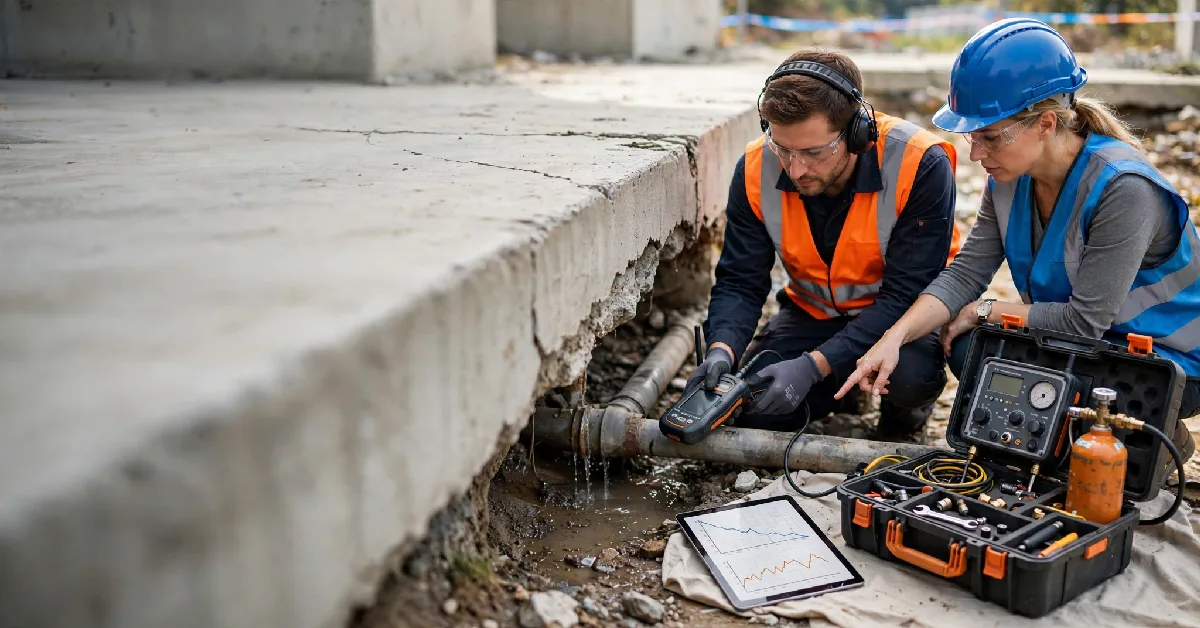
Leak lessons teach you how to find, measure, and stop water loss before it becomes a costly repair. Training combines acoustic listening, pressure testing, tracer gas methods, and real field practice.
The best programs blend certification standards with hands-on work on live leaks, so you leave able to diagnose a problem and explain the fix to a customer.
What Leak Lessons Teach You
Water loss is not a small problem. As of late 2024 and early 2025, utilities worldwide lose an estimated 346 million cubic meters of water every day. That equals roughly 39 billion US dollars in lost revenue and treatment costs each year. Leak lessons exist because finding those losses requires skill, not guesswork.
A good training program does more than show you how to turn on a listening device. It teaches you how leaks behave under pressure, how different pipe materials change the sound, and how to confirm a leak before you cut into a slab or open a wall. You learn to separate a real leak from background noise, irrigation runoff, or a faulty meter. Those skills save time, protect property, and build trust with the person paying the bill.
This article covers the core lessons taught across water utility, plumbing, industrial, and pool leak detection programs. You will see what top training academies include, which standards matter, and how to pick a course that gives you usable field skills instead of a certificate with no practice behind it.
Why Leak Detection Training Matters Now
Ageing pipes, population growth, and climate pressure have pushed leak detection from a niche trade skill into a core operational need. In many systems, leaks and bursts account for 20 to 30 per cent of total water supplied. That number is higher in older networks where pipe corrosion and pressure swings create repeated failures.
Utilities are responding with technology and people. Southern Water in the UK reduced weekly leakage by more than 1 per cent between April 2024 and April 2025, cutting losses from 108.1 million litres per day to 91.1 million litres per day. The utility credits acoustic sensors and trained leak detection teams working from a control room. Tim McMahon, Southern Water’s Managing Director of Water, said the result came from incredible work by our teams around the region, finding and fixing the leaks from big pipes far below the ground which show no trace on the street.
Demand for leak detection skills is also growing in homes and businesses. The global market for residential water leak detection systems was valued at 142.31 million US dollars in 2024 and is forecast to reach 196.47 million by 2031. More sensors mean more data. More data means someone has to interpret it, locate the leak, and verify the repair. That someone needs training.
Core Leak Lessons for Water Systems
Most water leak detection courses build around a common set of field skills. Wording varies by region and sector, but the core lessons stay similar. Below are the main areas you should expect a reputable program to cover.
- Leak behaviour under pressure. You learn how pressure differentials drive water through cracks, joints, and fittings. You also learn why a small pressure drop can signal a large hidden leak.
- Acoustic detection and correlation. Listening sticks are largely replaced by acoustic loggers and correlators. Training teaches you to read sound signatures, filter interference, and pinpoint a leak between two sensor points.
- Tracer gas testing. For certain pipe systems, a safe gas mixture is introduced, and a detector locates where the gas escapes. This method works where acoustic signals are weak or blocked.
- Flow and mass balance checks. You learn to compare metered input against metered consumption. A gap between the two points to a leak somewhere in the network.
- Step testing and zone isolation. By isolating sections of a network, you narrow the search area before deploying more precise tools.
- Documentation and reporting. A leak is not fixed until the repair is verified. Training covers how to record location, leak rate, repair method, and follow-up readings.
These lessons matter because leaks rarely announce themselves. A pipe under a concrete slab or a pool plumbing line buried in soil gives few visual clues. Training gives you a repeatable process instead of random digging.
Hands-On Practice Beats Classroom Theory
Reading about leak detection is not the same as finding a leak. The strongest programs put you in front of live water. LeakPro, a Texas-based training provider, runs a two-day certification course on a purpose-built slab with 12 active leaks. The course costs 8,000 US dollars for the first trainee and includes line locating, slab leak detection, and sewer isolation testing. You train on the same equipment you will use in the field.
Pool leak detection follows the same principle. The Hunter Leak Institute teaches the four sources of pool water loss: environmental, equipment, plumbing, and shell. Training includes live classes and on-the-job ride-alongs with working technicians. That field time matters because pool leaks often involve evaporation, autofill errors, and underground line breaks that look identical on a water bill.
Industrial leak testing takes a different path. ATEQ’s Leak Testing Academy focuses on pressure decay, mass flow, and tracer gas methods for manufactured parts and sealed systems. The training uses calculators, white papers, and video tutorials to explain how volume, pressure, and leak rate interact. The lesson is the same: you need to understand the physics before you trust a pass or fail reading.
The common thread is repetition on real systems. A course that only offers slides and a multiple-choice exam leaves you unprepared for the noise, access problems, and uncertainty of field work.
Certification and Standards You Should Know
Leak lessons vary by industry, and so do the credentials. In industrial non-destructive testing, ISO 9712:2021 sets the international requirements for personnel who perform leak testing, excluding hydraulic pressure tests. The standard covers qualification, training, and third-party certification. Training for a Level 3 leak testing certification typically requires at least six days of instruction, with each training day lasting at least seven hours.
Water utility training often follows AWWA guidance. The American Water Works Association offers courses on non-revenue water control, leakage management, and pressure management. These programs teach you to define proactive leakage management, identify detection methods, and use water audit data to prioritise repairs. AWWA also runs webinars on acoustic detection, correlation logging, and continuous monitoring.
Plumbing and residential leak detection programs may not follow a single global standard. Instead, they issue their own certification after a set number of training days and field assessments. LeakPro, for example, certifies technicians after a two-day hands-on course. The value of that certificate depends on the provider’s reputation and the amount of live practice included.
Before you enrol, ask three questions. Which standard does the certificate reference? How many hours are spent on live leaks? And who teaches the course: a career instructor or a working technician? The answers tell you more than the certificate name.
Technology Changes the Lesson Plan
Leak detection tools have changed faster than most training curricula. Acoustic sensors now attach directly to pipes and send data to a control room. Southern Water uses 24,000 acoustic sensors across 15,500 kilometres of network, supported by 90 field teams. The old listening stick still has a place, but the modern technician must also read digital logs, spot pressure anomalies, and prioritise alerts.
That shift adds new lessons to training. You need to understand how sensors distinguish a leak from normal demand changes. You need to know when a pressure spike is a precursor to a burst, and when it is just a pump cycling. You also need to interpret false positives without dismissing real leaks. These skills sit between field work and data analysis, and they are increasingly part of utility leak detection courses.
Residential systems are moving in the same direction. Smart water shutoff valves and flow monitors can detect abnormal usage and close a valve before a small leak becomes a flood. Training for plumbers now includes configuring these devices, setting alert thresholds, and explaining the system to a homeowner who does not want a false alarm every time someone takes a shower.
The lesson is simple: technology does not replace the technician. It changes what the technician needs to know. A course that ignores digital tools leaves you behind. A course that teaches only software leaves you unable to confirm a leak in the field. The best programs cover both.
How to Choose the Right Training Program
Not every leak lesson is worth your money. The right course depends on where you work and what you want to do. Use the checklist below to compare programs before you enrol.
- Match the course to your sector. Utility water loss, plumbing slab leaks, pool leaks, and industrial pressure testing require different tools and methods. A general course may not prepare you for the specific leaks you will face.
- Check the hands-on hours. Ask how much time is spent on live leaks versus classroom instruction. A program with a live test slab or field ride-along gives you practice you cannot get from slides.
- Confirm the equipment. You should train on the same detectors, correlators, and locators you will use on the job. Training on unfamiliar gear adds a second learning curve in the field.
- Ask about certification recognition. If you need ISO 9712 or an industry-specific credential, verify that the course meets the training-hour and assessment requirements.
- Review the instructor’s field experience. A trainer who still performs leak detection understands the access problems, customer conversations, and diagnostic dead ends that a career instructor may not.
- Look for reporting and communication training. Finding a leak is half the job. The other half is explaining the problem, the repair options, and the cost to a customer or manager.
For a related guide on monitoring hidden moisture and subsurface issues around a property, see subsurface sentinels. That resource pairs well with the field lessons covered in a leak detection course.
FAQs
How long does leak detection training take?
Program length varies by sector. A hands-on plumbing certification can run two days. Industrial leak testing training for a Level 3 certification requires at least six days of instruction. Utility water loss programs may be shorter courses or multi-module certificate programs. The key variable is practice time, not the number of days.
Do I need a certificate to find leaks professionally?
Not always, but certification helps. Some regions and industries require third-party certification under ISO 9712 or an equivalent standard. Plumbing and pool leak detection markets often rely on provider-specific certification and demonstrated field experience. Check your local regulations and the expectations of your target customers before you pay for a course.
Can leak lessons help a homeowner?
Yes. Basic leak lessons teach you how to read a water meter, check for silent toilet leaks, and identify signs of a slab or irrigation leak. If you are setting up a home gym or another water-using space, a short guide on how to make a home gym can help you plan moisture control around equipment. Professional training goes further, but the basic lessons are useful for anyone who pays a water bill.