

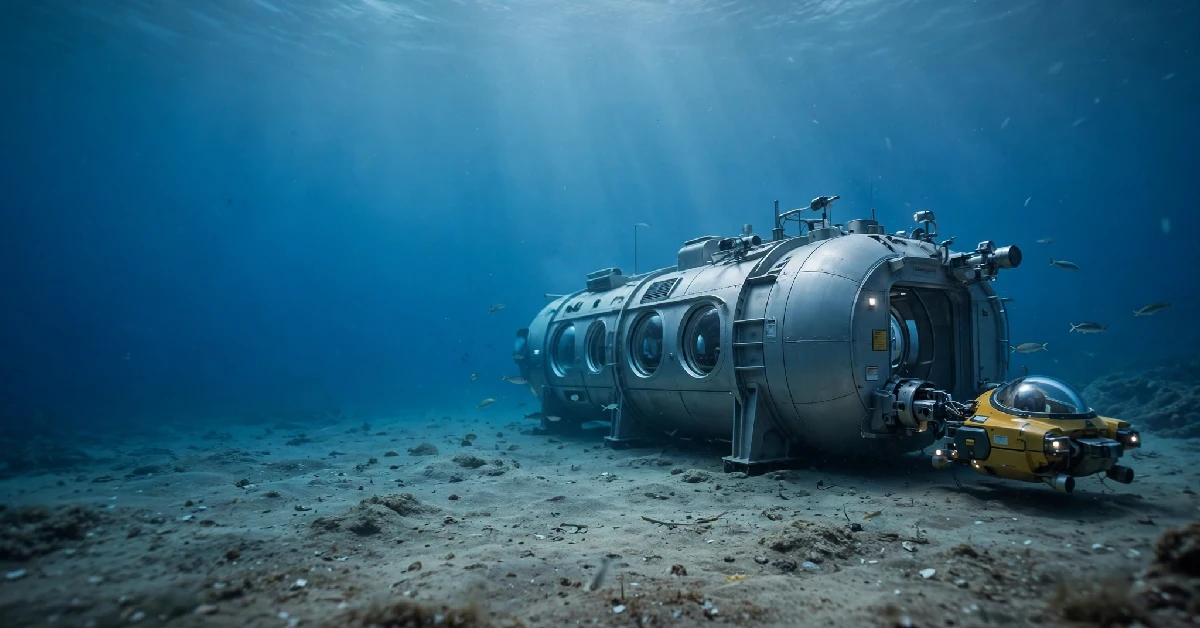
Subsurface Sentinels are modular underwater habitats built for long-term human stays on the seafloor. A leading example, DEEP’s Sentinel, is designed for crews of six who live at depths near 200 meters for rotations of up to 28 days. This guide covers design, safety, and what these habitats could mean for research.
Less than a third of the ocean floor has been mapped to modern standards. In April 2026, the Seabed 2030 project reported that 28.7 Percent of the seafloor is now mapped, up from about 6 Percent when the project launched in 2017. Most of the deep ocean remains largely unstudied. Human presence down there is rarer still.
Most underwater work relies on short dives launched from ships. Staying below for days or weeks is a different problem. It requires pressure-tolerant living space, safe transfers, trained crews, and reliable life support. A growing set of seabed structures aims to solve that problem. This guide calls them Subsurface Sentinels, after the best-known project, and explains how they work.
You will learn what these habitats are, how they are built and moved, what daily life inside them looks like, and how safety and training are handled. The article also covers possible uses, why similar product names cause confusion, and what remains uncertain.
What Subsurface Sentinels Are and Why They Matter
Subsurface Sentinels are seabed habitats designed to stay in place for long periods. The best-known project is Sentinel, developed by DEEP, an ocean technology company based in the United Kingdom. DEEP describes Sentinel as a habitat for long-term human occupancy, with construction and testing underway at its UK campus.
Sentinel is a steel structure about 60 meters long, according to ITV News reporting from early 2025. The habitat offers roughly 450 cubic meters of internal space. The base design supports a crew of six, and DEEP says the modular layout can expand to hold up to 50 people. The company plans to deploy the habitat at depths of up to 200 meters.
Long-stay habitats could support work that short dives cannot. CNN’s reporting on DEEP’s plans lists several possible uses:
- Monitoring and repairing critical subsea infrastructure is one target use.
- Coral restoration work could continue for weeks at a time.
- Naval and commercial divers could train on site.
- Medical research could use the habitat’s controlled environment.
- Tourism and public education programs are also under discussion.
Each of these uses depends on keeping crews safe and comfortable for long periods. That makes design and operations as important as the mission itself.
How Sentinel Habitats Are Built and Moved
Sentinel is modular. Teams can add or remove sections, reconfigure rooms, and relocate the whole habitat as research needs change. DEEP states a service life of up to 20 years, which would let one unit support several research programs over time.
Moving people between the surface and the habitat requires a transfer shuttle. DEEP has named its shuttle Vanguard in company materials. The shuttle is designed to manage decompression, which reduces risk when crews move between pressurised conditions and the surface. Safe transfers matter because a crew cannot simply walk out of a pressurised space.
Certification is the next major step. DEEP works with DNV, a classification and certification body, and says Sentinel will be the first subsea habitat to earn third-party certification. The company also says testing will be completed before any open-water deployment. Certification is not final until it is issued, so readers should check for the official result before treating the claim as settled.
Safety questions carry extra weight after the 2023 Titan submersible implosion, which killed all five people aboard. Titan was built with carbon fibre and operated outside traditional certification rules. DEEP says Sentinel is made of steel and follows a different development process. Readers should judge that claim against the certification results once they are published.
Daily Life Inside a Sentinel Habitat
Sentinel includes private bedrooms with a single bed and storage space. Some planned designs also include a television for unwinding. Each bathroom has a shower, toilet, and sink. Private rooms matter for crews who may spend a month sharing a small space.
Shared areas include a kitchen, dining space, social rooms, and several laboratory areas. A mezzanine provides flexible workspace. DEEP has described the workspaces as configurable, so teams can adjust them for different research projects.
Breathing is one of the most unusual parts of life inside the habitat. Crews breathe a mix of helium and oxygen, which raises the pitch of their voices in a noticeable way. ITV News reported on this effect during its visit to the project. Crews will need time to adjust to speaking and communicating under these conditions.
DEEP’s stated design goal is comfort. The company wants crews to look forward to returning to the habitat, rather than counting the days until they can leave. That goal shapes room size, lighting, and shared spaces. Comfort also supports safety, since fatigue and stress can affect judgment during long missions.
Readers interested in how proportion and layout shape livable rooms may find our classical architecture guide useful background for thinking about compact spaces.
Safety Rules and Crew Training Requirements
Training is central to the program. DEEP has set up the DEEP Institute to prepare users, and the company says it will offer specialised training for Sentinel operators. According to DEEP’s research diving and training lead, an inexperienced diver needs roughly 12 to 18 months to learn to operate the system effectively.
DEEP’s published habitat criteria focus on four areas: safety, autonomy, modularity and reconfigurability, and habitability. Each area shapes both design and daily operations. Autonomy matters because a remote seabed habitat cannot rely on quick help from the surface.
Monitoring systems also need careful planning. Sensors for oxygen levels, pressure, power, and air quality must alert crews early and reliably. Our smart home security guide covers basic sensor and alert setups, which follow some of the same principles on a much smaller scale.
Where Subsurface Sentinels Could Be Used
Location planning depends on accurate seafloor data. The Seabed 2030 project makes its bathymetric data public through the GEBCO global grid, which operators can use when choosing sites. Mapping progress has been fast, with nearly five million square kilometres added in one year, but large gaps remain.
DEEP says Sentinel can be placed on the continental shelf, the relatively shallow edge of a continent that extends under the sea. Many cables and pipelines run across continental shelves, which makes infrastructure monitoring a plausible early use.
Research teams could base studies at a single site for weeks. That reduces the number of boat trips needed to reach the work area. Fewer trips could lower operating costs over time, although actual savings will depend on how each program is run.
Other Sentinel Systems Are Not Habitats
The name Sentinel appears in several subsea products, so search results can mix them up. Cellula Robotics, an autonomous vehicle company, has launched a product called Subsea Sentinel. It is a monitoring system that provides real-time surveillance of critical subsea infrastructure and flags potential threats. It is not a place for people to live.
Sentinel Subsea, an Aberdeen-based company founded in 2018, makes WellSentinel. That system provides passive monitoring of subsea wells and assets without needing subsea power or data connections. The company reports installations in Brazil, the Gulf of Mexico, and Australia.
When you read about a Sentinel, check the context. Habitat stories mention crews, living quarters, and dive training. Monitoring stories mention wells, infrastructure, and sensors.
Costs, Timelines, and Open Questions
Reports describe a $100 million investment behind DEEP’s program. That funding supports development, testing, and the training institute. Costs are likely to stay high because the habitat requires certified equipment and specialised personnel.
Timing is less settled. DEEP has said Sentinel should launch by 2027. Some reports mention a first deep-sea test by the end of 2026, and one regional news site has described a planned crew deployment in November 2026. Schedules have shifted in past reporting, so readers should rely on DEEP’s latest official updates.
Access is another open question. Some coverage suggests early residency may appeal mainly to very wealthy buyers. DEEP has described a longer-term goal of broader access to ocean research and exploration. CNN reports that operators can lease, buy, or share space in a habitat, so models of use may vary.
FAQs
How deep can a Sentinel habitat operate?
DEEP designs Sentinel to operate at depths of up to 200 meters. Crews can stay for rotations of up to 28 days before returning to the surface.
How many people can live in one?
The base configuration supports six crew members. DEEP says the modular design can expand to accommodate up to 50 people.
Can the general public visit a Sentinel habitat?
Public access is a long-term goal in some coverage. The reports reviewed for this article do not describe clear rules, eligibility, or prices. Readers should check DEEP’s official channels for current details.
Where can I track the project’s progress?
DEEP’s official website and announcements are the most reliable sources for launch dates and certification updates. Independent news reports can lag behind company statements or differ from them.